7/8/2008 -Art Feierman![]()
InFocus IN83
Image Quality
General Performance
Warranty
Summary, Pros, Cons
The InFocus IN83 is a fantastic home theater projector. I don't get this excited too often. In recent memory - the JVC RS1 about two years ago, and the Epson Home Cinema 1080 UB/Epson Pro Cinema 1080 UB, in late 2007. Add the IN83 to that list. Like other great projectors, it isn't perfect, but its strengths easily outway the few minor flaws.
Perhaps it has something to do with the Darkchip4, the latest DLP processor, but I've never before had any projector here that produces such a natural looking and color accurate image, after calibration. I concede now that part of that (natural look) may be related to also being much brighter than almost all of the competition. In fact, only the Optoma HD81-LV, of all the 1080p projectors we've reviewed, is brighter.
The IN83 is almost identical to the IN82 we reviewed late last year. Both are DLP projectors using a seven segment wheel. The IN83 claims 100 more lumens - 1600 compared to 1500 - although the IN83 measured slightly less than we tracked when reviewing the IN82. Both share the same curved black casing, and are physically identical but for the different model numbers.
The biggest difference is that the IN83 sports the new Darkchip4 DLP processor (perhaps the first to ship under $10,000), while the IN82 has inside it the widely used Darkchip3. I don't know the full technical differences, but apparently it's enough for the IN83 to claim native contrast of 5000:1, while the IN82 has 4000:1. That implies better black levels, which was confirmed by viewing. InFocus also changed some of the inputs (for the better).
Review continues below this advertisement.
Click here for full IN83 specs, and access to a pdf file of the projector's brochure.
MSRP: $5999 (US)
Technology: Single Chip Darkchip4 DLP
Native Resolution: 1080p (1920x1080)
Brightness: 1600 lumens
Contrast: Up to 15,000:1 (stopping down manual iris)
Zoom Lens ratio: 1.2:1
Lens shift: None
Lamp life: 2500 hours low power (eco-mode), 2000 hours at full lamp power
Weight: 14.1 lbs. (6.4 Kg)
Warranty: 2 Years Parts and Labor
This is just a slight re-write from the IN82 review , as little has changed, not even the mix of inputs.
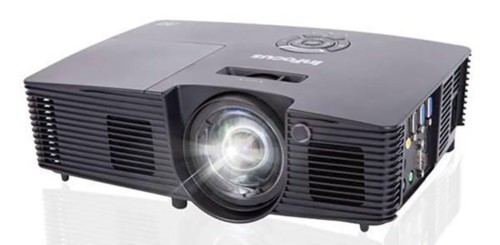
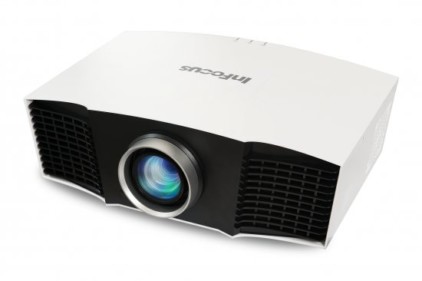
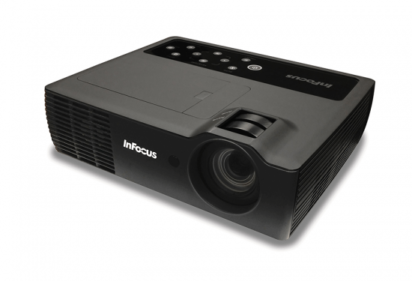
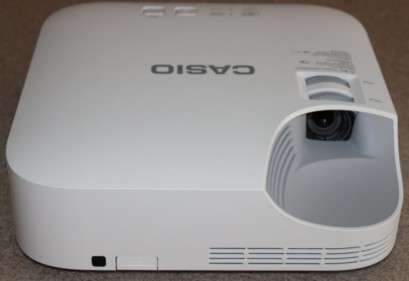
The InFocus IN83 is physically larger than most home theater projectors, but still a bit smaller than some of its toughest competitors, including the JVC RS1x and RS2, and the Sony VPL-VW40 and VW60 projectors. The IN83 is all black (except for the InFocus name in white). It is nicely sculpted, with no hard edges. 
InFocus assumes that this projector will be ceiling mounted, a very logical assumption, as they expect it to end up in dedicated rooms. Of course, it can be placed on a table or a low shelf.
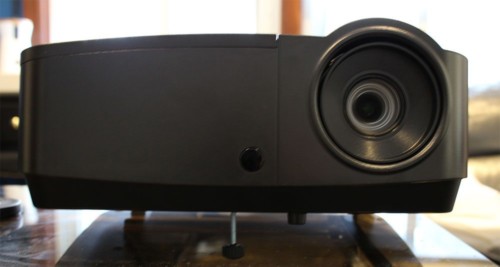
From the front of the InFocus IN83 projector: The manual zoom lens has a 1.2:1 zoom ratio, which is typical of DLP projectors, and far less range than any of the 3LCD or LCoS competitors. The lens is mounted off-center, to the left. For a 100" diagonal screen, the front of this InFocus IN83 projector can be as close as 13.5 feet, and as far back as 16.1 feet. Lens offset will be discussed in the General Performance section.
That's all that's going on at the front of this InFocus projector.
There are no adjustable feet, of course, because of the provided InFocus swivel (and tilt) base (not shown). The smaller InFocus home theater projectors come with the base attached, right out of the box. As I said, though, most will mount this projector so InFocus packed them separately.
On the top of the projector, or rather on the front left edge, at the top (if looking from behind), is the only infra-red sensor. From using the projector in both my theater and testing room, that one is all that is needed. It is essentially invisible on the projector itself. 
On the opposite side, the front right, if looking from the back, is a removable door that lets you access large zoom and focus wheels for the zoom lens.
On the top of the projector, centered, right at the back, is a black Indicator panel, that when the projector is unplugged, is essentially invisible. However, on that panel are indicator lights for Power, Temperature, Lamp, and Service.
Review continues below this advertisement.
Immediately below is the input panel of the InFocus IN83. Once again, since the IN83 will be ceiling mounted in most installations, all the labeling is upside down to make the labels easier to read when the projector is mounted and it is time to connect cabling. For your convenience, I have flipped (vertically) the image of the input panel to make it more readable.

That takes us to the back of the IN83. The IN83 had one of their their proprietary M1-DA connectors that supports digital input (HDMI or DVI), analog, and component video, plus 1 HDMI. Both digital inputs support HDCP, Deep Color, and 24fps. The IN83 also has one component video input (3 color coded RCA jacks), plus the obligatory lower resolution Composite video and S-Video inputs. There is also command and control, from an RS-232 port, a 12 volt screen trigger, and an IR repeater which is apparently Niles/Xantech control system compatible. And of course, the power receptacle.
InFocus IN83
Image Quality
General Performance
Warranty
Summary, Pros, Cons