Mitsubishi HC4900 DLP Home Theater Projector Review - General Performance

Mitsubishi HC4900
Image Quality
General Performance
Warranty
Summary, Pros, Cons

Check out how the Mitsubishi HC4900 fared in our comparison report.

The HC4900 is a feature laden projector. In this section we'll look at

HC4900 Menus
HC4900 User Memory Settings
HC4900 Remote Control
Lens Throw and Lens Shift and Sharpness
SDE and Rainbow Effect
HC4900 Projector Brightness
Light Leakage
Audible Noise Levels
Projector Screen Recommendations
HC4900 Calibration
Image Noise

HC4900 Menus

This Mitsubishi HC4900 projector uses the same basic menu system as other Mitsubishi home theater projectors including it's "big brother", the HC5000. As a result, this menu section is copied directly from the HC5000 review.

The main menu has five options - Image, Installation, Feature, Signal, and Info.

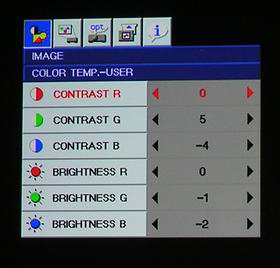
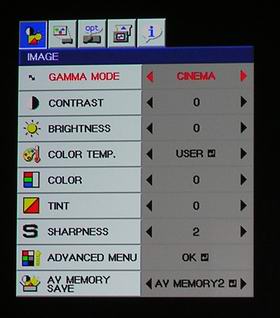
Image menu of the Mitsubishi HC4900 projector.The Image menu contains most of the goodies to adjust the image quality. Gamma mode lets you select between choices such as Cinema, Sports, Video, and Auto. You can also adjust the gamma manually for low medium and bright areas. Color Temp offers several different color temperatures - warm, medium, and cool. (In some other Mitsubishi home theater projectors, they actually listed temperatures, like 6500K, 7500K, etc., although our testing found that they weren't particularly accurate - so "warm" is safer than 6500K.) Shown immediately below the Image menu, is the Color Temp User menu, with separate controls for R, G, and B, for both Contrast and Brightness.

Image temperature menu of the Mitsubishi HC4900 projector.There are two User settings for Gamma, one for Color Temp, and those user settings, along with other settings like Brightness and Contrast can be saved in the AV Memory. There are three AV Memory save options as well.

Of course there is the usual Color saturation, Tint, and Sharpness, along with Brightness and Contrast adjustments on the Image Menu.


The Advanced menu gives you control of a number of items, but most notably, the Iris, with three different Auto Iris solutions, and Open (Iris wide open).

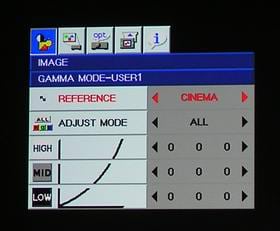
Gamma control menu of the Mitsubishi HC4900 projector.


I played with the gamma controls (shown right) just a little, trying to see if I could bring a little more shadow detail out by lifting the Low values (and the medium just a notch). I had some success but, again did not play with it extensively.


Moving on, next comes the Installation menu.

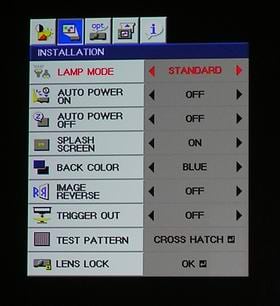
Installation menu of the Mitsubishi HC4900 projector.Of particular note is the first item, which is lamp power - Standard or Low.

After that, there are Auto Power On and Off functions, allowing the projector to turn off automatically when not in use, ranging from 5 to 60 minutes. Also present are the usual settings for front or rear, ceiling or table positioning, and control of the 12 volt trigger for motorized screen control.

You can also Lock the Lens Shift setting.


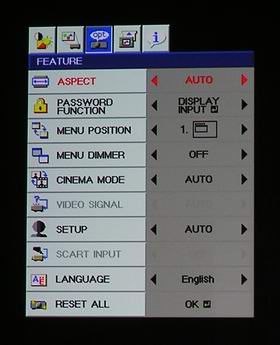
The next major menu is the Feature menu, shown below.
Feature menu of the Mitsubishi HC4900 projector.


That leaves two: The Signal menu which controls horizontal and vertical positioning, and Overscan control should a lower resolution image leave noise at the top or bottom of the screen.


Lastly is the Information menu, not shown, but identifies the resolution of the current source signal, and also has the lamp timer to show you how many hours are on the lamp.

Enough of the menus, already!


HC4900 User Memory Settings

The HC4900 projector offers several layers of user menus. There are user settings for both gamma and color temp. In addition there is one general user saved setting.

HC4900 Projector - Remote Control

The H4900's remote is above average. I must apologize, for the first time in about a year and a half, I somehow forgot to take a picture of the remote before sending back the projector the other day.

There are discrete buttons for On and Off, as well as an Auto Position button on the top row. Then come two rows allowing direct access of the different sources (DVI, HDMI, Computer, etc.)

The fourth row has three buttons, one for each User saveable memory.

The four arrow keys and center Enter button for navigating the menus.

Below that, left side is the Menu button, a button to select different Iris options and Aspect ratio change. Next come two more rows, including Contrast Brightness, Color Temp, Gamma, Sharpness and Color (saturation). Basically most features on the Image menu, can be directly accessed without going through the Main and Image menus.

The last row has one button that toggles between controlling the lens' Zoom and Focus (arrow keys handle the actual adjustment), another for controlling the Lens shift, and finally a Noise Reduction button.

I found that I was able to access most of the controls - including the Menu and arrow keys without having to shift my hand on the remote - something all remotes should strive for. Hitting any button engages the backlight - moderately bright, no problem there.

I also found that there was enough spacing in the remote that I could easily find the Menu button, and the arrow keys/Enter buttons without having to look at the remote.

Range of the remote, however was not particularly strong. With the projector about 17 feet from the screen and my seating positon 11 feet from the screen (28 feet total), I had only occasional success bouncing the remote's signal off of my screen and wall, to the projector. Mostly I had to point it rear. Note though at slightly shorter total distances, it became reliable. Thus I would say that if you are using a 100" or 110" screen you should have better luck!

HC4900 Lens Throw, Lens Shift, and Sharpness

Positioning the projector for a 100" 16:9 diagonal screen; the zoom lens will allow the projector (front), to be as close as 10 feet 3 inches and as far back as 16 feet 5 inches. As noted elsewhere, the zoom and focus are motorized, as is the lens shift. The lens shift feature has an unusually large adjustment range, a real plus. This allows the projector, (measured from the center of the lens) to be placed anywhere from significantly below to significantly above the screen surface. Overall the range is approximately 160% of screen height. For that 100" diagonal screen, for example, the center of the lens can be anywhere between about 13" below the bottom of the surface, to about 13" above the top. There is a small amount of horizontal lens shift as well, certainly more than you need to compensate for the off center lens, when mounting. The HC5000BL gets an "A" for placement flexibility.

As to sharpness, this Mitsubishi is exceptionally sharp! In fact, sharpness is one of the standout capabilities of both the HC4900 and HC5000.


For a sharpness test, I have been using my DTS sampler disk, for an image to demonstrate both sharpness and pixel visiblity. The image seen here, is about 10% of the DTS disk's menu screen. Click on it, and you will see a much closer (and larger view) that covers probably no more than 5% of the whole screen. Pixel structure is slightly visible here. You will find this image on a number of other recent reviews, for comparison.

Mitsubishi HC4900 SDE and Rainbow Effect, Pixel Visibility

Of course, being an LCD projector, there is no spinning color filter wheel, and therefore, no rainbow effect.

When it comes to pixel visibility and the Screen Door Effect, the HC5000BL performs extremely well, by virtue of being a 1080p projector. While sitting my usual 11 feet from my 128" diagonal Stewart Firehawk, pixels (barely visible on occasion on my 720p resolution DLP), were essentially gone! Only on credits could I really spot them when looking, and couldn't pick them out during normal movie or sports content. As a result, let's say this projector can comfortably be watched at close as a little less than 1 times screen width. That should make everyone (like me) who like to sit close in order to have a huge image, and better immerse themselves in the image, to be extremely pleased! After all, that's what front projectors are all about. (Who wants to watch on one of those tiny 60" plasma displays - they just don't give you that theater effect!) The only LCD projector I have seen with less visible pixels is the new Panasonic PT-AX100U (720p) using their smooth screen technology, and the Mitsubishi overall, is much sharper. When I get my hands on the new Panasonic 1080p - the PT-AE1000U, which also has Smooth Screen, I suspect pixels will be less visible on it, but the question is, will the Panasonic appear as sharp?

Review continues below this advertisement.


Mitsubishi HC4900 Projector Brightness

The HC4900 performed about as expected, in terms of brightness. Rated 1000 lumens, the HC4900 projector measured 962 lumens in its brightness mode (Dynamic), with lamp at full power.

For all measurements, the zoom lens was slightly to the wide angle side of center. (A projector with a zoom lens of 1.6:1 like this projector is significantly dimmer in full telephoto, than full wide angle. The difference should be at least 35%.

In Cinema mode, the HC4900 produced a very impressive 688 lumens, which is significantly more than the original HC5000 measured (480 lumens), despite being rated the same 1000 lumens. The difference could be do to one of several things. First of all, when we reviewed the HC5000, it was one of the very first units out the door. I checked my notes, and sure enough, the original HC5000 was a pre-production unit. Pre-production models often aren't as bright as the finished product. Also there is a tradeoff between brightness and contrast, and the HC4900 has a lower contrast ratio - 7500:1 compared to the HC5000's 10,000:1. I should note, though, that the lower contrast ratio can be due to other things such as the auto iris, so, attributing the difference in brightness to the contrast difference, is iffy at best.

So, let's just be impressed with the brighter performance of the HC4900. For example, is is far brighter in "best mode" than the Panasonic direct competition, the PT-AE1000U.

Ultimately, the bottom line is that the HC4900 home theater projector has plenty of brightness in Cinema mode. While not as bright as my own JVC RS1, in its best mode, the HC4900 has to be considered to be a moderately bright projector, that can handle larger screens in Cinema mode.

Switching the HC4900 into standard mode output 602 lumens, also not bad at all.

The measured difference between lamp on full power and eco-mode, is a little less than with most. Low power dropped the total lumens in Dynamic mode, by 17% in our measurements, and that should be fairly consistant, regardless of mode.

Compared to the competition, the HC4900 is brighter in best modes than the Panasonic PT-AE1000U (by a great deal) and is a bit brighter than the Epson Home Cinema 1080. It is also much brighter than the Panasonic in brightest mode, but the Epson cranks out almost 1700 lumens in its brightest mode, a dramatic jump over the Mitsubishi. Translated, for movie watching, the Mitsubishi is the brightest of the group, but if you need to crank up the lumens for sports and/or significant ambient light, the Epson is king. Optoma's HD81 has almost identical brightness, when compared to the HC4900, but the Optoma, while still no match for the Epson in brightest mode, is slightly brighter than the HC4900.

HC4900 Projector - Light Leakage

When it comes to light leakage, the HC4900 does an excellent job, with virtually no light leakage, and what little there is, is a non-issue. The leakage comes out the lens, but is so dim, even compared to a "black" screen, that it's not worth considering.

Mitsubishi HC4900 Audible Noise Levels

This is easy. The HC4900 ties the HC5000 as the quietest home theater projector on the market. It claims an almost silent 19 db in low power, and even in full power, at 24 db, it is quieter than virtually all other home theater projectors, even when the others are in their "quiet modes". Outstanding!

Review continues below this advertisement.


HC4900 Projector Screen Recommendations

Alas, as noted, the big sacrifice of the HC4900, compared to the HC5000 is in the area of black levels, and corresponding shadow detail. For all but those trying to use an exceptionally large screen surface, I have to recommend HC gray projection screens, and for the first time in a while, I'll recommend some of the screens that were designed for older projectors with so-so black levels.

Even on my Firehawk, at 128" diagonal, I find the blacks coming out a bit to bright a gray for my taste. Remember, I'm spoiled, my JVC RS1 - at about twice the price of the HC4900, does the best job on black levels of any fixed pixel (LCD, DLP, LCOS) projector I have tested.

I would think Stewart's Grayhawk would be a great matchup, and for less money, alternates would include Da-Lite's HC Da-Mat, and Carada's affordable HC gray surface. Carada's is one I've never worked with, but from my understanding it is a dark gray, that should match very well. If you want to go larger screen sizes, the Firehawk, and Elite's HC gray surface, would be reasonable options. I'd avoid, in general, white surfaces, unless your primary purpose is non-movie content, such as sports viewing.

Mind you, the blacks, while not extremely dark, are at least comparable to most DLP projectors using the Darkchip 2, and it does a better job, than, say almost any 720p LCD projector. That said, of the LCD 1080p projectors, the HC4900's black levels are lighter than the Panasonic PT-AE1000U, the Epson Home and Pro Cinema 1080, and, of course the Mitsubishi HC5000.

HC4900 Projector Measurements and Calibration

Overall, the Mitsubishi HC4900 was off a bit from the desired 6500K temperature in Cinema mode. It runs cool, with white at 6774K. The darker grays are even cooler.

The adjustment controls of the HC4900, however, are flexible, and it is fairly easy to adjust grayscale balance. That is something that those of you using the AVIA or DVE disks to fine tune your projector, will really appreciate.

We initially adjusted the brightness to +1, and contrast remained unchanged. Color (saturation), we reduced to -1, although there were definitely times when viewing content, where the image was slightly oversaturated.

After starting with the initially cool default settings (mostly around 6800K - 7200K) I ended up with these settings, after a few minutes of trial and error:

100 IRE: 6657K
80 IRE: 6732K
50 IRE: 6830K
30 IRE: 6997K

Further adjustment should be able to bring the range closer than the 440K difference between the warmest and coolest range, and further "warm" the image, but these numbers produce an excellent, very watchable image.

The adjustments made to accomplish that:

Contrast: Red= -3, Green= +3, Blue= 0
Brightness: Red= 0, Green= +2, Blue= +2

Fleshtones with these settings were pretty natural, and the overall settings, worked just great, even though they can be improved upon.

HC4900 Image Noise

There seems to be a difference in some noise levels compared to the HC5000, and in some cases I noted a graininess to the image when I viewed at distances that were probably just a little too close to be considered reasonable seating distance. However, I did not turn on the Noise Reduction circuitry. Overall, I don't think the processing is a problem, but there are cleaner images out there. Jaggies were definitely not an issue, and it performed pretty well on motion artifacts too.

Next...

Mitsubishi HC4900
Image Quality
General Performance
Warranty
Summary, Pros, Cons