Epson Home Cinema 5010 Home Theater Projector Review

11/23/2011 - Art Feierman

It was a close thing, the Home Cinema 5010 projector arrived less than a week before Thanksgiving, with another review (Acer already started). Despite that, we managed to get about 75% of the review posted the night before Thanksgiving. -art

Update, 1/20/2012: Epson replaced the original pre-production Home Cinema 5010 projector, with a full production one. The new one is visibly sharper, impressively so. It is sharper than the JVC RS45 I'm currently reviewing at the time of this update. The rest of the review is not updated to reflect this improvement.

Let us begin.

The Epson projector here is actually the "e" version, and it is currently showing Hubble 3D as I write this. Writing with the 3D glasses on gets tiring, so they are on top of my head at the moment. If something really cool is going on, I look up, lower the "shades" and take a look: We're passing through a nebula right now, and I must admit that, looking through the Epson Home Cinema 5010, the 3D Universe is something to behold. But, I digress, let's get this review of the Epson Home Cinema 5010 started.


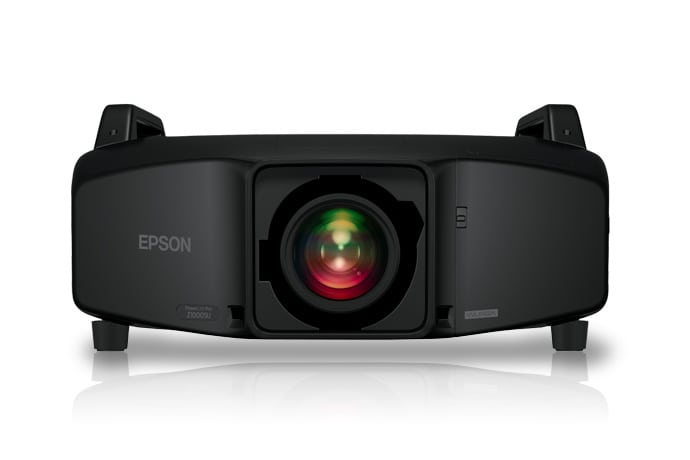
The Epson Home Cinema 5010 projector.

The Epson Home Cinema 5010 projector earns our Hot Product Award!

Epson Home Cinema 5010 Projector Overview

The Home Cinema 5010 (click for specifications) projector starts off with all the performance of last year's Best In Class winner, the Home Cinema 8700UB. It too, is a 3LCD projector, although it sports newer LCD panels; Epson's latest D9 panels (which are also used by Panasonic). These 480hz panels improve overall performance, and enhances 3D as well.

And that's the point. The Home Cinema 5010 offers 3D as well as 2D, and is the brightest under $10K home theater projector we've seen, when doing 3D.

The Home Cinema 5010 projector is the standard projector in the Epson lineup, and comes pretty loaded with features. There is a second version, the Home Cinema 5010e, which sells for $300 more, and gives you wireless HDMI capability for the difference in price. More on that later. There is also the Pro Cinema 6010 sold only by local authorized dealers. It bears a black case, has just a couple extra features, but is basically a 5010e with anamorphic lens support.

Epson sticks with the same Fujinon lens it's been using for years. The HDMI ports are new HDMI 1.4a for handling Blu-ray 3D.

Quantum of Solace image from the Epson Home Cinema 5010 projector.

But mostly, this Epson is a all purpose home theater projector, designed for your home theater - or "cave", but with all that extra brightness, it will be just as happy in the bonus room or living room.

Aaron Rodgers image from the Epson Home Cinema 5010 projector.

What is the most direct competition for this Epson projector? From a pricing standpoint, if you clear the $2000 price point, there are a handful (and growing) list of home theater projectors that are 3D capable, and some additional that are 2D only.

The most direct competiton is, of course, the Panasonic PT-AE7000, which even uses the same LCD panels. This contest will be discussed at length, as the major shoot-out in the $2000 to $3500 Class that we consider the market sweet spot.

The Fifth Element image from the Epson Home Cinema 5010 projector.

Interestingly, this is the first time Epson is selling their projector for less than the competing Panasonic. Other contenders will include - the forthcoming BenQ W7000, the Mitsubishi HC7800, and at the top end of that range, the Sony VPL-HW30ES, JVC RS45, and Sharp XV-Z17000. All of those should be shipping by the last days of 2011. A few more will likely be announced at CES, and ship in Q2.

Lord of the Rings image from the Epson Home Cinema 5010 projector.

The Home Cinema 5010 receives our Hot Product Award. We can quibble about this or that , and we do, - but, just as I said about the Panasonic, the combination of performance and price looks better than any of the more expensive LCoS and DLP 3D capable projectors I've just mentioned.

Of course, that doesn't mean one of those others isn't a better choice for you. It's always about matching the projector to your room and your tastes/requirements. This projector can handle most room environments! Few others can. And the Home Cinema 5010e might even save you a chunk of money if you are wiring your room, with its Wireless HD (more later).

Few projectors can match the versatility of the Home Cinema 5010 projector series, in terms of working in your room environment. and with that said, let's see what Epson brings to the table, in terms of Highlights, Basic Specs, and all those Special Features found below (and others we don't even get to mention).

^ Back to Top

Epson Home Cinema 5010 Projector Highlights

  • 2D and 3D capable with best in class brightness for 3D
  • Full color management system for excellent color and skin tones
  • Ultra High contrast projector with superb black level performance in 2D
  • 480hz D9 LCD panels - the latest and greatest, and fastest
  • Rated 2400 lumens, highest rated home theater projector under $5,000
  • Suitable for theater or family room
  • Excellent placement flexibility
  • Very Long life lamp
  • Zoom lens with wide range, lens shift, for placement flexibilty
  • 2 HDMI 1.4a inputs (Blu-ray 3D compatible)
  • Split screen, two choices of sizes, both can be hi-res
  • Great warranty
  • Excellent price/performance value

Casino Royale image from the Epson Home Cinema 5010 projector.

Above, Leeloo (the Perfect Being), from The Fifth Element

^ Back to Top

Basic Specs for Epson Home Cinema 5010

Home Cinema 5010 MSRP: $3499, MAP: $2699,
Home Cinema 5010e, MSRP, $3499, MAP $2999
no 3D glasses included - they are $99 MSRP,
Native Resolution: 1080p (1920x1080)
Brightness: Manufacturer claim: 2400 lumens, 2051 measured max, 630 lumens, post calibration in "best" mode
Contrast: 200,000:1
Zoom Lens ratio: 2.1:1 manual zoom and focus
Lens shift: Horizontal and Vertical (manual)
Lamp life: 4000 hours at full power, 5000 hours in eco mode - Estimated replacement cost: $299
Weight: 18 lbs. (8.2 Kg)
Warranty: 2 Year Parts and Labor, 2 year fast (2nd day) replacement program

View full specifications here: Epson Home Cinema 5010

Gandalf image from the Epson Home Cinema 5010 projector.

^ Back to Top

Epson Home Cinema 5010 Special Features

Split Screen viewing

The Epson 5010 series projectors, and the Pro Cinema 6010, offer the same Split screen viewing as the lower cost Home Cinema 3010 projectors. I've dropped in the copy from the 3010 review, with minor revisions:

The Home Cinema 5010 lets you select two different sources and put them up side by side, either with both images the same size, or the one you designate, to be larger than the other (about 2:1).

Here's the catch (a standard one). You can't feed it two different HDMI sources, because there is, as is typical, only 1 HDMI circuit in the projector (shared by the two inputs). That means you will need a second source, and if you want that second source to be another hi-res source, you are looking at either component video or traditional analog computer. I'm just pointing all this out to you. It's no sweat if you aren't mounting the projector and have a temporary setup. It's always easy to run another wire as long as they are outside of walls. If you are wiring, though, and not sure, add a component video, analog computer, or a pair of USB cables (the analog computer also carries component, so the most flexible).

I did it. Had to rummage through my storage room, found a component video cable and fed component from my satellite box, and HDMI from my PS3, and put them up side by side. I am ready for Fantasy football - with the game on one side, and my online tracking of my players on the other. Why not!

I did encounter some problems when I tried my DirecTV box on the HDMI side. My Playstation worked better. Regarding the satellite box, it worked shortly before on full screen, but would come up "not suported" in split screen. I'll work this out with Epson. This is a pre-production projector, and I trust problems like this will be fixed in the full production versions. Epson always makes good, it seems.

Update: Fu

If you are willing to run the extra set of cables, it sure is a lot of fun for some applications. You can watch a movie while your kid is playing a game on the other side of the screen. The kid can listen to sound through his head phones.

Anime image from the Epson Home Cinema 5010 projector.

Home Cinema 5010 Dynamic Iris

A dynamic iris is the key on most projectors to improving overall black levels on darker scenes, and the resulting improvement in the viewing experience.

Star Trek image from the Epson Home Cinema 5010 projector.

Image above from Quantum of Solace

Epson's dynamic iris in the Home Cinema 5010 is what we've come to expect. Epson offers two speeds or off settings. Both are very good examples of what's possible in faster and slower irises, and more to the point, the Epson delivers blacker blacks, than any other projector near its $2699 online street price! As has been the case with older Epsons, their dynamic iris has a lower rumbly sound, with some clickity sounds, too. For most, you will only notice during silence, ie. while switching sources.

Epson's blacks are perhaps the key reason I've been a huge fan of the Epson UB projectors we've been reviewing for the last 4 years. The HC5010 is the 8700UB's logical replacement, and claims the same black levels, which is to say - outstanding, especially for a 2D/3D projector at this price, and better than almost all projectors selling for twice the price.

Home Cinema 5010e WirelessHD

This is a feature found only on the Epson Home "e" projectors, that would be the Home Cinema 5010e, and the lower cost 3010e The short version though is that the Epson can receive wireless HD signals from the transmitter that is included. Place the transmitter by your (HDMI) equipment, and you don't need to run an HDMI cable to your Epson projector. Very cool, and for those who have older theaters without HDMI wiring, a potential huge cost saver.

The system is lossless - that is, the picture quality should be every bit as good as when using expensive wiring.

Home Cinema 5010 Projector 3D

This is the primary discussion area for the Epson's 3D performance:

I really love most of what the Epson Home Cinema 5010 projector offers when doing 3D. It's the two things it lacks, however, that does take a bit of the fun out of it.

First of all, the Epson Home Cinema 5010 projector is bright when doing 3D. We're now seeing projectors hitting the market that are roughly twice as bright as all the ones we looked at in the first generation, last year.

This Epson joins its lower cost sibling, and the new Panasonic PT-AE7000, in being the three brightest home theater projectors when doing 3D, and under $5,000, and for that matter, under $10,000. A few others get close. The rest, left in the dust.

The 3D picture really works for me. I'm not seeing any particular issues, beyond the usual one expects with 3D, which is to say, imperfect, compared to 2D. I'm still learning, and I know I'm not as sensitive to some aspects as are some other folk. Very fast motion cause a kind of flicker (or whatever the proper term is - I don't think that's part of what most call "ghosting"). A tiny football on a kick-off sort of flickers in and out of existence, as it flies - but the same "artifact" is true for the Panasonic, the Sony, the Optoma... I think those issues will work themselves out over the next generations, and I consider them a minor inconvenience. Let's face it - 3D is still far more imperfect than 2D (except in the real world), when it comes to displays.

OK, so, lots of good 3D - where's the beef?

For one, dynamic iris is not available in 3D mode. Now that's not as bad as some might think, but it does mean we're in for a discussion here, some of you might want to drop down about five paragraphs to the "bottom line".

Actually Epson does not let you use the dynamic iris in 3D modes. Nor the CFI, and some other dynamic features (Super-Resolution). I can understand the logic with the iris - by the time a very bright projector is in 3D, it's about 1/4th as bright as 2D. That's huge. So while the Epson puts up a reasonable picture brightness, the blacks are going to be fairly dark. Remember this is still a "UB" projector, even with its iris off, it's blacker than the lower cost 3010 with iris working on most darker scenes! I didn't try this, but the Home Cinema 5010 would seem to do better blacks then almost all of those $1500 projectors, even with its dynamic iris turned off.

Being the black level fanatic that I am, the lack of the iris availability has concerned me. I have watched 3D - especially dark scenes, compared to the Panasonic PT-AE7000 and the Optoma HD8300, and both of those do a better job on blacks, since their irises are working.

For this reason, I spent a whole lot of time comparing, and then, watching chunks of my 3D library, using a 100" sized normal screen or larger, and tried to determine how big a deal this is.

If it was 2D - a magnitude brighter - the advantage of the Panasonic and the Optoma would be significant, and it would cost the Epson dearly. 3D being darker, even at its best, however, mitigates most of this. No doubt about the advantage of the others, especially the Optoma, but I finally (for now) sorted it out this way:

Consider the difference between the 5010 and the Panasonic in terms of 2D blacks. The Panny's really good, the Epson better. It's sort of like that, in reverse. Oh, the difference is: Both greater in 3D, And less importan in 3D. In other words, I'd prefer the Panasonic's blacks in this case, no question, but I could live with the Epson for my 3D viewing.

I watched tonnage, from movies like Alice, Step-Up 3D, some dark (inside the house) scenes in Monster House, other animation, Hubble 3D, Legends of Flight, some concerts and more. It was fine on most, but on a few things, I actually noticed that the blacks could be better. Not on content like Step-Up 3D, Flight, or Tahiti, but a few places in Narnia: The Dawn Trader 3D, and no doubt the cave in Bond's Quantum of Solace if that was in 3D.

I wish Epson did allow the dynamic iris to function in 3D, but I have decided that I certainly can live with it.

Which brings us to CFI - also missing in action. In this case, I'll give Epson a pass. Remember the football? I've played with the CFI settings on several 3D projectors now, and turned it off, and I still can't get that tiny football to stay substantial.

It's either the shutter glasses in general, or my eyes, or both, but that fast motion seems to be the area of greatest weakness in 3D viewing. In other words, if the smoother motion of CFI still leaves us with something more noticeable, it doesn't matter as much. Even on boxing, on other projectors I've tried on and off with their CFI feature. You can tell the difference, just that other things are more noticeable. Ok? Done. I like having CFI, but even in 2D I've said many times, it's a feature I could live without. On the other hand, the Epson would not be competitive if it didn't have a Dynamic iris for 2D.

Bottom line on 3D: The Epson is Dazzling. I can kvetch (complain) all I want about the dynamic iris not being active, but the overall 3D is bright and stunning. The blacks could be blacker, but are black enough. The rest is killer.

My friends come over and are truly taken aback. (in fairness, that has also been the case with the Panasonic). I plant everyone about 4-5 feet from the screen and show them Hubble 3D, or Flight, or Tahiti, or maybe even football or boxing in 3D (amazing, truly amazing), or perhaps, a movie.

What a projector filling a large screen brings to the party is so euphoric, that the government should ban 3D on anything smaller than 90 inches! (and that from a guy with libertarian tendences).

Home Cinema 5010 Creative Frame Interpolation - CFI - smooth motion

The Home Cinema 5010 has CFI. It seems like previous CFI's on the older UB projectors, which is to say, even the Low setting is too much for most movies, at least for any purist. It does its job nicely for sports viewing. As noted elsewhere, Epson only allows CFI functionality in 2D. My daughter understands the difference, and can easily spot CFI, but doesn't seem to really mind a good CFI on a movie. For us purists and enthusiasts, though most of us will prefer OFF for movies.

Home Cinema 5010 Audio - Or Lack Thereof

I borrowed this heading from the Home Cinema 3010 projector review, to make a point. There are no speakers in the Home Cinema 5010!

That lower cost HC3010 projector (about $1000 less) is targeted primarily as a home entertainment projector - you know, the family room, the bonus room, the living room, the garage door... while this Home Cinema 5010 projector is more the Home THEATER projector. That's not to say a lot of folks won't be placing these 5010s in all sorts of rooms and in all sorts of conditions. After all, the Home Cinema 5010 really is bright - right up there with any of the home entertainment projectors, and then some, in many cases.

As a serious Home Theater projector, Epson, and I, would expect you to match the high quality projected image, with a really good, or better, a truly great sound system. A couple of 10 watt speakers aren't going to make us enthuisasts happy, nor anyone who really wants to rock the house. Bottom line - no speakers - worries!

Star Trek image from the Epson Home Cinema 5010 projector.

HDMI-Link

From the Home Cinema 5010 remote control, you can control other devices such as many Blu-ray players that support HDMI-Link. Note, you'll find a full set of DVD type controls on the Epson remote, which we discuss on next page.

Home Cinema 5010 Lamp Life

Another Epson, another platitude: It doesn't get much better than this. In terms of lamp life. Epson is claiming that the Home Cinema 5010 lamp will last 4000 hours running at full power, and 5000 hours in eco-mode. I don't recall ever seeing a projector running a lamp, that claims more than 5000 lumens at full power - at any price. Consider this Epson, therefore, to have a very low cost of operation. Epson lamp prices tend to be on the lower side as well. In this case, we haven't confirmed but the replacement lamp seems to be $299.

Epson's Fujinon 2.1:1 zoom lens

Epson's been using this lens since the original Home Cinema 1080 more than 5 years ago. It's got a touch more zoom range than anything close (such as the competing Panasonic). The optics do look pretty good. The lens allows a really sharp look at your pixels if you stand next to the screen. This is a 3 chip LCD projector, which means there's never perfect conversion. With the Epson Home Cinema 5010, no issues on the optics, and more placement flexibility than other lenses, very few of which offer more than 1.6:1.

Just remember, if you are going to place the projector at the maximum distance from your screen, as with all projectors with zoom lenses, the optics are at their least bright, and brightest, when the projector is at its closest.

^ Back to Top

NEXT: Take a physical tour of the Epson Home Cinema 5010