Overview of the Three Most Popular Display Technologies used in Consumer Projectors: LCD, LCoS, and DLP
This article will cover the three most popular projector imaging technologies used in consumer and business projectors: Digital Light Processing (DLP), Liquid Crystal Display (LCD), and Liquid Crystal on Silicon (LCoS). We will discuss how their technologies work and what the Pros and Cons are of each technology.
DLP
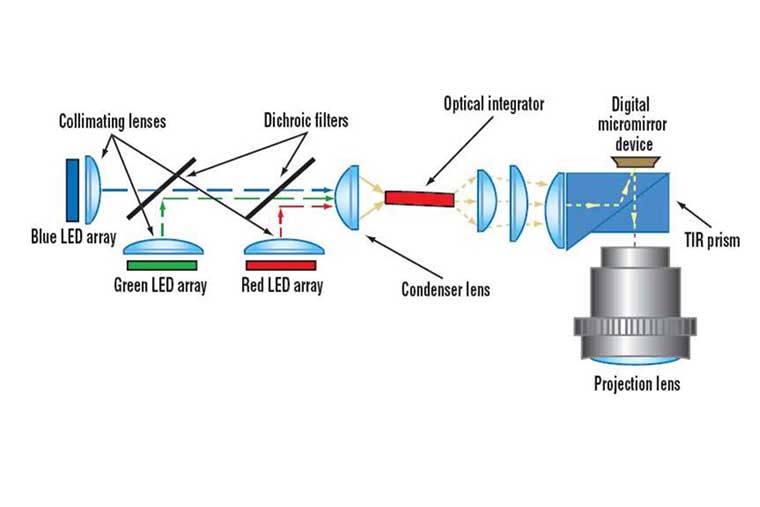
First let's discuss the technology behind DLP (Digital Light Processor). DLP works when light passes through a spinning RGB color wheel and then bounces off a single DLP (or DMD, Digital Micromirror Device) chip that is covered with micro-mirrors. The light is reflected off the mirrors on the chip, then passes through the projector's lens and onto the screen to produce an image. Because DLP projectors only require a single chip, they are often among the smallest and most portable projectors on the market.
The resolution and performance of DLP chips have improved with each successive generation. Native resolution has increased up to WUXGA (1920 x 1200). While a DLP chip does not have 8.3 million mirrors, it can deliver a perceived resolution of 4K (3840 x 2160).
DLP XPR technology leverages the immense speed of the DMD (Digital Micromirror Device) to process pixels faster than the rate of the video signal. This speed is how DLP can utilize one imaging chip to create multiple colors and multiple pixel locations.
In the earlier DMD designs, the pixel would only pivot on or off using one hinge and axis. The XPR chip tilts in 4 directions and operates fast enough for our eyes to see all the pixels and perceive the entire image all at once.
While the newest 0.47" DMD chips only have about 2.1 million mirrors, they can deliver a perceived resolution of 8.3 million pixels. This system works so well that it would be difficult for any viewer to see a difference in resolution from a native 4K UHD (8.3 megapixels) imager.
LCD
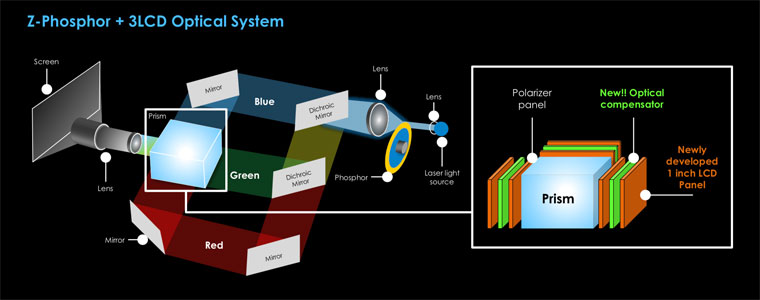
The technology behind LCD (Transmissive Liquid Crystal Display) also starts off with a single light source, just like with DLP. But, with LCD and 3LCD, the single light source is split into 3 beams -- one each for red, green, and blue - the primary colors. Once the light is split, mirrors send the beams to different locations inside the projector box. At that point, the light passes through one of the LCD panels (or three panels if it is a 3LCD projector). These panels are not colored, but grayscale, and each has a different color filter. The end result, when light passes through them, is the red, green, and blue beams that then pass through a dichroic prism, which recombines the three beams into a single full color beam.
While early LCD projectors contrast performance was behind its DLP competition, the last six years has seen remarkable leaps forward for LCD.
A projector is more than the sum of its parts. It has been said that the actual projector is only one half of the equation, with the screen being the other factor that impacts perceived picture quality. The truth is you have to look at the projector systemically. When you do you will find, among other improvements, the dynamic iris contributes to LCD projector's improved contrast.
LCoS
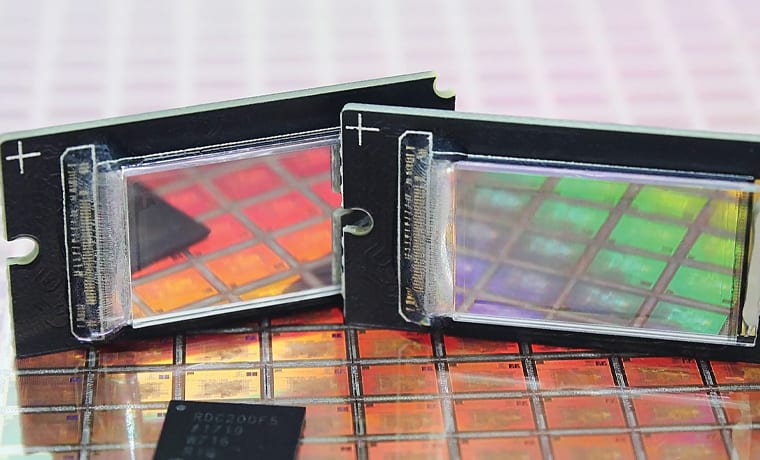
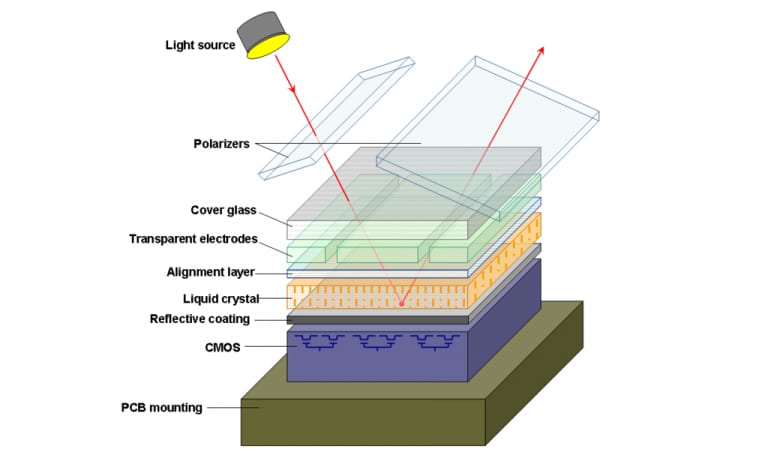
With LCoS, the process is similar to 3LCD, in that you start by splitting the light into three beams. A key difference, though, is that LCoS (Liquid Crystal on Silicon) is a reflective panel (like DLP) rather than transmissive (light passing through it), like the 3LCD panels. So, light bounces off of the LCoS panels, then to a dichroic prism (like 3LCD) to recombine the light into a single, full-color image.
LCoS imagers have a higher pixel density than their DLP or LCD counterparts so a smaller LCoS chip can produce more resolution. This is why most native 4K Home Theater projectors utilize LCoS chips.
What I'm talking about is 8 million pixels, each producing an individual element of the picture. There are other ways of displaying 4K. Technologies like DLP's wobulation and LCD's pixel-shifting are some examples. But are these native 4K? It's something of a debate in the industry. Is native resolution determined by how many pixels you can see on the screen or how many pixels or mirrors exist on the chip? You're going to have to be the judge of that because it's about how you perceive the picture.
Which technology is best for my application?
Each technology may have certain strengths or weaknesses, but no one technology has it all over the other two. When considering which technology to buy, it is best to consider the application, price, and how the projector will be used in making a decision. Here are some observations on the three technologies below:
DLP
DLP tends to be the brightest and might work best in a room with a lot of ambient light. However, DLP also can't produce the deepest black levels if that is a consideration. DLP chips are less expensive, which reduces the manufacturing cost. This is why most entry-level projectors utilize DLP. A single-chip DLP optics are also very compact, so this technology is often used in the smallest portable projectors.
Low maintenance is another benefit of DLP. With a single-chip DLP projector, the user will never have to deal with convergence issues, unlike a 3 chip LCD or LCoS projector, so the image will remain sharp throughout the projector's life without periodical adjustment.
Also, DLP projectors have a sealed light path to protect the optics from the dreaded "dust blob." Having a sealed light path prevents particles of dust from settling inside the light path and obstructing the projected image.
LCD
Modern LCD panels produce good contrast and black levels (which is preferred for serious movie watchers) and are priced in the middle range of the two, with some projectors even priced on the lower side like DLP.
It is also a good option for viewers who are sensitive to the rainbow (color break up) effect caused by the color wheel found in many DLP projectors.
However, the native resolution of LCD projectors is not always as good. While 4K pixel shifting can increase the detail and sharpness of an LCD projector, it can't match the 4K resolution reproduced by native LCoS or DLP wobulation.
LCoS
LCoS certainly produces the highest quality black levels of the three technologies and offer the highest native resolution. However, that comes at a price, with LCoS also being the most expensive of the three technologies.
Also, LCoS projectors are usually focused on the higher end professional and home theater markets. They are usually three-chip and tend to utilize better, larger optics and quieter cooling systems so their chassis are traditionally the largest.
Summary
At the end of the day, it's not necessarily about the technology – all are capable of great performance. So, don't worry about the actual technology, only consider what works best for your specific application and use case (as well as budget and space).
Determine what is being watched, and when it is being watched, and what's most important. As usual no one single technology wins hands down, but as you can see, depending on your needs, one technology may have more projectors that will work than another will. Better to create your short list of projectors that meet your overall requirements and narrow it down from there.