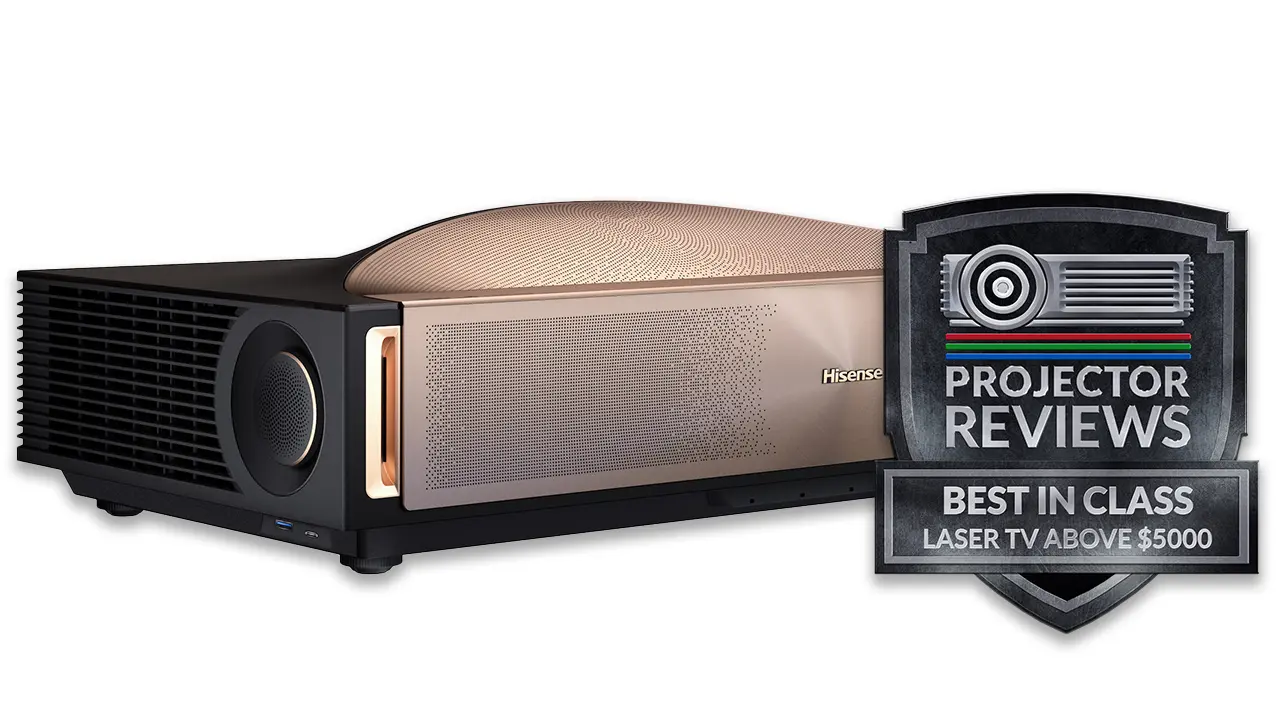
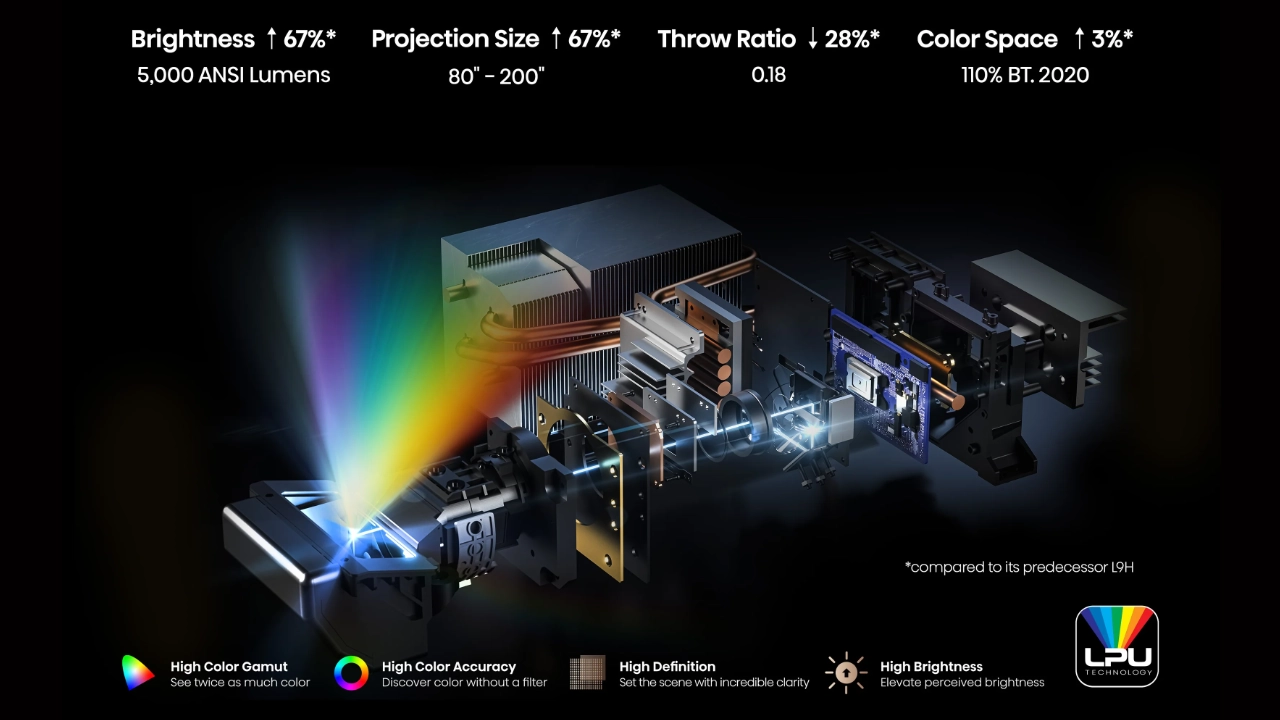
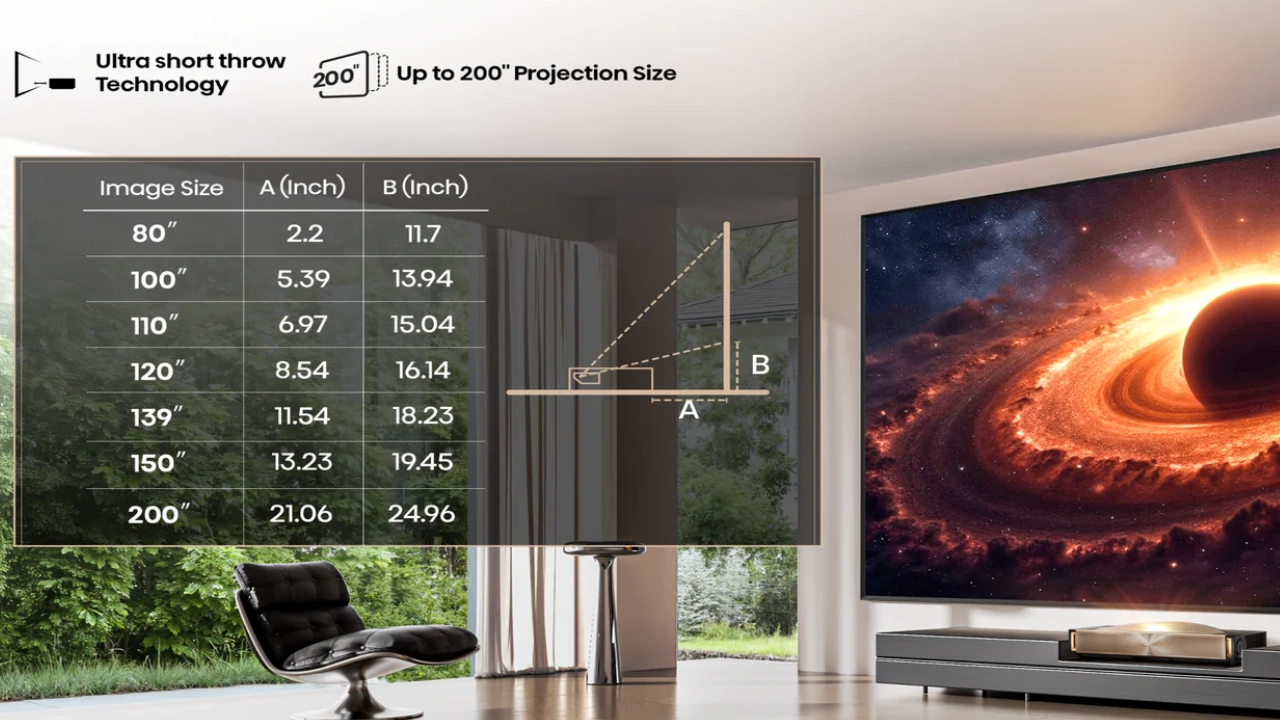
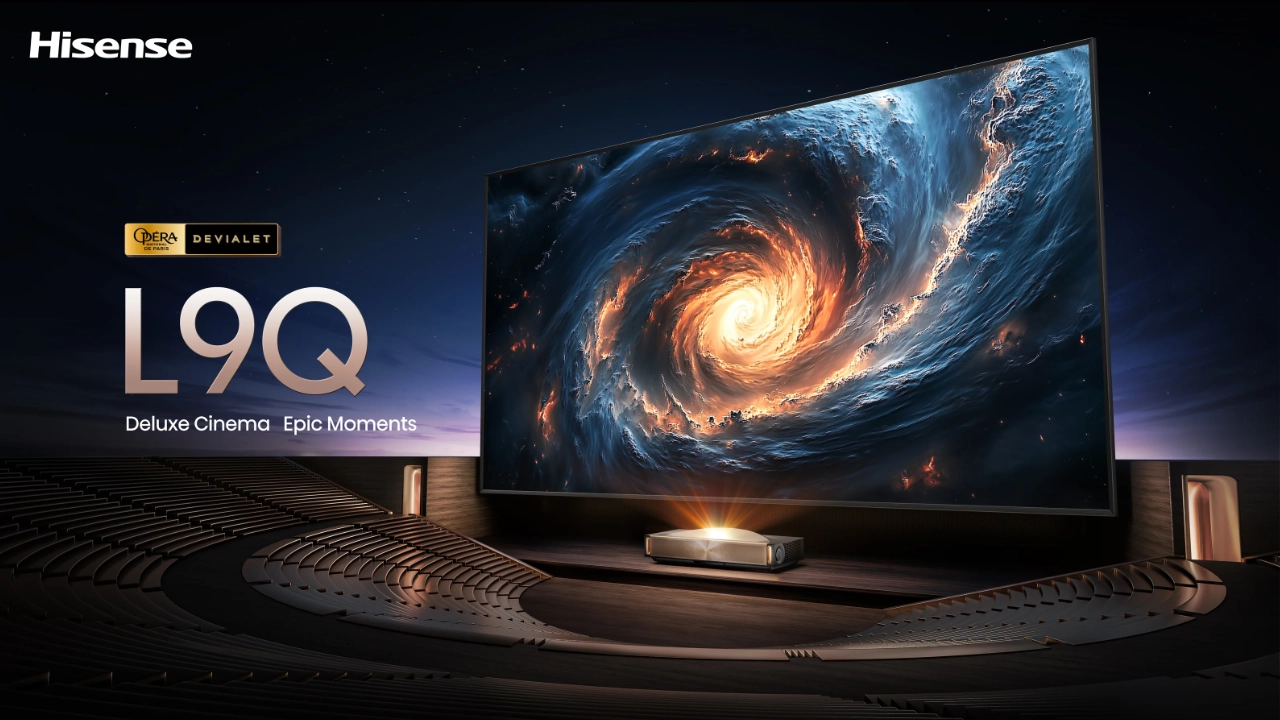
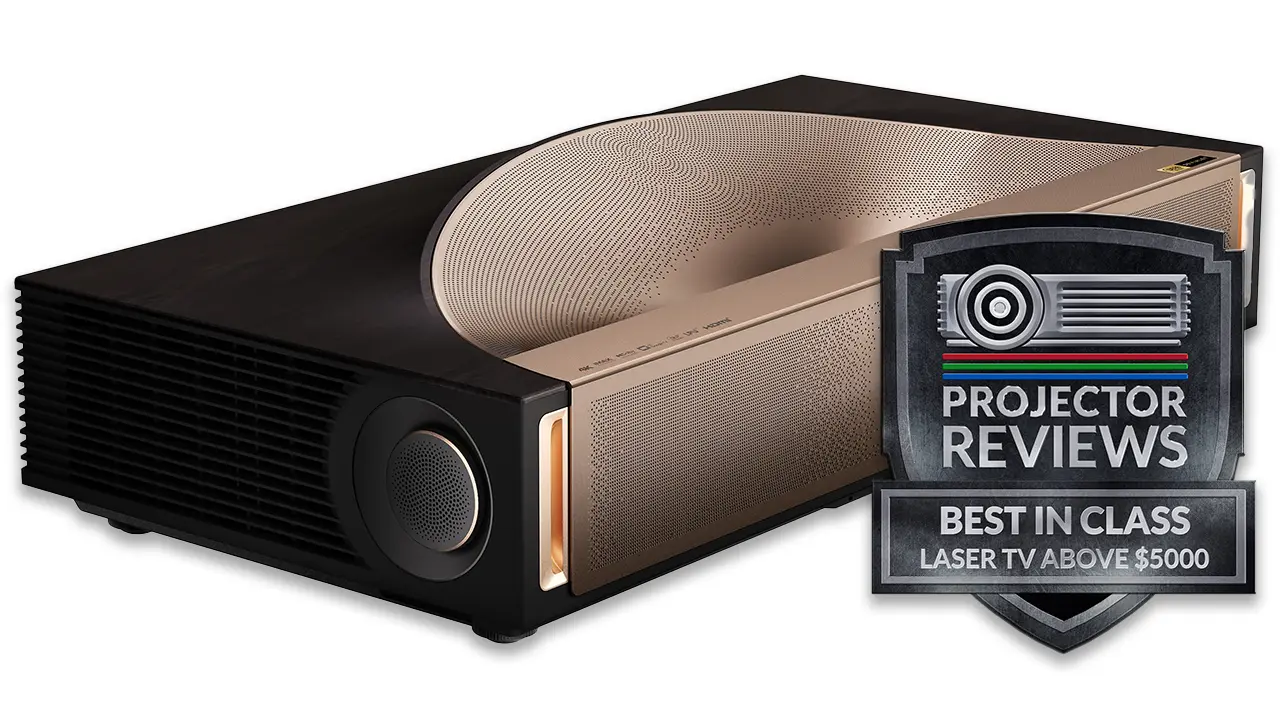
The Hisense L9Q is the company's 2025 flagship ultra-short projector. The L9Q sells for $5,999 MSRP, but you get the best Hisense has to offer in design, features, and performance. The L9Q is a 4K UHD (3,840 x 2,160p) powered by the company’s latest high-performance LPU technology featuring a 0.47-inch chipset, an RGB triple laser light source, a precision-engineered lens, and a reduced throw ratio so you can enjoy a 100-inch image with the projector placed about 5.4 inches from the screen.
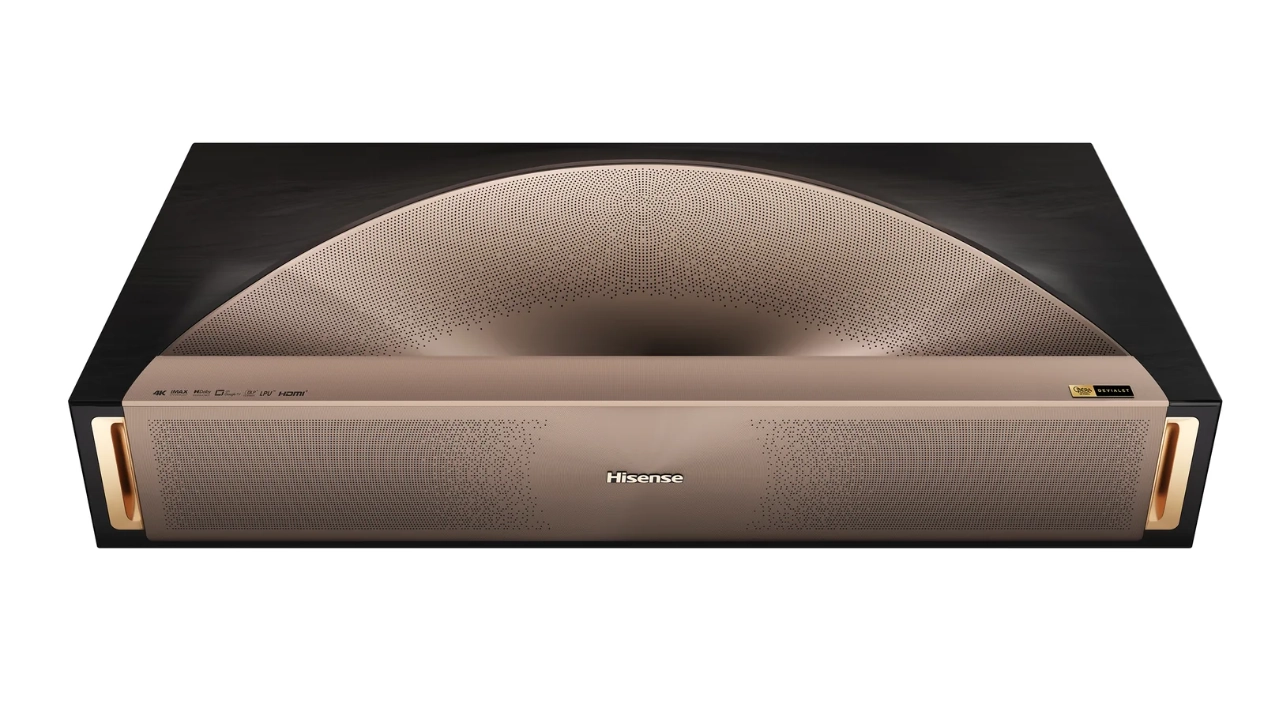
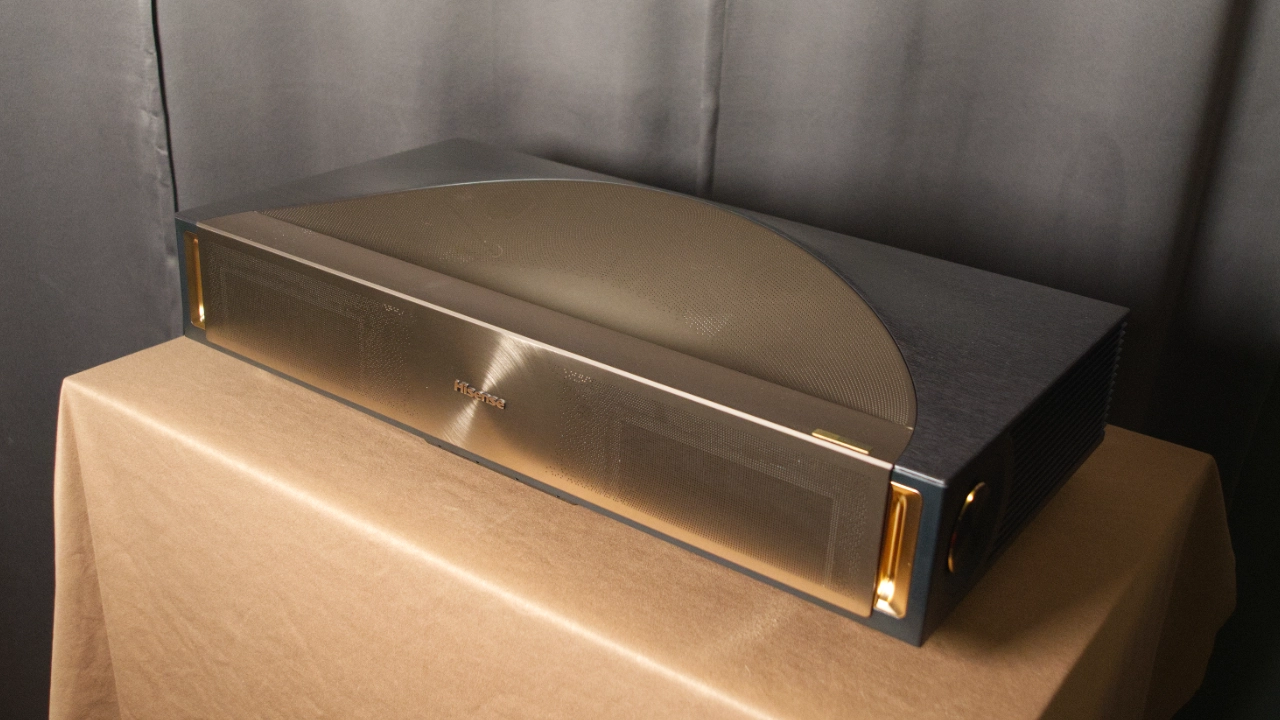
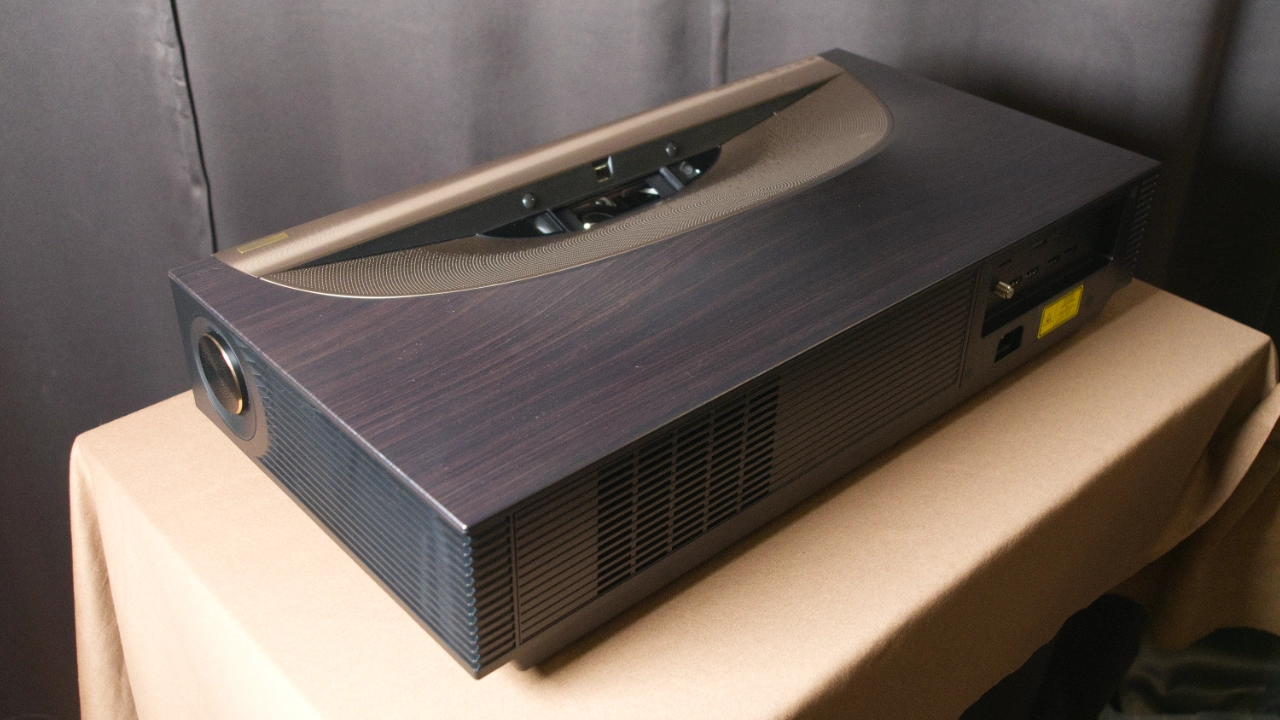
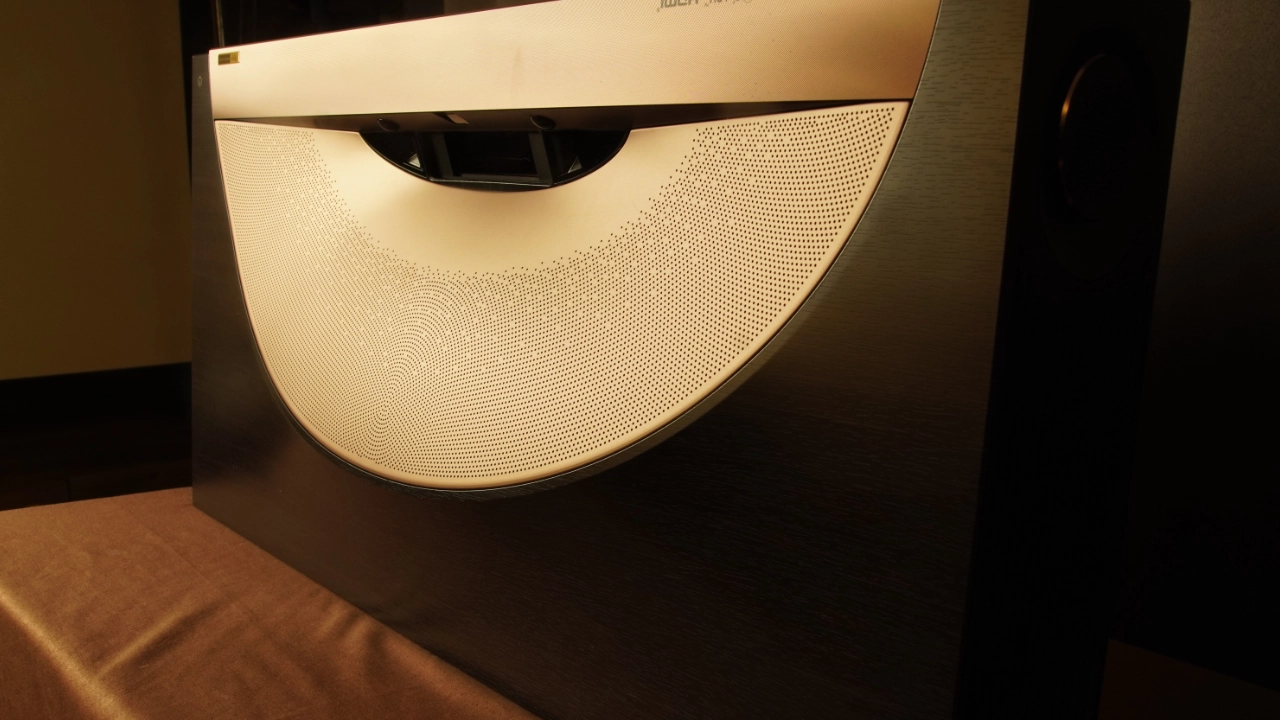
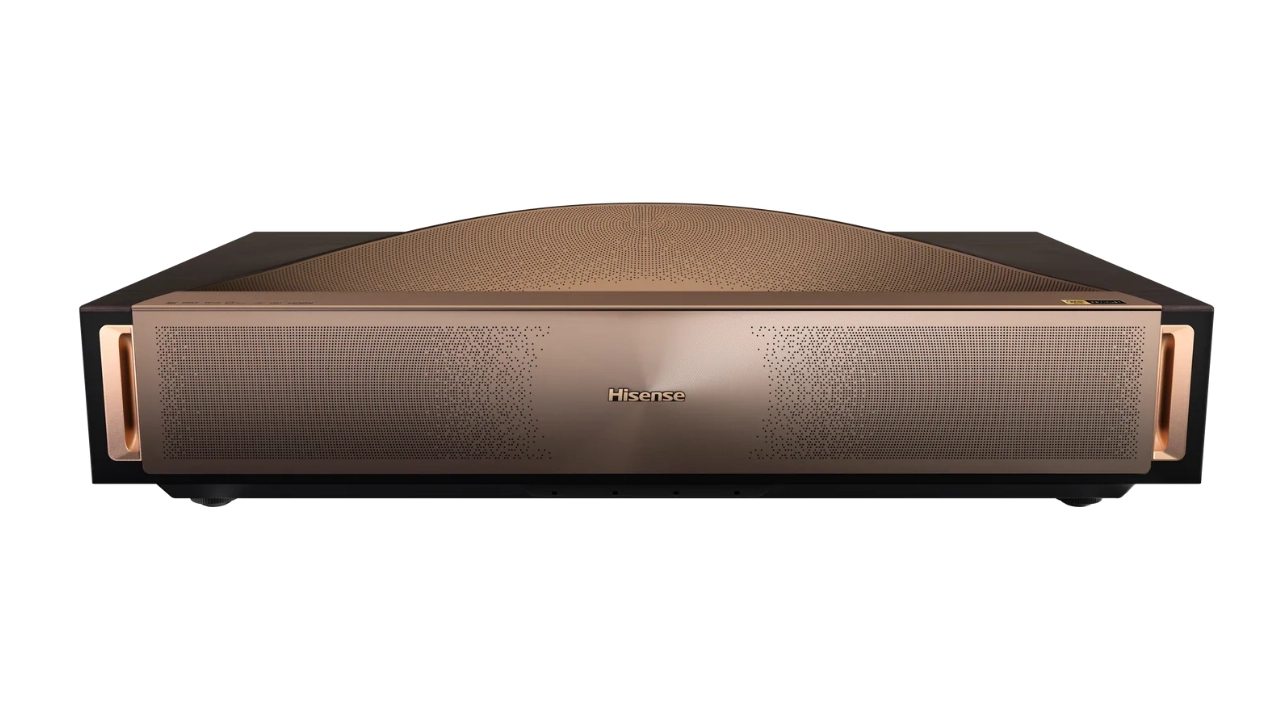
Hisense has completely redesigned the L9Q chassis, featuring an elegant champagne color with maple wood accents, giving the projector a luxury look and feel. This new design and color help the projector blend into almost any space and doubles as an elegant art piece when turned off.
The L9Q offers 5,000 lumens of brightness, about 66% more than last year's Hisense flagship, producing a clear, vivid projected image even in well-lit rooms. The projector is spec'd with a 5,000:1 native contrast ratio to deliver better-than-average blacks and bright whites, with excellent detail and outstanding color reproduction.
Hisense has created a new professional AI processor that can refine the picture's brightness and contrast in real time, while eliminating visual noise to ensure every scene is noise-free and as realistic as the creator intended. The state-of-the-art RGB laser light source covers 110% of the BT.2020 color space, offering the largest color palette available in the industry today. The L9Q has even been validated by Pantone, ensuring Pantone SkinTone colors appear natural and accurate.
The L9Q continues the company's practice of supporting all HDR formats, including Dolby Vision, HDR10+, HDR10, and HLG. The L9Q is factory-certified as an IMAX Enhanced device and continues to support 3-D video.
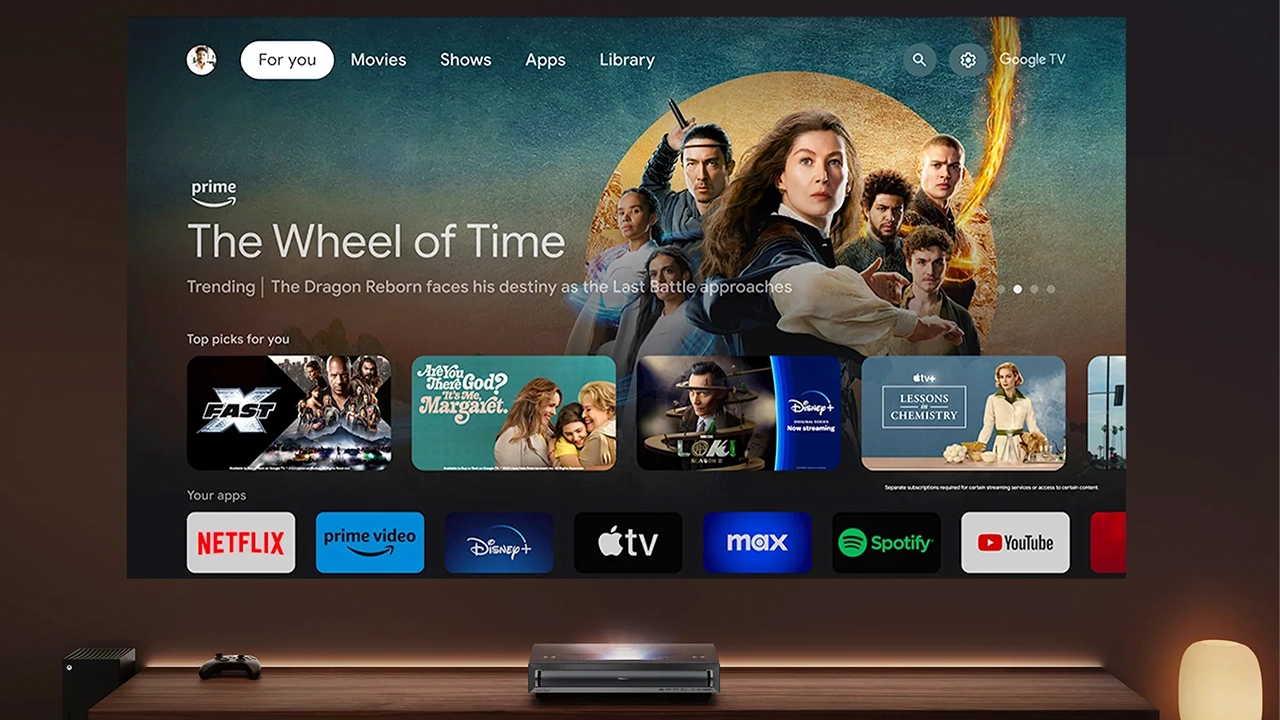
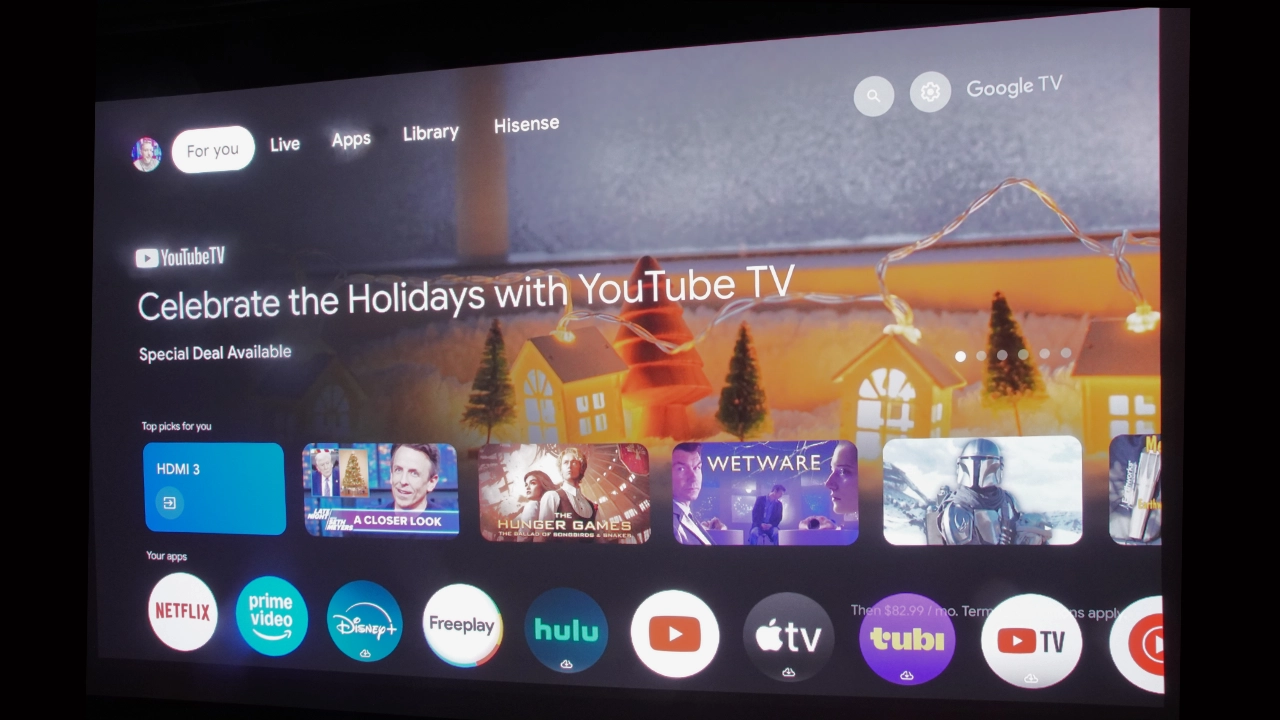
The Hisense L9Q is a smart projector featuring a fully integrated Google TV interface that provides seamless access to the largest selection of streaming services on any smart media device, including popular apps like Netflix, Hulu, Amazon Prime Video, and Disney+.
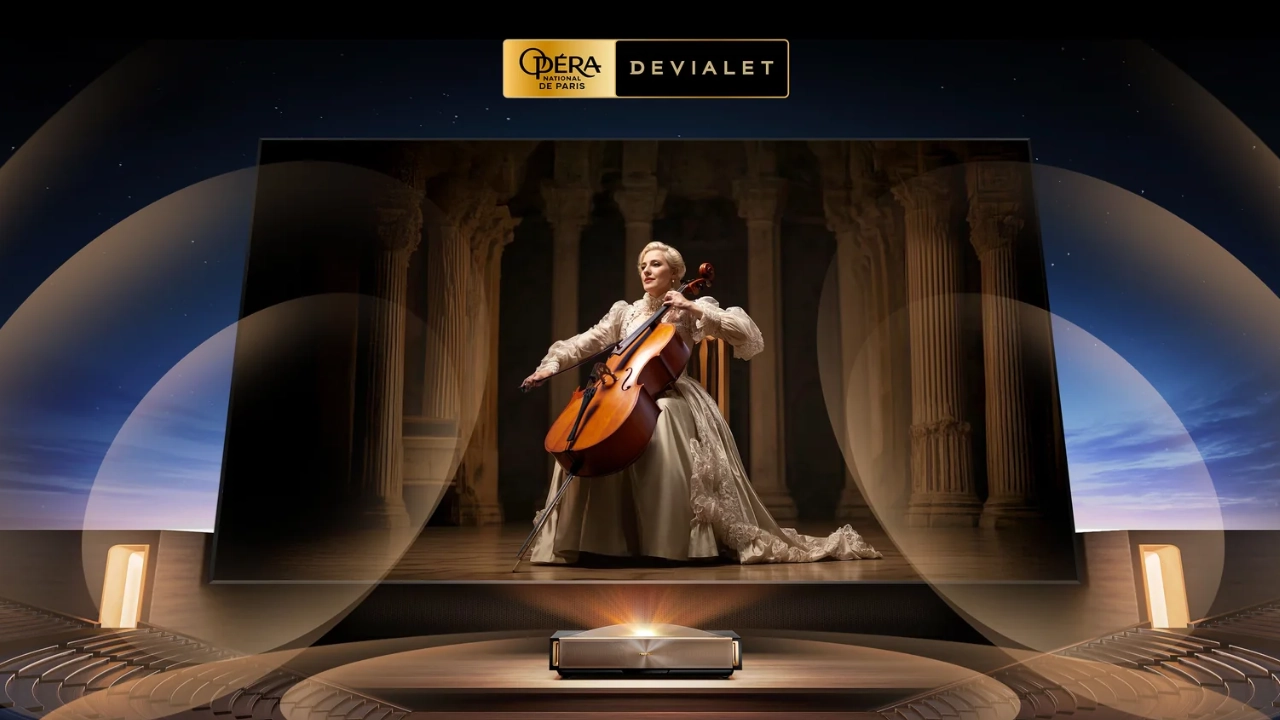
The L9Q features a theater-inspired 6.2.2 sound system from Devialet, delivering deep bass, crisp highs, and immersive clarity. Professional sound calibration by the Opéra de Paris fine-tunes the audio for rich detail and depth, bringing cinematic-quality sound to your living room. The L9Q delivers deep bass from two desiccated subwoofers and up-firing speakers for a stunning 3D soundstage, letting you hear every detail, from footsteps behind you to rain overhead.
Hisense L9Q
Suggested Retail Price: $5999
Ratings Based On Comparable Models
Brightness
Color Reproduction
Contrast
Sound Quality
Pros
+ 5000 Lumens of Brightness + TriChroma laser offers great color + Low input lag for gaming + 116 Watt Dolby Audio offers big sound + Supports Dolby Vision, and HDR10+ + IMAX Enhanced and Pantone Certified + CMS offers extensive picture adjustments
Cons
- Brightness and Color Shift using Scenario Enhancement Setting - Some Rainbow Effect - Blacks are DLP gray - Two different menu systems
If you are interested in purchasing the projector mentioned in this article, we always appreciate it if you use one of the links in the article because Projector Reviews earns a small commission on the sale at no cost to you.
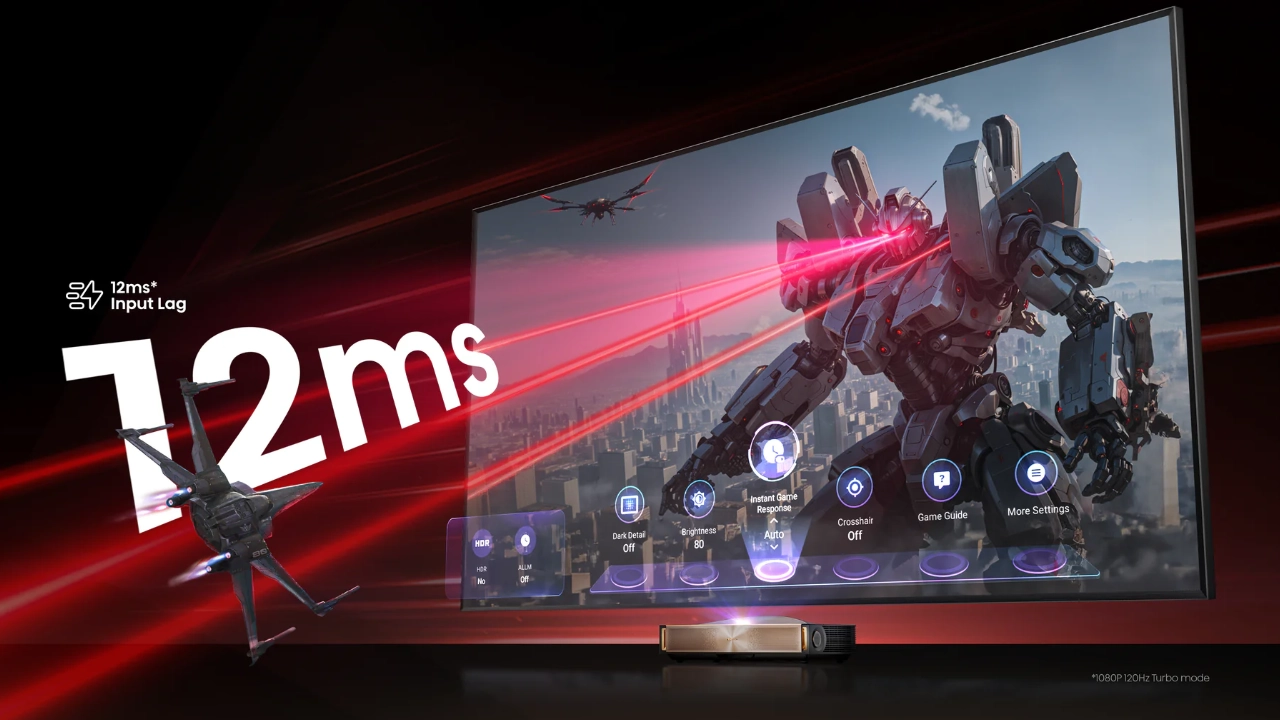
The L9Q helps you take your gaming to the next level. Enjoy fast-paced gaming with ultra-smooth motion and minimal motion blur. The Auto Low Latency Mode automatically detects and switches to a low-latency setting for responsive gameplay. The Hisense L9Q raises the performance bar by offering next-level picture and sound quality. Hisense has also taken the projector's visual design to the next level, creating a unit that looks as good as it performs.
When it comes to the projector's impressive list of features and performance, NexiGo has gone all in, providing its customers with an ultra-short-throw display that is both a high-end home theater projector and a fast gaming projector, competing with many dedicated gaming projectors. Nexigo has thrown in just about every feature, except the kitchen sink.
OVERVIEW
Hisense is the world's leading provider of Laser TVs. 2025 marks the sixth consecutive year the company has led the industry as the world's largest provider of Laser TV, according to Omdia Market Research Institute, achieving a staggering 65.8% global market share. Hisense not only produces some of the best ultra-short throw projectors available today but also continues to grow its OEM business, supplying components and producing projectors in partnership with multiple projection brands.
The Hisense L9Q is the company's eighth-generation UST projector and its 2025 flagship ultra-short throw projector. The L9Q is the first L9-series UST in the company's Laser Cinema series. Laser Cinema and Laser TV projectors are similar, with the key difference being that Cinema series projectors don’t include a matching projection screen. Laser Cinema projectors can digitally adjust focus for any 16x9 screen up to 200 inches diagonally.
The 2025 L9 Series continues to raise the bar for Laser TV, featuring Hisense’s proprietary TriChrom RGB laser light engine
At the heart of the Hisense L9Q is an incredibly powerful laser light engine that the company has newly trademarked as an LPU Digital Laser Engine. The LPU houses all the technology, from the Trichroma RGB laser light source to the new high-quality ultra-short throw lens to everything in the light path. The Hisense L9Q's Trichroma RGB laser light source has been significantly boosted, providing several improvements over previous models. First, Hisense has increased the projector's brightness to a manufacturer's rated 5,000 lumens, a 66% increase over the previous model, the Hisense PX3-PRO. (Click on the link to read my full review.) With all this extra brightness, the L9Q can be used in rooms with moderate ambient light without significant loss of color quality. This projector is designed for both dark-room and lights-on viewing. Add an ALR (Ambient Light Rejecting) screen, and you can overcome many uncontrolled light sources found in well-lit rooms.
The L9Q is the second series of Hisense ultra-short throw projectors to use the company's LPU Technology, featuring a TriChroma laser light source that offers one of the widest color gamuts on the market today. The L9Q Trichroma laser can display a very wide and accurate color gamut, even compared to last year's flagship, the Hisense PX3-PRO. According to Hisense, the L9Q can reproduce up to 110% of the BT.2020 color space, resulting in realistic skin tones, natural landscapes, and an immersive cinematic experience. This projector's color gamut rating includes a “Validated by Pantone and Pantone SkinTone” certification, ensuring you see every detail as the content creators intended. Basically, these are the richest and most realistic colors Hisense has ever produced.
The L9Q's new Trichroma laser light source offers a much longer lifespan than traditional lamps and previous Hisense projectors, with a guaranteed 25,000+ hours of light-source life at full light output. This ensures consistent image quality over the projector's life with no noticeable brightness or color degradation.
Hisense has improved the projector's contrast, offering a native 5000:1 contrast ratio for surprising black-level performance and dark-area detail, especially given the projector's massive boost in brightness.
Without giving away too much, I will say my initial out-of-the-box experience with the L9Q’s color quality blew me away, surpassing my experience with last year's amazing PX3-PRO. Hisense has raised the bar for color and brightness on this projector. In fact, the L9Q won first place in “Dedicated Theater,” “Mix Room,” and “Overall Picture Quality” in the recent “2025 Ultra Short-Throw Projection Throwdown.”
The Hisense L9Q utilizes a Texas Instruments Digital Light Processor (DLP) (0.47″ DMD) chip to deliver 4K UHD (3,840 x 2,160) resolution. The 0.47″ DLP chip is sealed to keep dust and dirt away from sensitive components and uses Texas Instruments XPR technology to shift the light from each mirror four times (4x), displaying four distinct pixels on the screen.
Hisense continues to push the processing envelope by offering a new AI-powered image enhancement that adjusts contrast, color, and brightness in real time, using advanced algorithms to upscale resolution, reduce noise, and optimize HDR. The new Hisense 4K Al Upscaler ensures that everything from old classics to modern streaming content looks as good as possible on screen.
Speaking of HDR, the L9Q continues the Hisense trend of supporting all major HDR formats, including HDR10 and HLG. It offers full support for dynamic metadata and high-dynamic-range formats, including HDR10+ and Dolby Vision. By supporting both technologies, Hisense is investing to ensure you can achieve the best possible performance with any content exclusively encoded in Dolby Vision or HDR10+, without needing to downscale to standard HDR10. On top of a “Kitchen Sink” approach to high-dynamic-range format support, which we love here at Projector Reviews, the L9Q is also fully “Certified by IMAX” as capable of bringing the IMAX cinema experience to your home theater. IMAX support on the L9Q allows you to watch IMAX content in an expanded aspect ratio, giving you up to 26% more picture without black bars. There’s quite a bit of IMAX-enhanced content available to stream, including almost all the Marvel Cinematic Universe films on Disney+ and many Sony Pictures films.
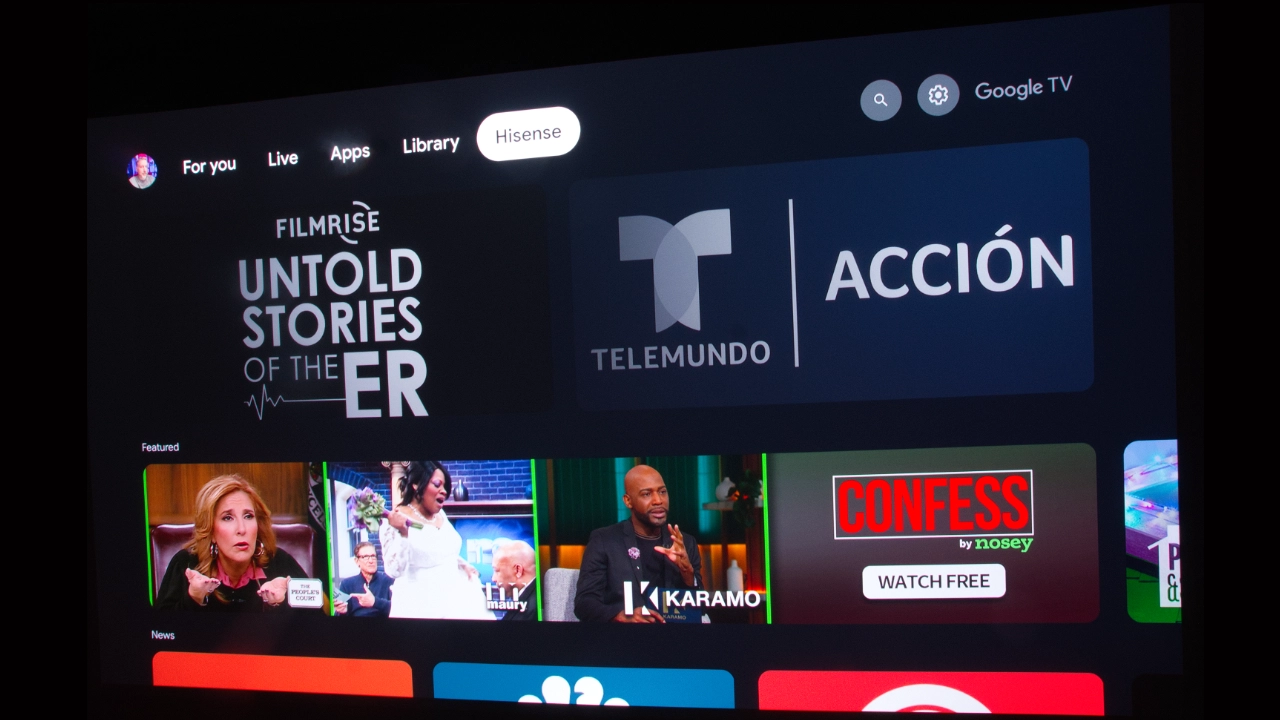
The L9Q projector is powered by the latest Google TV OS, making it a smart device that gives you access to thousands of popular Android applications and a wide range of streaming platforms, including Netflix, Amazon Prime Video, Disney+, YouTube, and more.
Google TV organizes movies, shows, and more from your subscriptions, so you no longer need to jump from app to app to find what you want to watch. It provides curated recommendations and uses Google's powerful search to find shows across 10,000+ apps or to browse hundreds of free channels.
The Google TV OS also provides access to the Google Assistant, allowing you to use voice control for many features and verbally navigate many of the projector's menus. The L9Q can also control a wide range of compatible smart home devices using your voice via Google Assistant.
The L9Q comes with auto setup features such as SCREEN ALIGNMENT and KEYSTONE CORRECTION to automatically fit the image to your screen perfectly, even for screen sizes up to 120 inches.
Over the past several years, high-performance gaming on home theater projectors has shifted from a niche priority to a rapidly growing one for potential projector buyers. According to a 2024 GIS (Global Insight Services) report, the gaming projector market is projected to grow from $1.79 billion in 2024 to $4.83 billion in 10 years, which is impressive. North America is the biggest market for fast gaming projectors, primarily due to the USA’s strong gaming industry and tech-savvy population. The European market follows, then the Asia-Pacific region.
Hisense is working to meet the needs of this growing segment of customers by focusing on three key areas: enhancing connectivity with high-speed, low-latency performance; delivering smooth motion; and supporting compatibility with the ever-increasing number of high-performance wireless gaming devices.
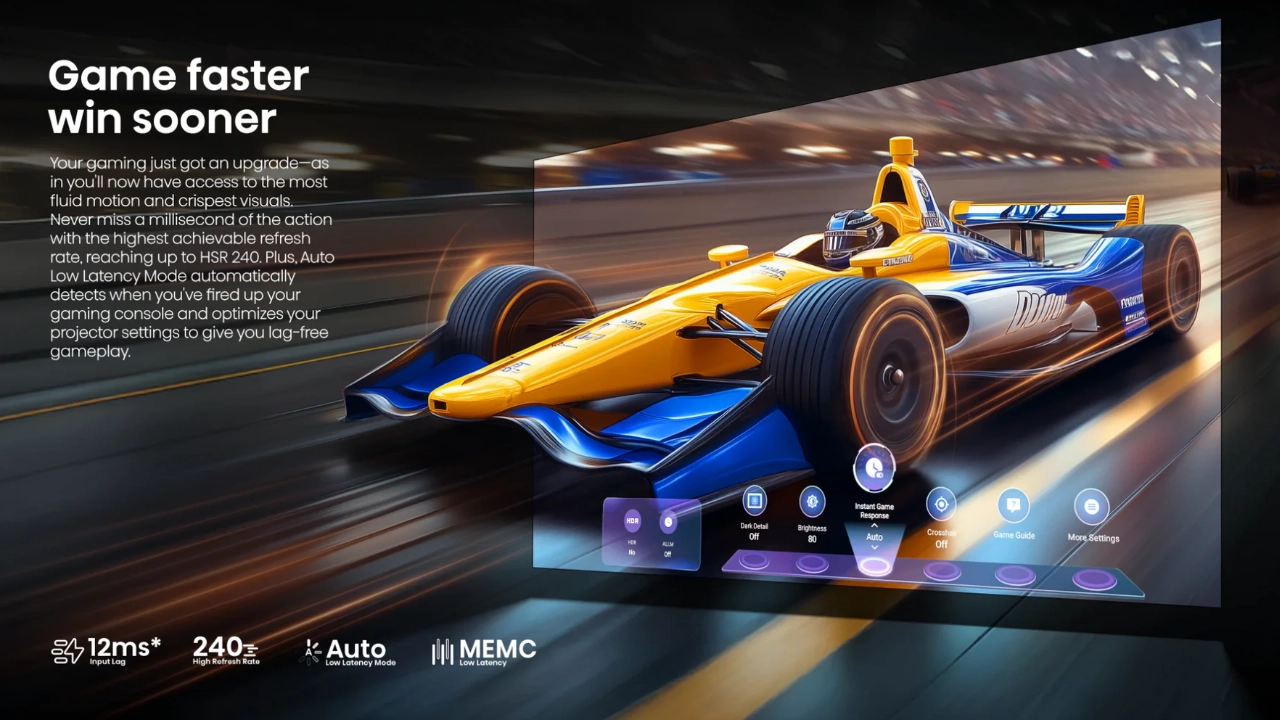
Hisense is making it easier than ever to level up your gaming skills with features like its ultra-responsive performance. GAME mode reduces input lag to 12ms at 2K/120Hz. At the same time, Turbo Mode keeps fast action smooth by reducing motion blur. The Game Bar puts all your key settings right at your fingertips. Enjoy fast-paced gaming with ultra-smooth motion and minimal motion blur. The Auto Low Latency Mode automatically detects and switches to a low-latency setting for responsive gameplay.
Hisense Ultra Short Projector Model Comparison
Model
L9Q
PT1
PX3-PRO
Price (MSRP)
$5999
$2999
$3499
Brightness
5000 lumens
2500 lumens
3000 lumens
Laser Type
TriChroma RGB
TriChroma RGB
TriChroma RGB
Dynamic Contrast
Yes
Yes
Yes
Contrast
5000:1 (Native)
3000:1 (Native)
3000:1 (Native)
Throw Ratio
0.18:1
0.2:1
0.22:1
Low Input Lag
12 ms
12 ms
12 ms
Sound System
116 Watt Devialet 6.2.2 Speaker
46 Watt Dolby Atmos (Stereo)
60 Watt Harmon Kardon (Stereo)
HARDWARE
CHASSIS
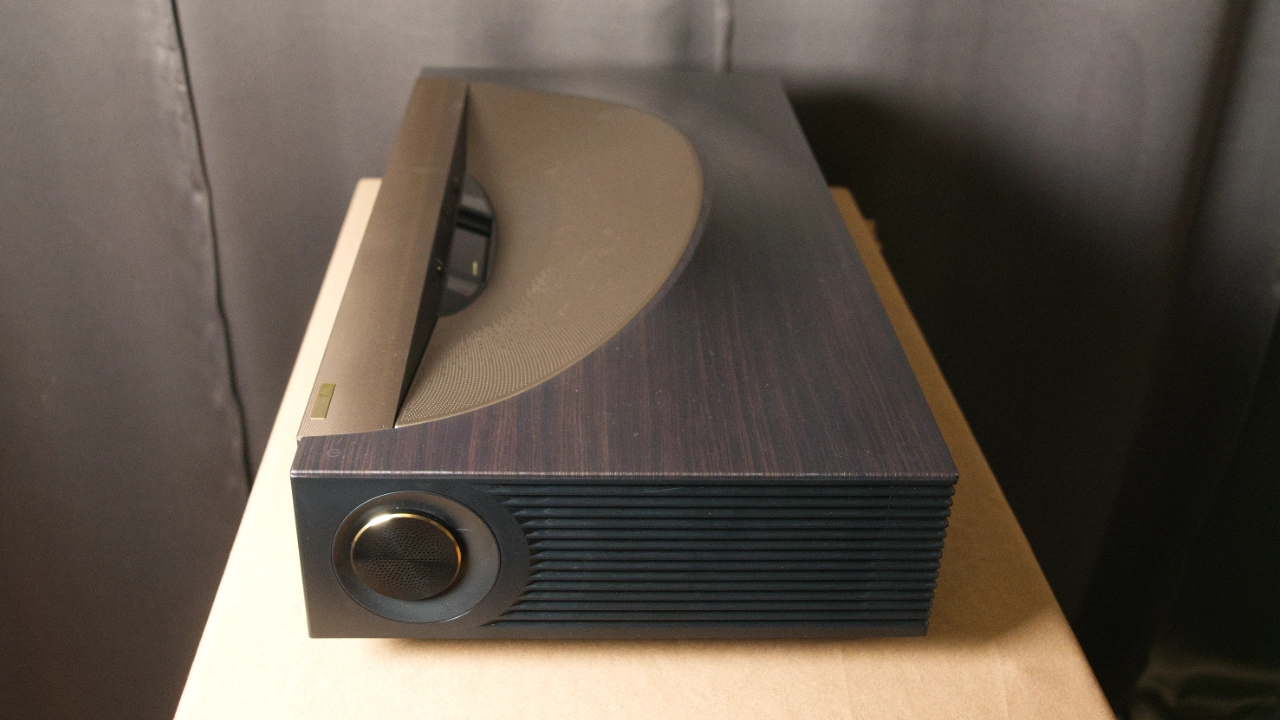
The L9Q features an all-new chassis design that is wider and heavier compared to previous models. This is likely due to the sound system's increased performance and number of built-in speakers. It features a modern champagne finish and maple wood accents that stand out from previous Hisense models and many competitors. The L9Q measures 24.6” x 12.5” x 6.5” (624.84 mm x 317.50 mm x 165.10 mm) and weighs 28.4 lb (12.88 kg). The projector chassis is an all-new design with a metal-and-molded-plastic color scheme, modeled to resemble wood.
The L9Q uses the same two large status headlight bars on the right and left sides of the front panel. These lights remain lit even when the option to power the projector off fully is selected. To shut them off, go to (ENU/SETTINGS/SYSTEM/ POWER&ENERGY/POWER), and you'll find a switch to turn off the LED indicator lights.
The projector's only control button is Power On/Off, located on the right-side panel near the front of the projector. The remote controls everything else.
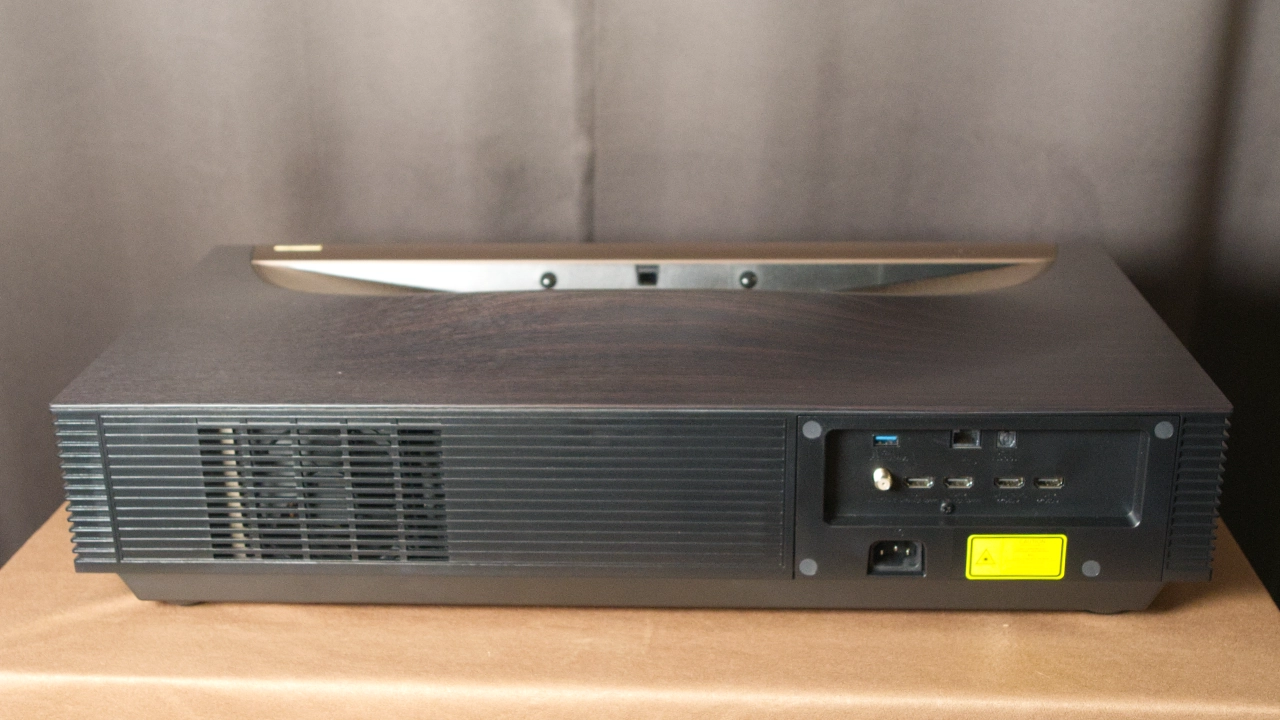
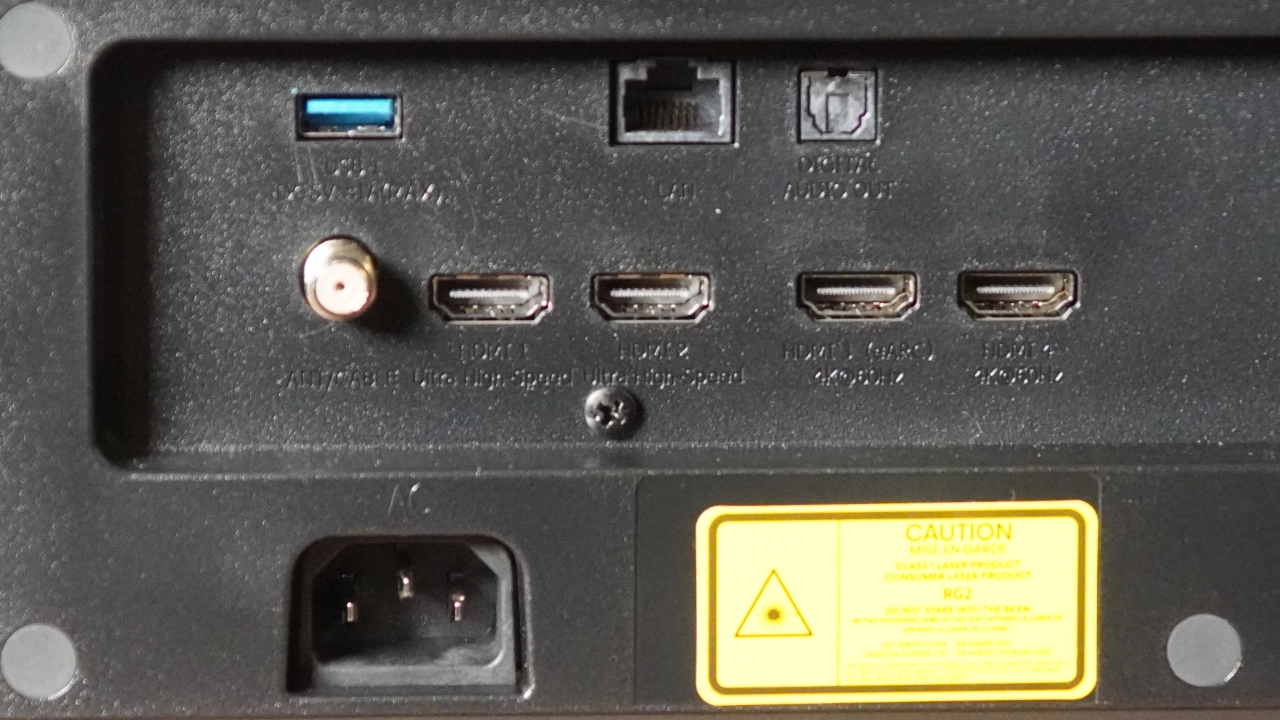
All inputs and connections are on the projector's back panel, except for a single USB located on the projector's right side at the bottom.
The L9Q features four HDMI ports on the rear of the projector, all supporting HDMI 2.1. HDMI inputs 1 and 2 support ULTRA HIGH-SPEED devices, and HDMI input 3 supports Enhanced Audio Return (eARC) functionality. HDMI inputs 3 and 4 support HDMI 2.0. This projector's DLP chip supports only up to 4K@60Hz video playback, but HDMI inputs still offer a few notable benefits, including ALLM and eARC.
Auto Low Latency Mode (ALLM) automatically switches the L9Q to a low-latency, low-lag game mode when game content is detected. The L9Q can also control connected devices, such as an A/V receiver, via HDMI Consumer Electronics Control (CEC). Other available inputs include a USB 3.0 Type-A and a USB 2.0 Type-A input on the side. The projector also has a LAN port, an optical digital output, and L/R analog audio outputs.
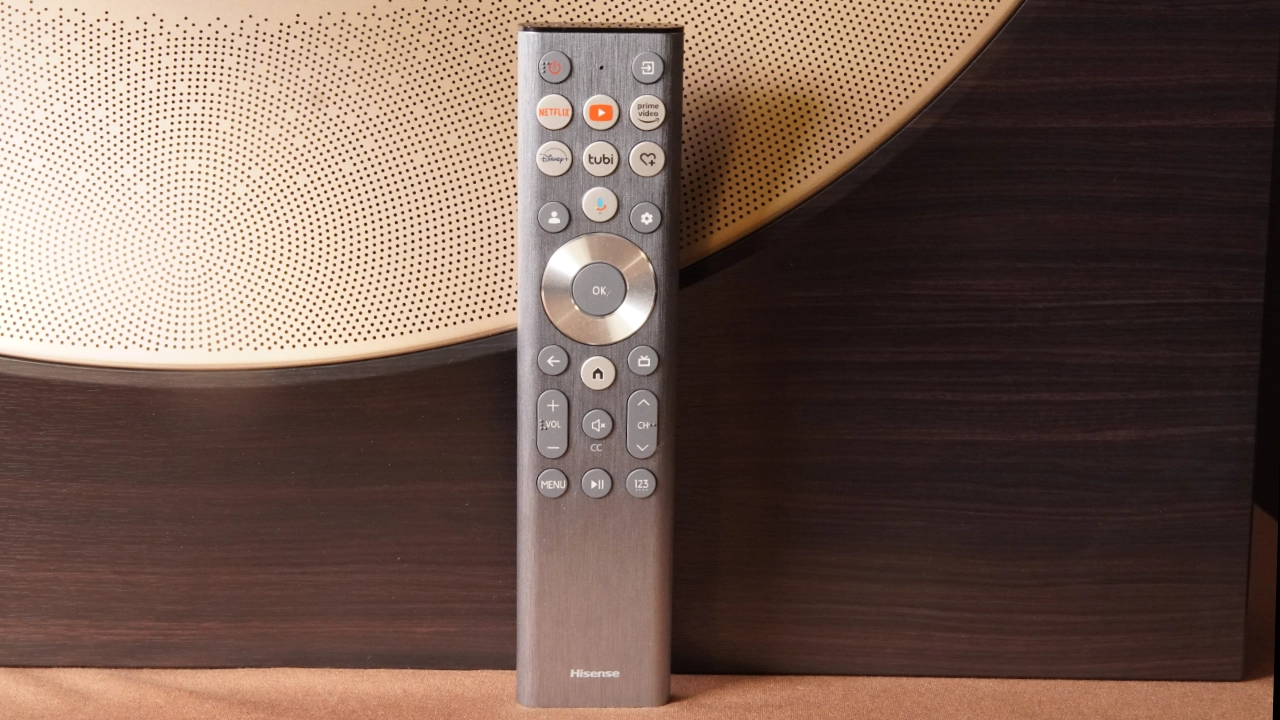
The included remote has a brushed-metal look. The built-in media player's power, dedicated service buttons, and major streaming services, including Netflix, Prime Video, YouTube, Disney+, and Tubi, are all on the remote, along with a sixth assignable button. Bluetooth pairing ensures the projector can be controlled even when the remote is not in direct sight. The remote control includes an Infrared (IR) capability to control the projector or a third-party cable/satellite box. For custom integration, the L9Q can also be controlled via RS-232.
Located at the top center of the remote, above the standard D-Ring, is a dedicated Google Assistant button for voice control of a wide range of smart features, including—but not limited to—voice search, compatible projector switching, hardware controls, and many Internet of Things devices.
This remote shares the same dim backlight issue as previous models, and the light does not stay on long enough. Another drawback is that the six streaming-service shortcut buttons at the top of the remote lack backlighting.
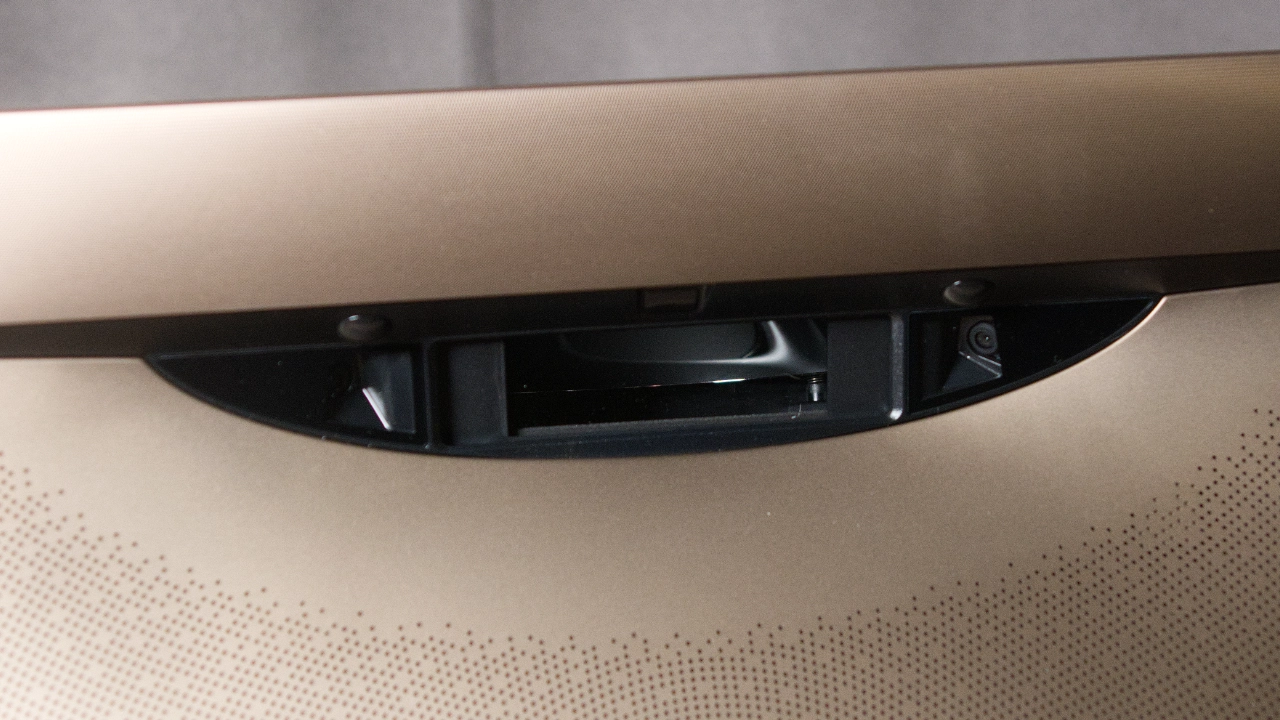
UST lens systems are highly specialized, designed to project images at steep, extreme angles while positioned mere inches from the screen. The L9Q maintains brightness uniformity across the projected image, with minimal softening of focus at the extreme corners.
The L9Q features Hisense's Digital Lens Focusing (DLF). However, there is some softening of the focus, especially at the image edges. The DLF system is about the same speed as the PX3-PRO, based on my experience. My only minor complaint is that at the extreme DLF adjustment range, there is noticeable distortion at the top of the image. An easy fix for this is to back off the furthest focus range. To reach the extremes of the projector's DLF adjustment range, ensure the screen is flat against the wall.
The L9Q continues to offer the useful Hisense Auto Geometric Correction feature with a manual option. The tool uses a mobile phone to monitor image squaring progress. Simply take a photo and send it to Hisense. They'll use this data to automatically configure the projector's screen geometry for optimal image alignment.
While these auto-geometry tools offer quick, convenient setups, they come with a trade-off. They should only be used as a last resort. I strongly recommend manually aligning the projector to the screen, because while convenient, keystone correction (manual or auto) reduces overall image quality.
The new Google TV OS on the L9Q delivers a first-class streaming experience, and Hisense steps up on this model by giving users access to Netflix and other premium streaming services, including Disney+, Max, Hulu, and more. Google TV also lets users watch live TV and access on-demand content based on their subscriptions. Google TV gives users access to all the streaming, entertainment, and gaming content available on previous Android TV models while adding new control features, letting users make the projector a control hub for other connected devices in the home.
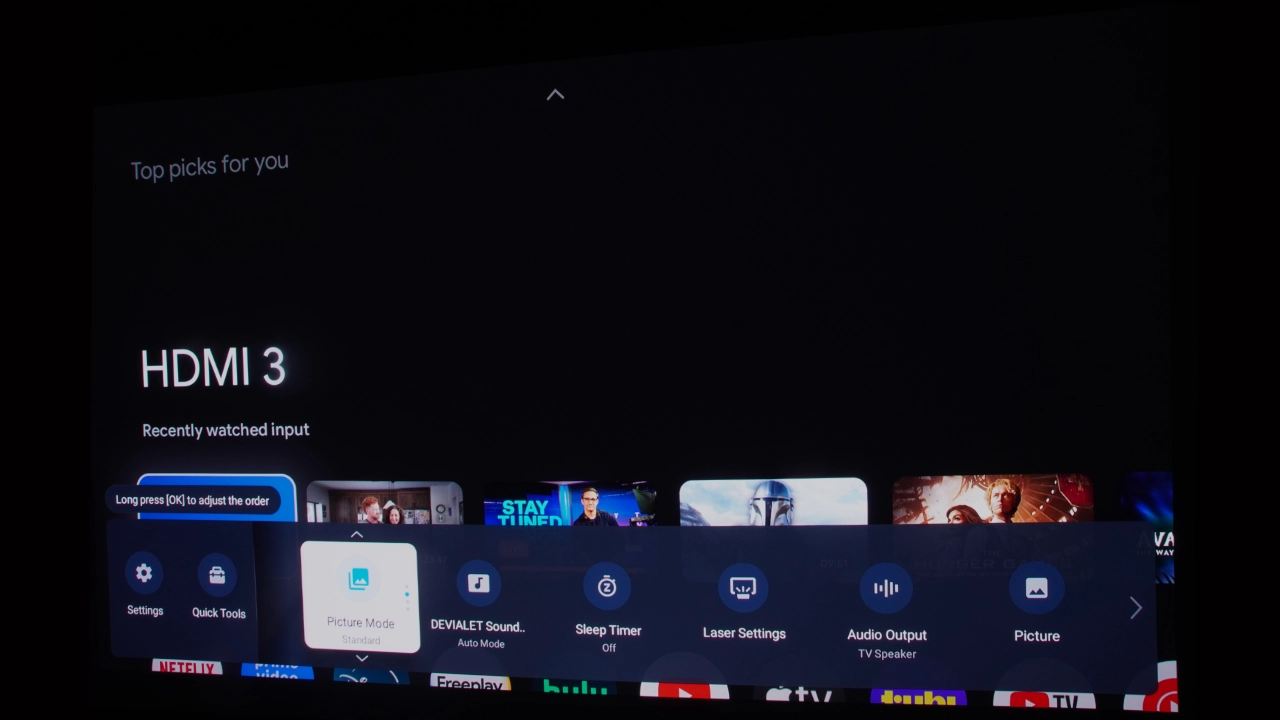
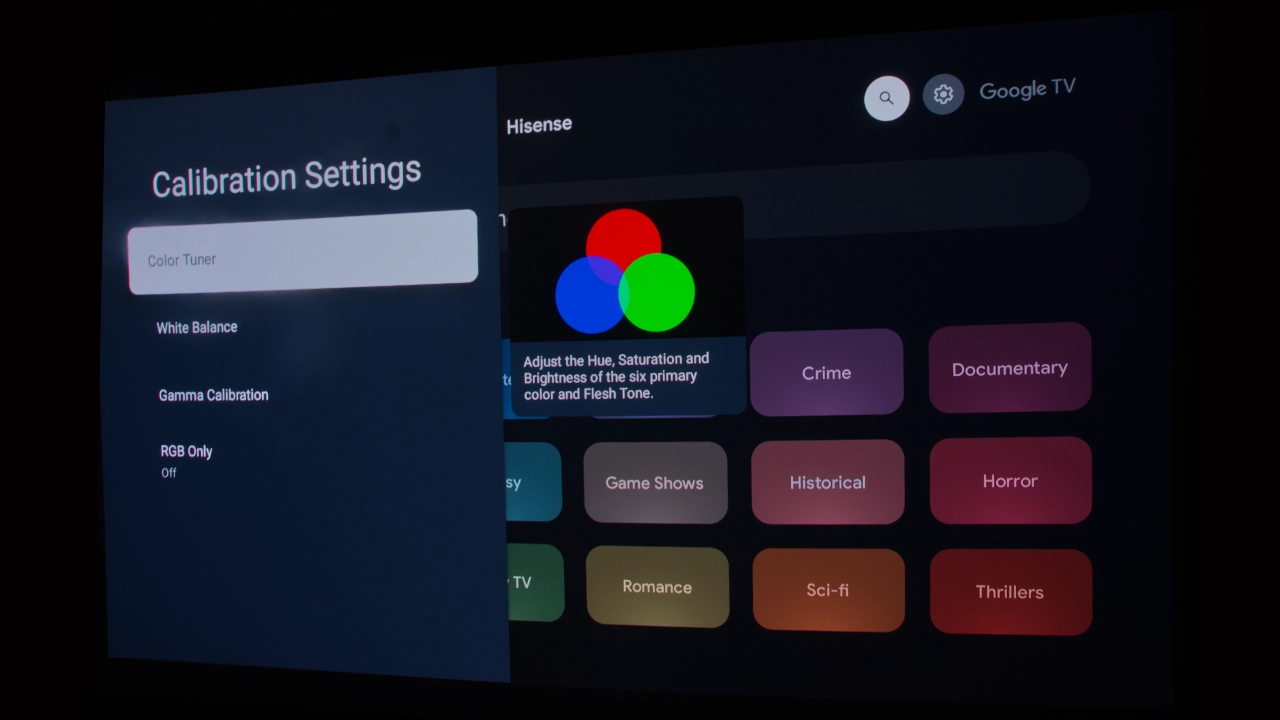
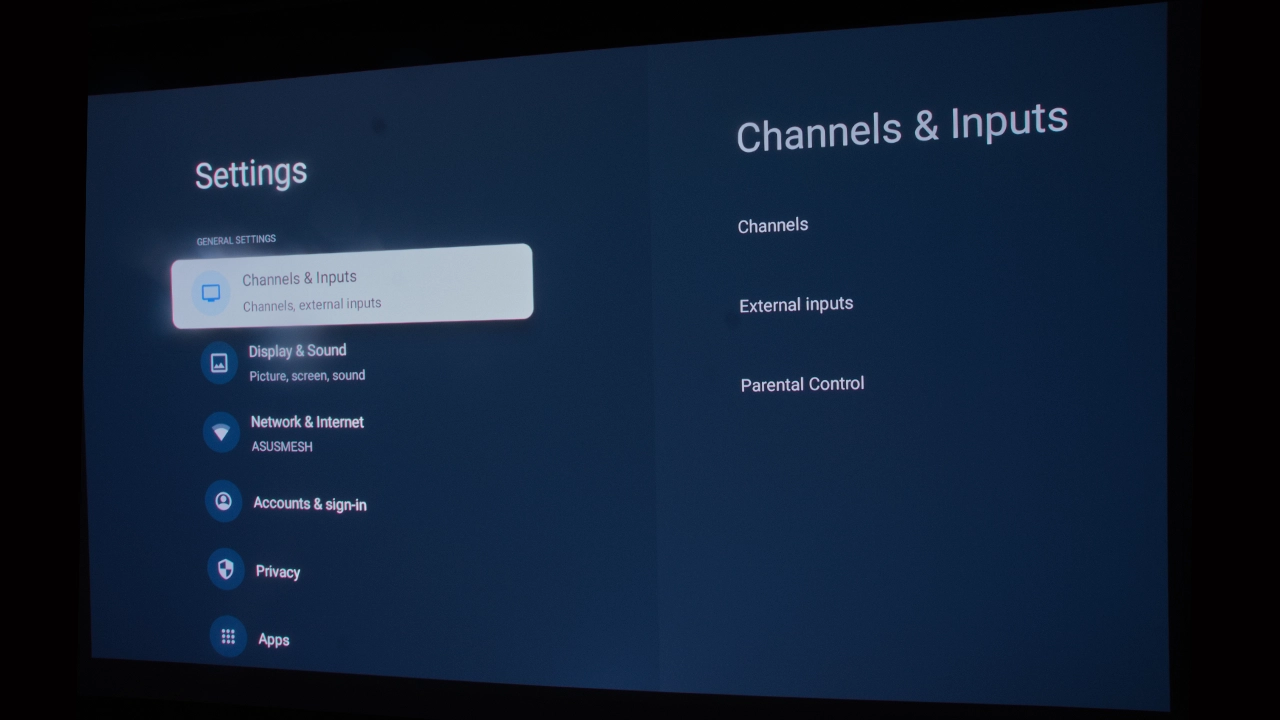
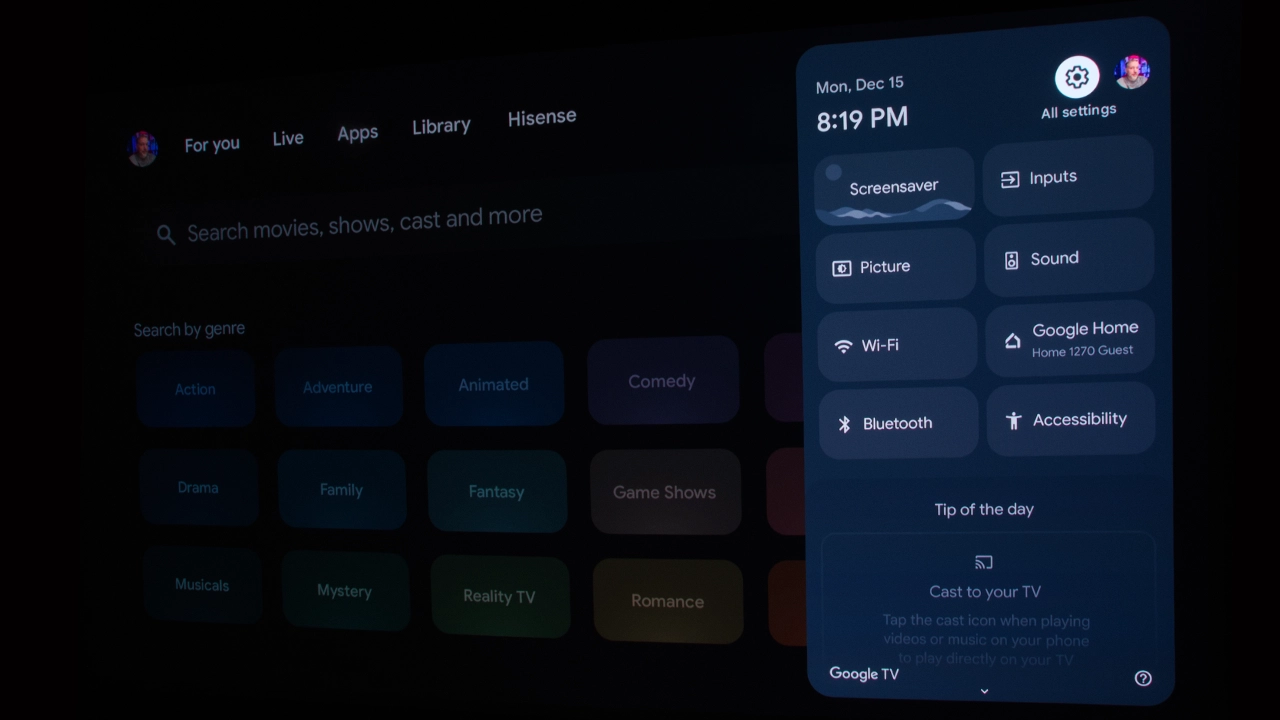
Hisense has added a new quick-access menu system that is activated by pressing the Menu button on the bottom left of the remote control. This new menu replaces several direct shortcut buttons previously found on some Hisense remote controls and significantly expands the number of menu adjustments with quick access. Users can access the projector's full settings by scrolling left to right in this menu. Hisense also allows users to edit the items on this quick-access ribbon.
PERFORMANCE
The screen used for testing in this review is a Da-Lite 110-inch, 16:9 aspect ratio Tensioned Designer Contour Electrol screen system, with the company's ultra-white HD Progressive 1.1 screen surface, designed for high-resolution video up to 16K. This high-quality screen is designed to work with most projector form factors, including the ultra-short throw Nexigo Aurora Pro MKII.
The Tensioned Designer Contour Electrol screen system is ideal for environments where a traditional behind-the-wall installation is difficult. It offers all the benefits of an electric screen but with the flexibility of wire-free installation. The screen has a built-in rechargeable lithium-ion battery-powered motor that Da-Lite calls Agility.
COLOR REPRODUCTION
The L9Q's out-of-the-box (OOTB) color is excellent. I am a huge fan of this unit's predecessor, the PX3-PRO, for its out-of-the-box (OoTB) color performance, so I’m not exaggerating when I say the L9Q is even better. The L9Q has almost eliminated color fringing, and even at two feet from a 100-inch image, the fringing was minimal enough that I only noticed it at the most extreme edges of the picture. Hisense has also done a fantastic job of eliminating laser speckle, even though this system uses a pure RGB laser light source with no LED enhancements. Not everything was perfect. I saw some DLP rainbow artifacts. To be clear, I am among the small percentage of people who can see this type of effect, especially on high-contrast content.
Last year, I reviewed the PX3-PRO and the L9H. The L9Q gets an OoTB color performance boost from these already excellent models. The L9Q features the SDR preset picture modes: VIVID, STANDARD, SPORTS, PC GAME, ENERGY SAVING, THEATER, and FILMMAKER. For HDR10 content, you keep all the SDR modes and add IMAX ENHANCED. HDR10+ content gets four modes: VIVID, GAME, STANDARD, and THEATER, and Dolby Vision content features BRIGHT, DARK, and CUSTOM.
The L9Q color was excellent when watching content using the projector's cinema-focused modes, including FILMMAKER mode. These are SDR modes, and the L9Q reproduces the Rec. 709 color gamut amazingly well. Most customers will be extremely happy with the projector's out-of-the-box color performance without professional calibration.
When it comes to improving out-of-the-box color performance, the L9Q projector is well served by its increased brightness, making it remarkably easy to dial in it overall color accuracy by just making a few quick adjustments. This was made possible only because of the time and effort Hisense engineers put into the projector’s factory color calibration. Although the factory presets are excellent, the L9Q can be improved with minimal calibration. The Hisense L9Q color performance is impressive. Topping the previous best we'd seen, which was the Hisense PX3-PRO last year.
The L9Q offers several AUTO picture adjustments. Most work well enough, but one in particular is not ready for primetime. The SCENARIO ENHANCEMENT mode introduced both brightness and color artifacts by adjusting the projector's settings in response to changes in scene brightness. The result was a visible shift in overall color temperature and brightness, sometimes within a scene but most often as scenes changed. At first, setting the mode to LOW fixed the issue, but as I continued testing, the projector would periodically display issues, so I turned it off in the menu. My editor tells me that Hisense is working on a fix, but as of this review, I have not received an update.
We calibrated this L9Q to get the best results, and I am including our numbers. For our testing, we use Portrait Displays Calman color calibration software to measure the projector's color accuracy. We don't share our detailed settings because your room and screen material are likely different from mine, which will significantly impact the overall picture. Projector Reviews does not recommend using someone else's calibration adjustments because the color profile of the unit you buy will likely differ from ours. Copying our results could negatively affect your unit's picture quality in your space.
Suppose you don't plan to have your projector professionally calibrated but still want to improve the picture by adjusting BRIGHTNESS, CONTRAST, and SHARPNESS. In that case, I've included links to multiple online tools that can help.
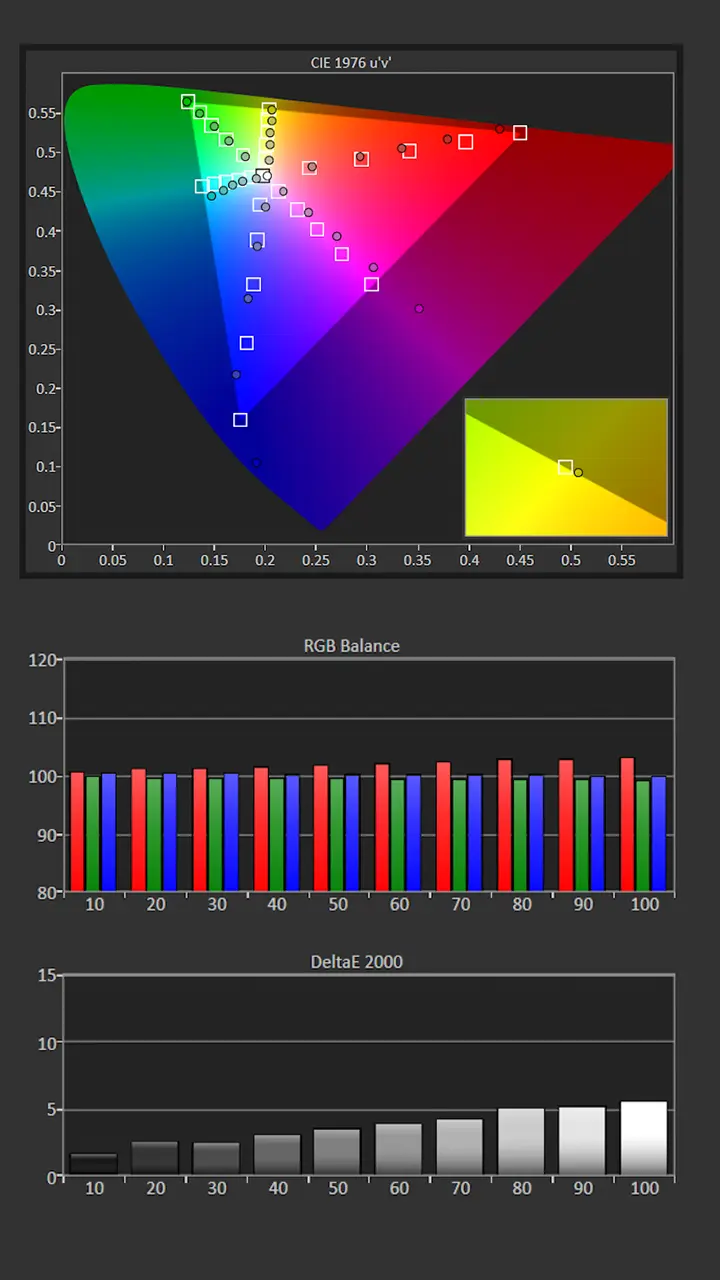
We choose to measure and adjust the THEATER mode since it was the most accurate out of the box. The RGB balance was pretty good out of the box. Pre-calibration, the color temperature was 6480K, which is close to my target of 6500K. The image was a little warmer than desired due to excessive red at higher IREs.
The gamma was around 2.24, which is very close to my normal target of 2.2. The projector black level are good enough to target a gamma of 2.4 but I feel that 2.2 looks better in most rooms.
The CMS measurements showed that brighter red and blue colors were oversaturated with some minor color shift. Before calibration, on my hundred-inch screen, the peak brightness produced 314 nits, which is more than bright enough to deliver a vibrant image, even under low to moderate ambient light.
Picture Mode: THEATER
Gamma: 2.22
Color Temperature: 6480kK
Average Grayscale dE: 4.1
Average Color Tracking dE: 3.1
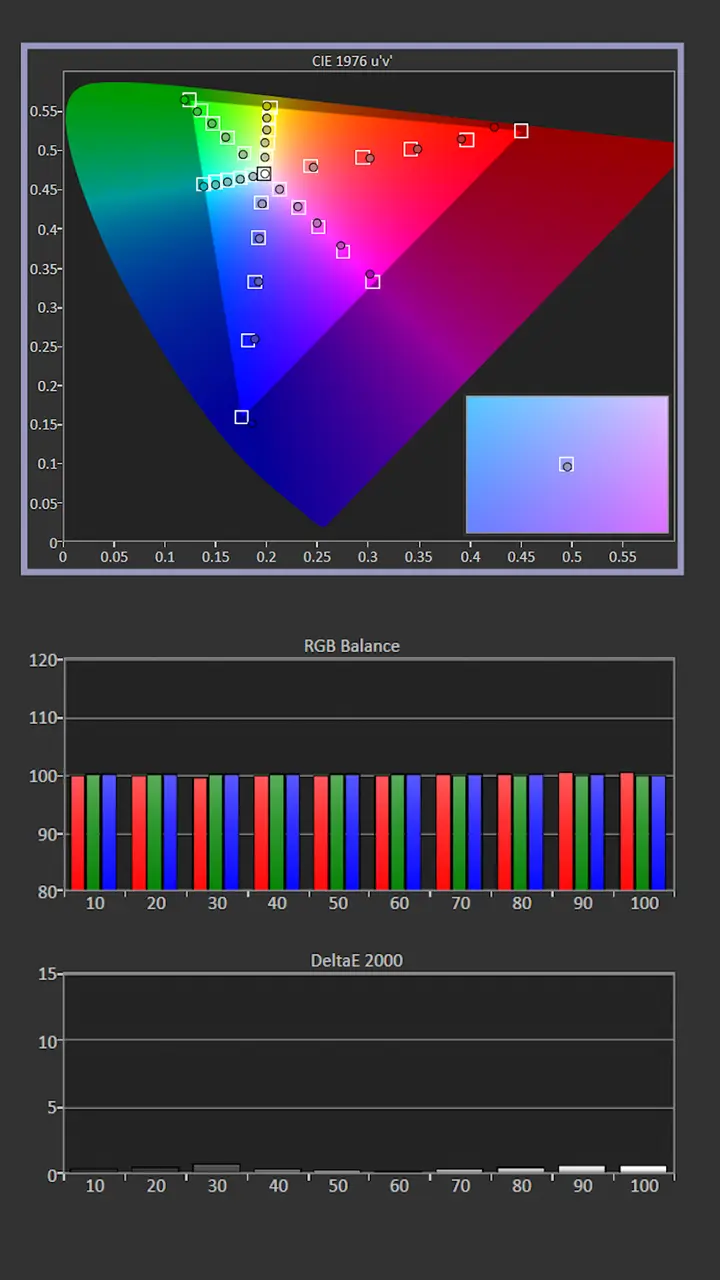
Post-Calibration Color Tracking and Grayscale
Since the measured Gamma was close to my target of 2.2, I made minor adjustments to the Contrast settings. I left the Color Temp setting at its default of Warm 1, which is fine since the color temperature was already close to my target of 6500K.
Measurements showed an excessive red bias, which resulted in an overly warm-looking image, but this was easily corrected using the Two Point White Balance adjustments. Once I reduced the Red Gain and Blue Gain settings, the color temperature was even closer to my target of 6500K.
Correcting the projector's white balance also significantly improved the unit's color tracking. We use CMS adjustments to reduce oversaturation and most color shift errors. When viewing SDR, bright reds were still slightly undersaturated, but most color points were spot on. Measured brightness after color calibration was 310 nits. When viewing SDR in a dark space, to reduce eye fatigue from excessive brightness, lower the Contrast setting and Laser Luminance Level.
Picture Mode: THEATER
Gamma: 2.2
Color Temperature: 6502K
Average Grayscale dE: 0.5
Average Color Tracking dE: 1.2
The projector’s grayscale and color reproduction are good enough out of the box to satisfy the average Laser TV customer. However, many home entertainment enthusiasts desire the best possible picture quality, so it is great that the Hisense L9Q includes a full suite of picture adjustments.
HDR Color Tracking and Grayscale
The L9Q offers seven preset HDR picture modes for standard HDR10 content, allowing you to fine-tune the on-screen brightness to match the filmmaker’s intent. For Dolby Vision, you get three presets: BRIGHT, DARK, and CUSTOM.
The out-of-the-box HDR color reproduction was also very good. The most accurate picture mode was HDR THEATER. Each SDR and HDR has its picture adjustments, including Contrast, Saturation, Brightness, Color Temp, and White Balance.
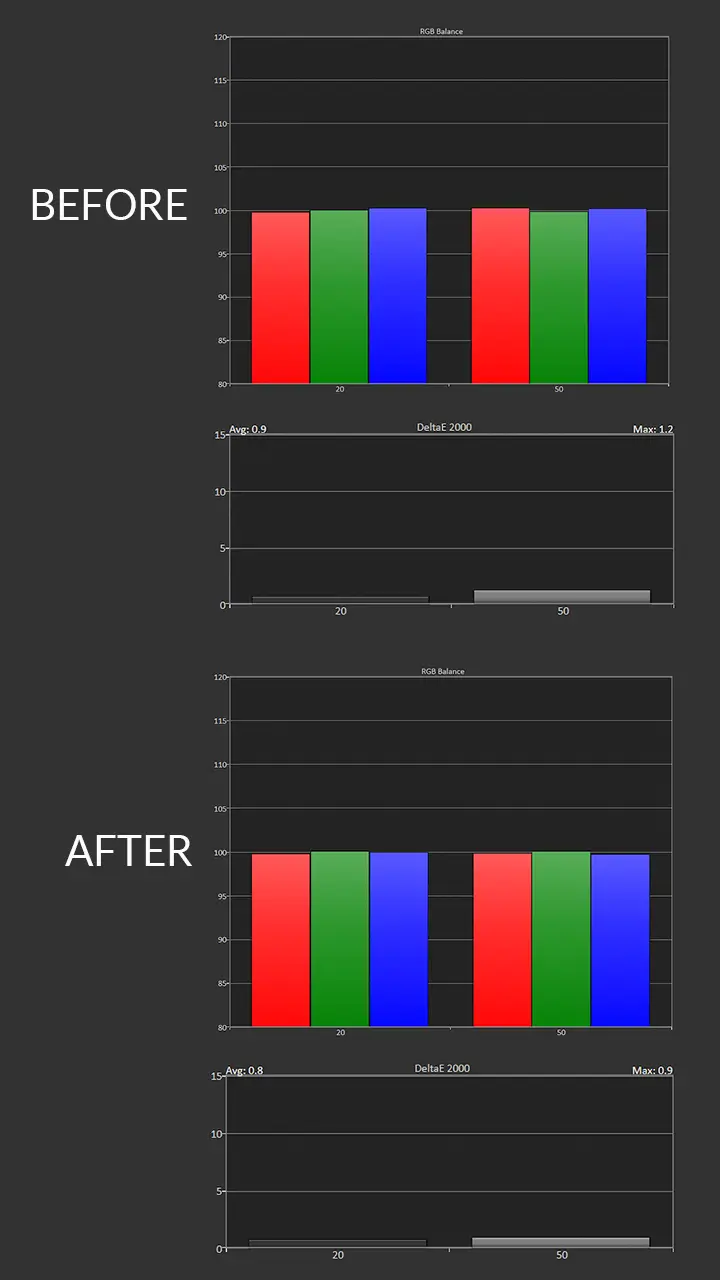
Based on its pre-calibration HDR Grayscale measurements, the HDR THEATER mode was extremely accurate out of the box, with an average DeltaE of just 1.2. You can use the Two-Point White Balance adjustment to slightly improve the White Balance, but most people probably won't notice a difference.
Our measurement confirmed that the L9Q can easily cover more than 100% of the BT2020 color gamut. The L9Q does an excellent job of mapping its massive color gamut to accurately reproduce the REC709 color space used in SDR content.
BRIGHTNESS
The Hisense L9Q is a stunningly bright projector. During our testing and calibration, it could be blinding when the calibration software displayed a white screen. At a manufacturer-rated 5,000 lumens, the L9Q will work in all kinds of rooms that previously would not support an ultra-short-throw projector. It looks at even moderate amounts of unwanted ambient light and says, “Is that all you’ve got?” I honestly feel bad about past reviews where I’ve written phrases like “It’s got brightness to spare” about 3,000-lumen projectors, because the L9Q really does have brightness to spare. It’s also very usable in brightness. For example, in my testing below, we wanted to get the most out of the projector and raised the laser level to 10; the picture was not blown out and still displayed acceptable highlight detail.
To determine the L9Q's brightness capabilities, I set the projector to VIVID mode, the projector's brightest picture mode, with the LASER LEVEL set to 10 from the factory setting of 8.I also switched the Brightness Enhancement to Ultra, which maximizes the projector's light output at the expense of color accuracy. I then took three to four readings about 15-20% out from the center of the lens.
The L9Q measured 4989 lumens in my space, which is close to Hisense's brightness claim. I also measured the brightness of several preset picture modes, leaving the laser output to its factory settings and the Brightness Enhancer off.
Picture Modes: Brightness and Color Temperature
Picture Mode
Brightness Measured (Lumens)
Average Color Temperature
VIVID
3162
10116K
STANDARD
3263
8723K
SPORTS
3201
8731K
PC/GAME
3167
8650K
ENERGY SAVING
2953
8825K
THEATER
3150
6480K
FILMMAKER
3201
6370K
The L9Q can deliver class-leading brightness while maintaining outstanding image quality. With all the projector's brightness adjustments set to maximum, the L9Q can deliver its advertised 5000-lumen brightness, but it is not worth the image-quality sacrifice.
Hisense L9Q is significantly brighter than the PX3-PRO, which helps when watching content in areas with even above-average uncontrolled ambient light, while maintaining decent color during lights-on viewing. The L9Q’s increased brightness makes a significant difference in seeing both dark and bright area details. This is critical for games where seeing what's happening in the environment can mean the difference between dying and advancing to the next level.
BLACK LEVEL AND SHADOW DETAIL
The Hisense L9Q's 5,000-lumen brightness really raises the performance bar for UST projectors and allows it to display a very natural-looking 5,000:1 native contrast. The 5,000:1 native contrast claim, if accurate, is, like the brightness claim, an increase of about 66%. For a single-chip DLP, that number is certainly ambitious. Whether that number is 100% accurate, the L9Q absolutely delivers a very good black floor with excellent detail in dark areas.
This means the L9Q delivers spot-on color accuracy and fine shadow detail. Even though it can’t produce the deep inky blacks of LCoS and the best large-format DLP projectors, it still delivers above-average black levels and contrast. When I first put the projector on the test bench, the L9Q appeared to be a genuinely strong contrast performer, though it did visually seem to fall a little short of the native spec the company claims.
Without engaging any dynamic processing, we measured the native contrast ratio at roughly 3223:1. Yes, this is measurement is lower than what the marketing suggests but it is similar to the PX3-PRO so it is still very good. When Dynamic Laser Dimming is engaged we measured 6913:1. If you switch to cinematic presets, such as FILMMAKER or THEATER, and enable the 'DARK DETAIL' setting in the Scenario Enhancement feature, the projector dynamically deepens the black floor.
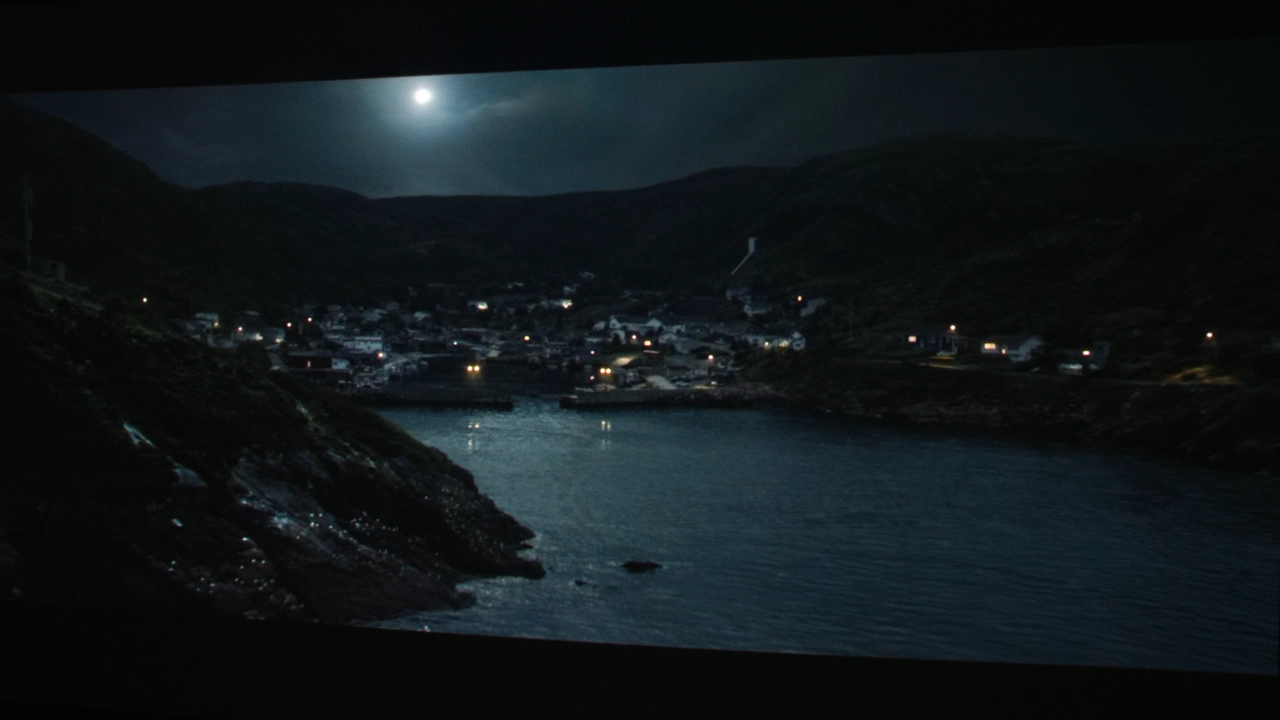
Ultimately, what really counts is how the image looks on the screen during a real movie-watching session, and here the L9Q really does shine. To be clear, the black level isn't going to give you those absolute, 'inky blacks' or razor-sharp shadows you'd expect from a high-end, dedicated home theater projector that costs three times as much. However, it is certainly strong and, frankly, above average for a UST projector, especially given the sheer muscle of its 5,000-lumen light output. The higher brightness delivers a higher perceived visual contrast especially under ambient light.
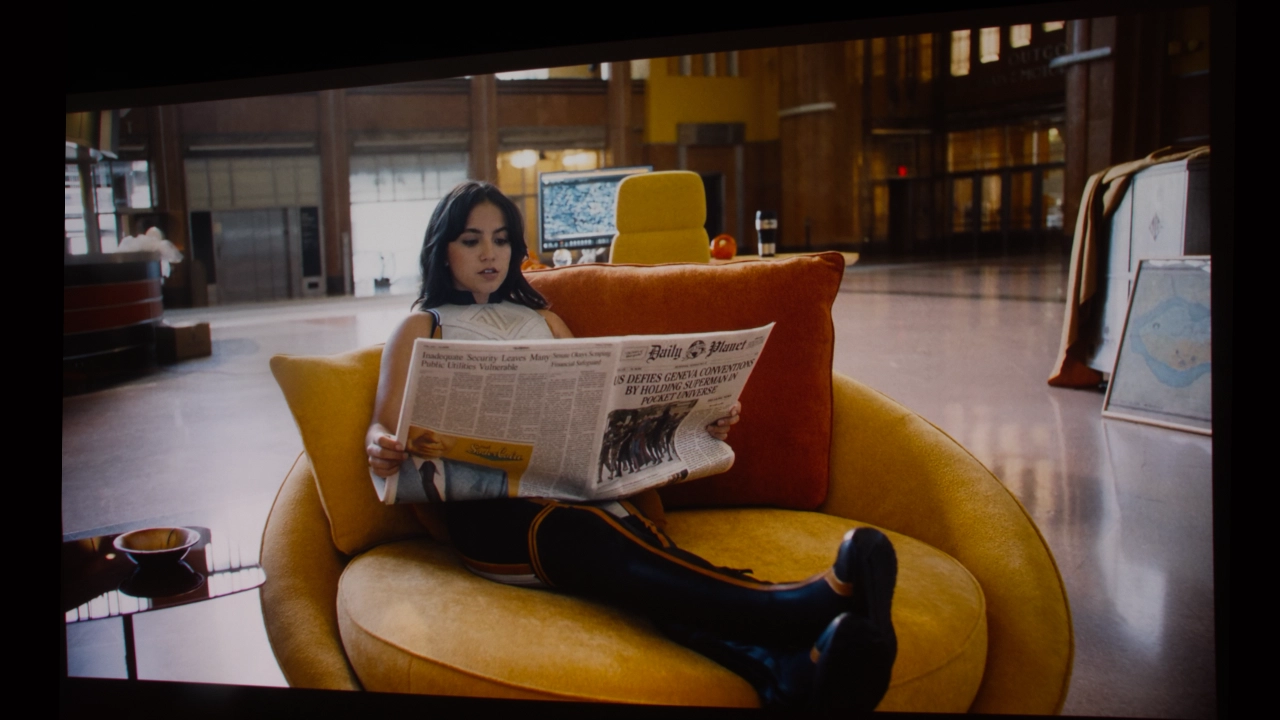
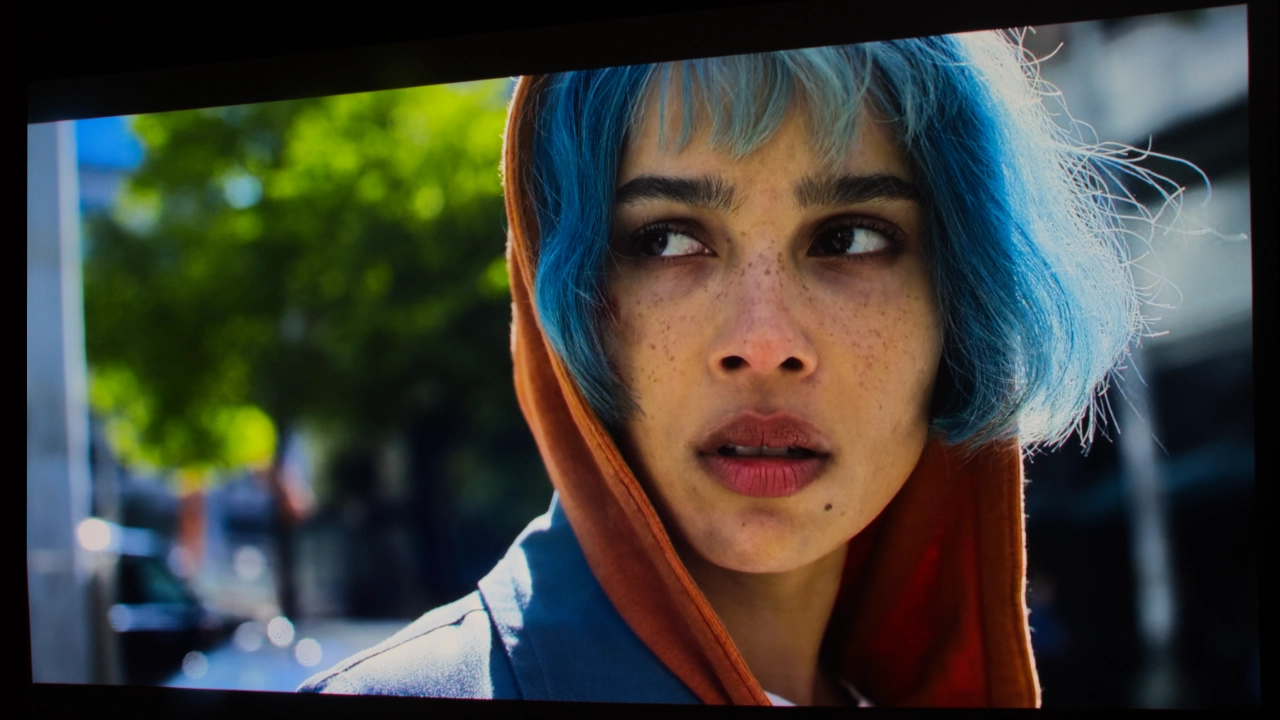
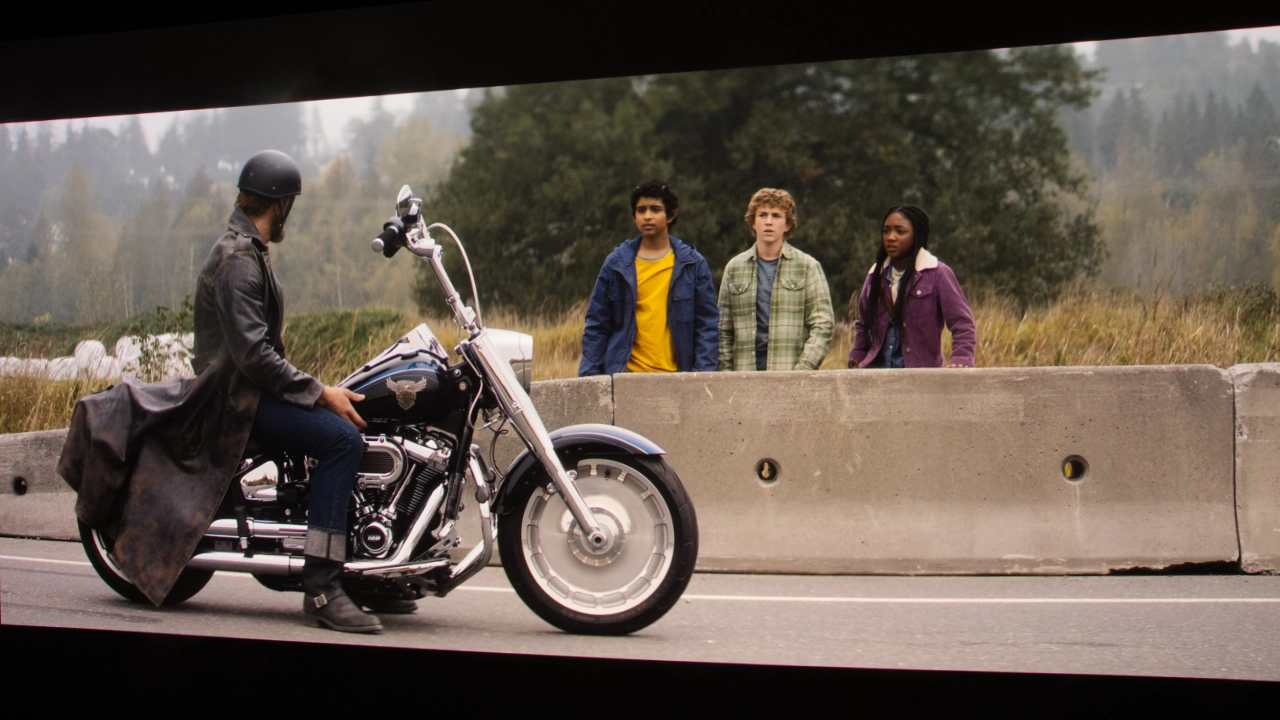
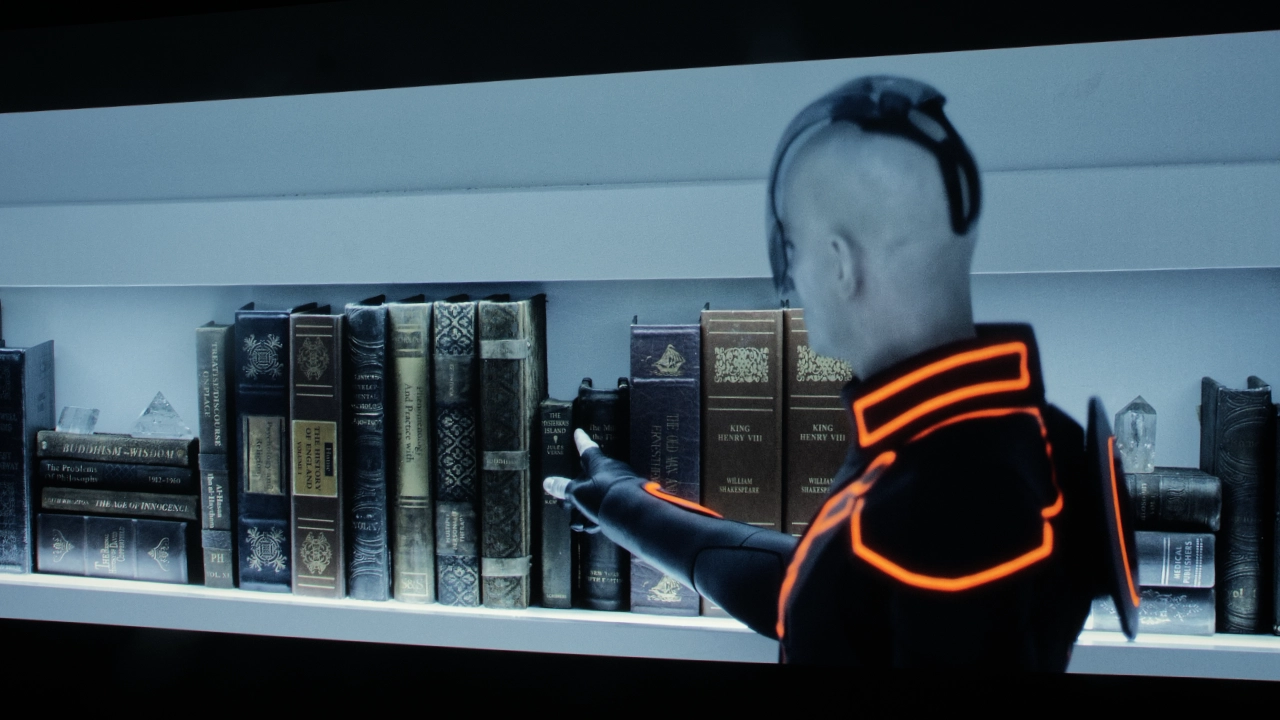
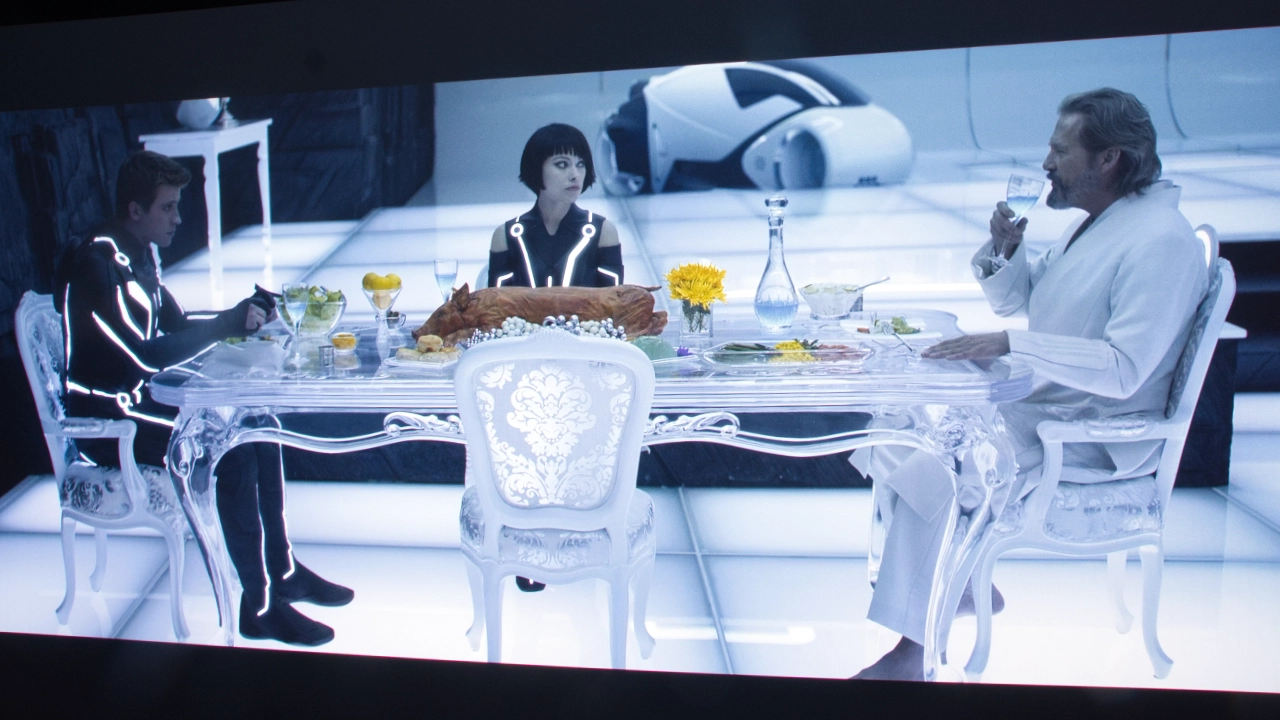
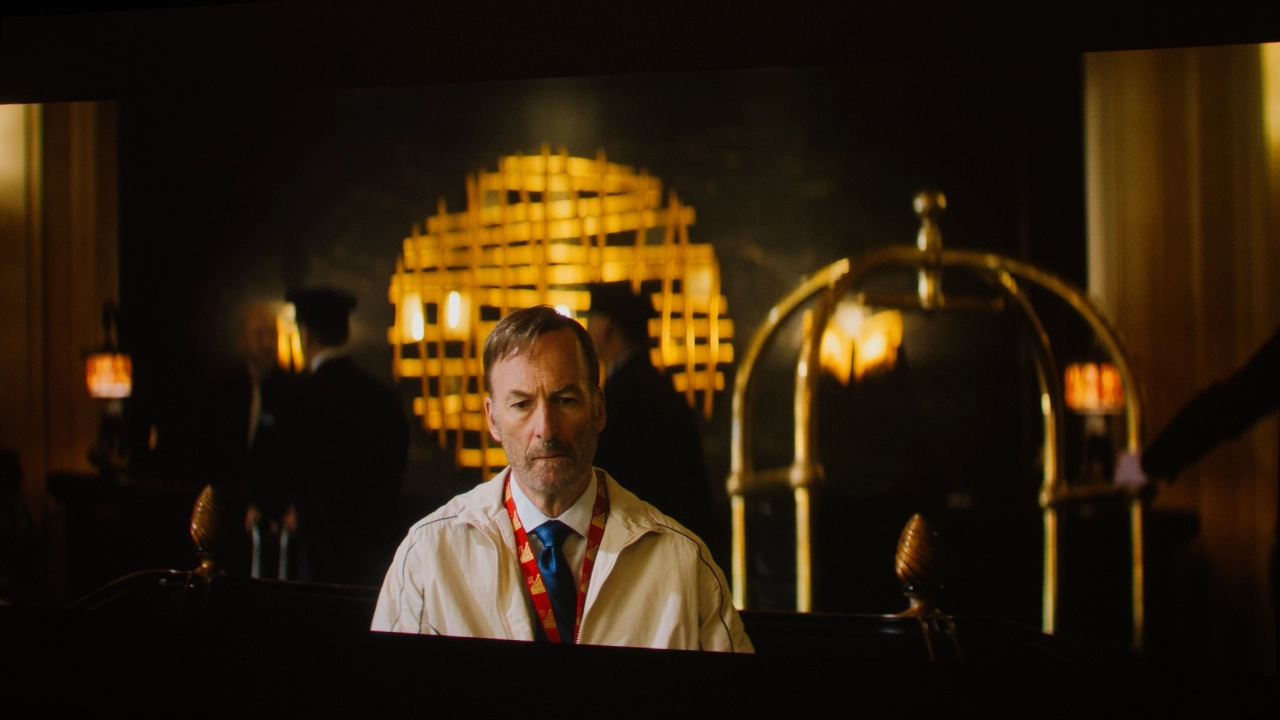
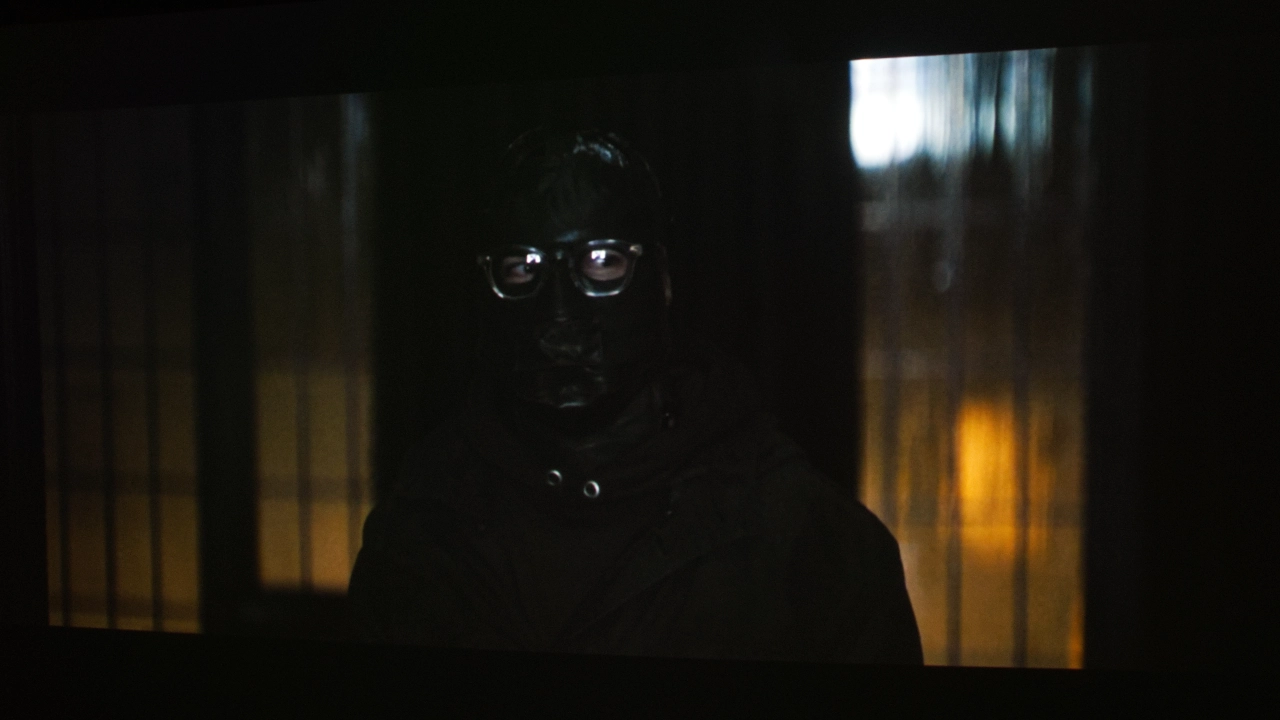
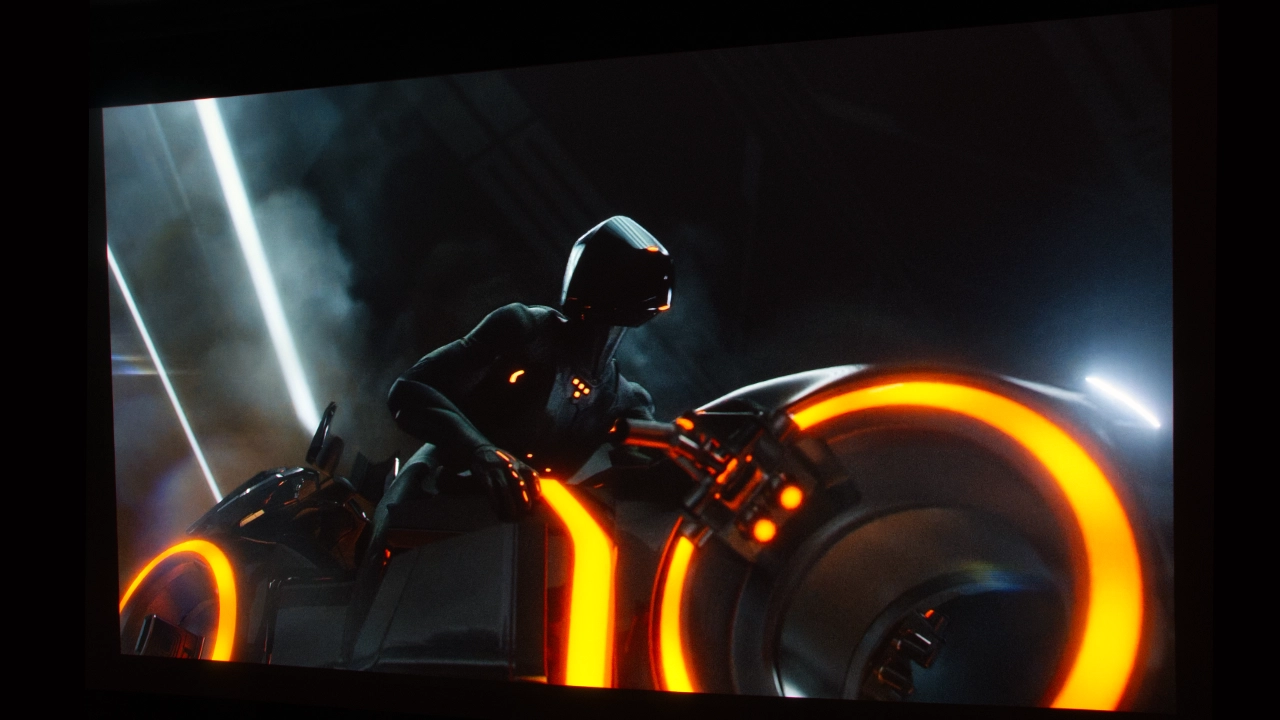
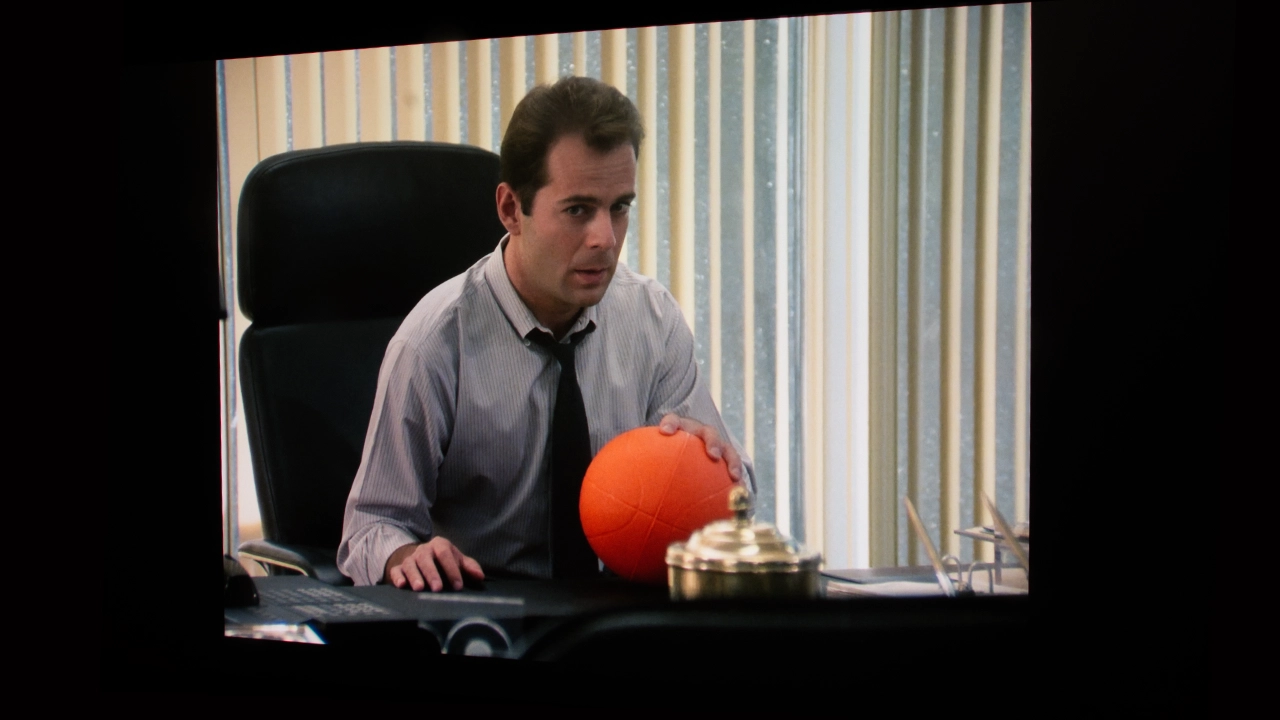
For example, it achieves a look that is nearly indistinguishable from models like the PX3-PRO, a unit I think has a slightly better black floor. You can clearly see in the slideshow above how well the projector handles scenes from Superman, The Last Jedi, Tron: Legacy, and others, and how well the L9Q displays black and dark-area details.
Although contrast ratio and black level are separate metrics, they are connected. In my PX3-PRO review, I wondered whether the projector’s “Designed for Xbox” functionality was related to the black-floor performance not being better. The L9Q does not have the Xbox badging, so that’s not pertinent here. All things considered, the L9Q’s contrast performance allows the projector to display a deep, almost three-dimensional picture. I think this projector makes a fantastic option for an immersive movie experience at home.
STANDARD DYNAMIC RANGE
It’s almost a disclaimer at this point in the review when we say that most TV shows and live broadcasts will likely remain in HD for years, making exceptional 4K upscaling crucial. The L9Q's upscaling capabilities are impressive, seamlessly elevating 720p sports and 1,080p Blu-ray content to a visually stunning level. Even SD content can be made to… look better. Hisense pulls this off by incorporating AI into its Laser Engine 2.0, with advanced AI algorithms that work in real time to refine the picture before displaying it on screen. Hisense uses AI to upscale lower-resolution content to 4K while reducing noise, making the content look sharper and cleaner than if the projector were just doing basic pixel-doubling.
The L9Q's FILMMAKER mode eliminates 3:2 pulldown, resulting in a more cinematic motion experience. When viewing 30p or 60p content, the CLEAR mode effectively minimizes motion artifacts. The L9Q offers MEMC (Motion Estimation Motion Compensation) for smoother motion in sports and video games. This feature inserts additional frames between the original ones to reduce judder and enhance overall smoothness.
Sports and live content, like talk shows, look fantastic on the L9Q. The projector delivers vibrant, colorful images that are enjoyable to watch. Even high-contrast content, such as animation, appears balanced and free from excessive oversaturation, a common issue with many DLP laser projectors.
HIGH DYNAMIC RANGE
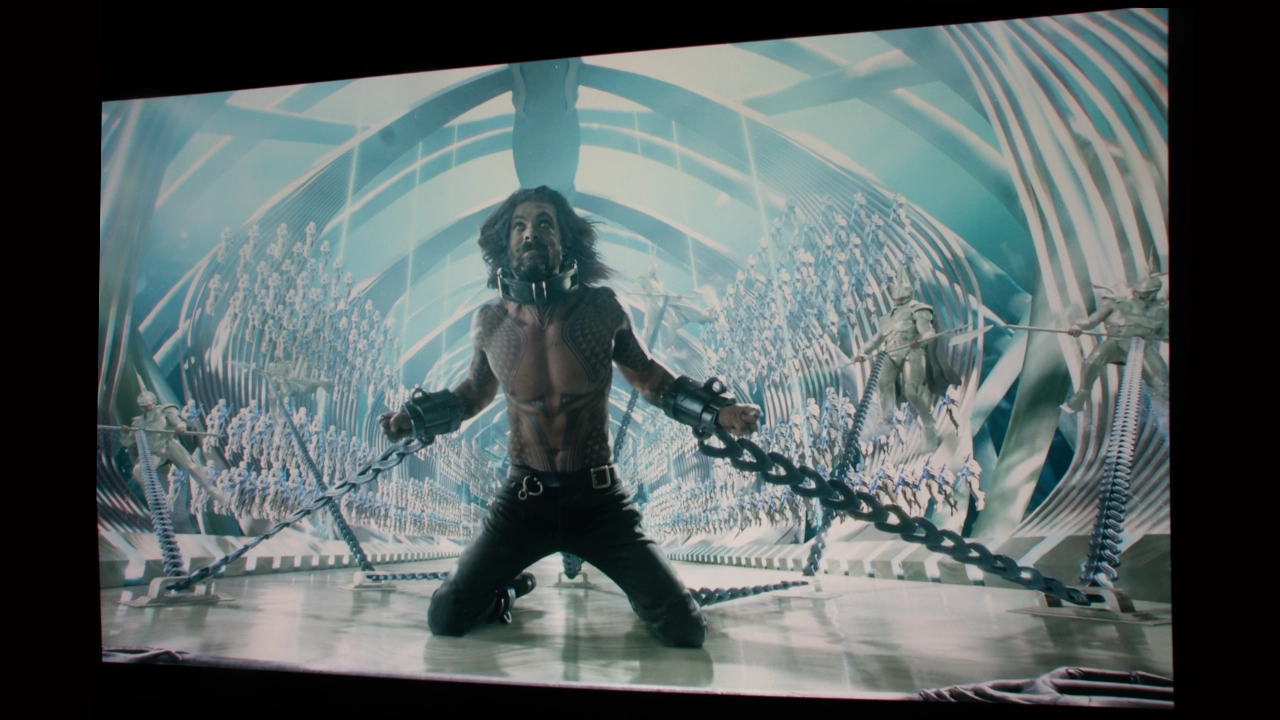
I have both the PX3-PRO and the L9H, so I can confirm what I’m about to say. The L9Q offers some of the best HDR performance in an ultra-short-throw projector. This is largely due to the previously noted 66% increase in brightness, as well as the projector's excellent optics and HDR tone mapping. In my opinion, the black level is similar (not identical) to the PX3-PRO. I think the black floor has been raised a bit on the L9Q, but the bright-area detail with HDR content is very noticeable in bright scenes from Lucy, Aquaman, and others.
I did most of the testing in my lab on a 110-inch matte-white professional screen. When I paired the L9Q with the ALR screen in my very light-heavy living room, the 5,000-lumen output started to produce a picture that approached the performance of a flat-panel display, especially in perceived brightness and color saturation with HDR-encoded content. The Rings of Power in HDR10+ looked amazing. In fact, Dolby Vision and HDR10+ content looked stunning on both my lab and living room screens. Yes, you will take a big hit in brightness across all HDR modes, but what you gain may well be worth the sacrifice in displayed lumens. This improved picture even applies to standard HDR and HLG content shown on the L9Q.
Hisense has continued its full HDR support strategy for the L9Q, offering both HDR10+ and Dolby Vision to ensure maximum HDR performance across formats. Beyond dynamic metadata HDR, the L9Q continues to support IMAX Enhanced content. If you watch those specific movies on services like Disney+, you’ll get the full benefits: the correct aspect ratio, specific processing, and DTS-X audio. The IMAX Enhanced program uses Digital Media Remastering (DMR) to reduce noise and enhance color and contrast, operating similarly to other advanced HDR systems.
From my viewing experience, the L9Q did a remarkably good job of automatically adjusting its HDR tone-mapping curve on the fly, perfectly matching it to the scene. For the best results with any of these dynamic formats, you’ll need to input your screen’s size and gain values accurately.
I found that Dolby Vision consistently looked superior to the projector's standard HDR10 tone mapping, especially with material mastered above 1,000 nits. The system demonstrated exceptional automatic tone-mapping across all the movie scenes I tested. The projector also supports HLG (Hybrid Log-Gamma), the essential HDR standard for live broadcasts, future-proofing you for sports and events. While Dolby Vision usually looked better, I was impressed with the picture quality of all HDR material.
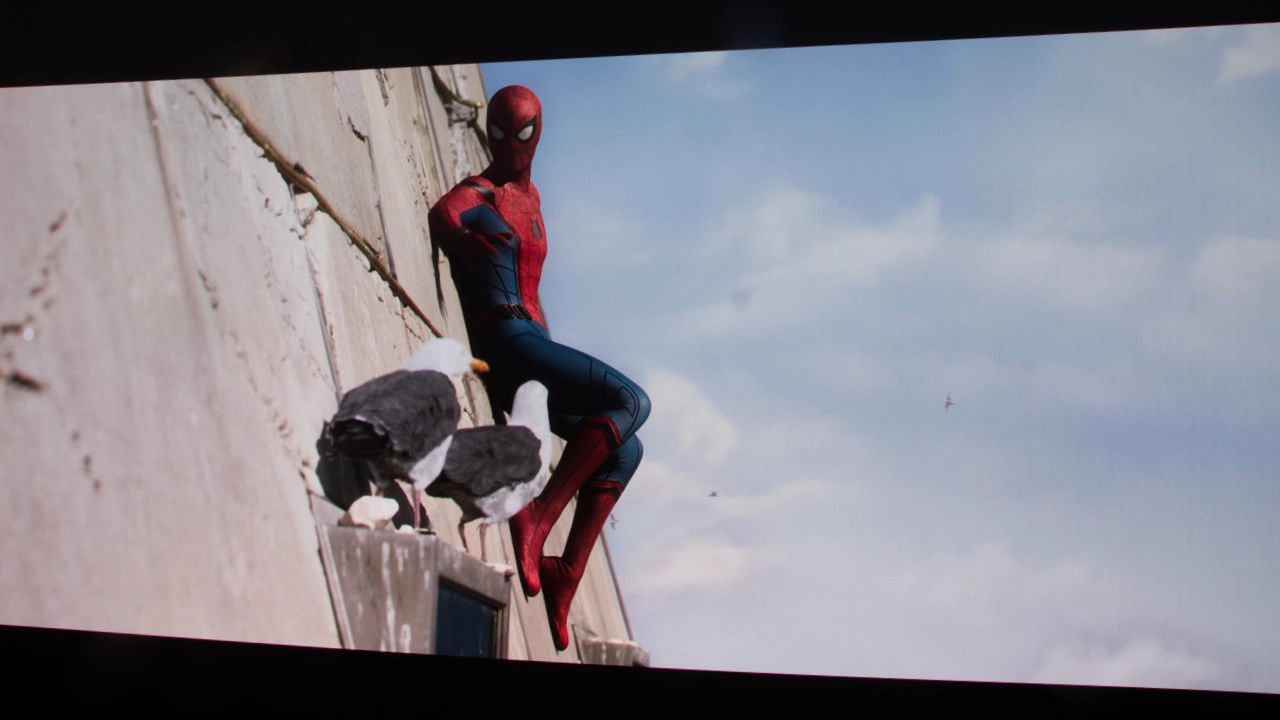
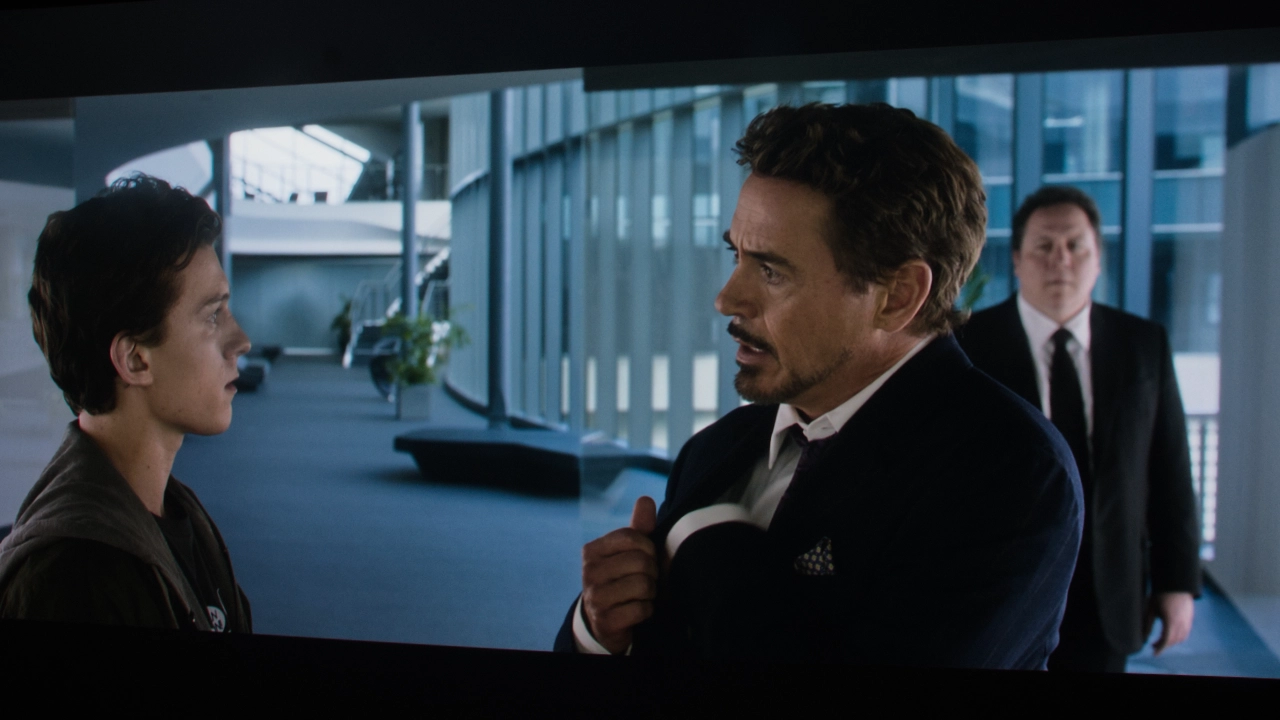
The L9Q’s ability to reach 110% BT.2020 results in rich, natural HDR colors, thanks in part to Trichroma technology. It accurately reproduces a wide range of colors, from the new Apple movie F1 and the stunning ”ship refueling in the sun” shots in Passengers to the gorgeous hues of Spider-Man Homecoming.
GAMING
While the previous PX3-PRO model proudly featured the "Designed for Xbox" badge, the newer Hisense L9Q does not come with this certification. However, it shares all the core technical capabilities that earned the PX3-PRO this badge in the first place. That being said, one feature that appears to be missing is native 1440p support; the L9Q, like many USTs using the 0.47-inch DLP chip, will accept a 1440p signal but then converts it to either 4K or 1080p at 60Hz. It’s an interesting technical limitation because other "Designed for Xbox" certified projectors can display 1440p at 120Hz without this conversion step.
Regarding my gaming experience on the L9Q, I can attest that it’s impressive. The L9Q features two HDMI 2.1 ports, designed to drive the highest-end consoles at 4K/120Hz (though the display is limited to 4K/60Hz). The important thing is that its Auto Low Latency Mode (ALLM) works great, instantly switching to a speedy GAME mode when it detects a compatible console is connected.
The L9Q Input lag is very competitive for a UST, measuring around 12 ms at 1080p/120Hz and a highly responsive 28 ms at 4K/60Hz. I’ve read reports that the latest firmware running the L9Q is capable of 8 ms at 1080p and under 18 ms at 4K 60 Hz. I didn't notice any delay while playing fast-paced titles on my Xbox Series X. My gameplay was fast and enjoyable. This projector's high brightness, combined with its color capabilities, only enhanced my fantastic gaming experience. Would native 1440p be a welcome addition? Absolutely, but that will likely require Hisense to transition to a different DLP imager in a future generation.
SOUND
To enhance the audio experience further, the Hisense L9Q offers nine preset audio modes, including STANDARD, THEATER, SPORTS, MUSIC, SPEECH, LATE NIGHT, and INTELLIGENT SOUND to tailor sound to match your content.
Historically, I’ve been very complimentary of Hisense's built-in ultra-short throw projectors and sound systems—often comparing them to a really good entry-level sound bar. Well, they've done it again and “raised the bar” on built-in sound performance with an all-new internal audio system.
To start with, Hisense has decided not to collaborate with its usual sound partner, Harmon Kardon, and instead sought out a boutique audio company called Devialet. Devialet is an independently owned French acoustic engineering company best known for its luxury audio equipment. The company has several proprietary, patented technologies. Their involvement provides the L9Q with a 116-watt, 6.2.2-channel system capable of true Dolby Atmos, a major leap in spatial audio performance compared to the PX3-PRO and L9H, which, at the time, I found quite impressive. The L9Q is noticeably better.
Hisense has more than doubled the available power from 40 watts on the L9H or 50 watts on the PX3-PRO to 116 watts on the L9Q. In real-world terms, this means the L9Q gets loud without noticeable distortion, especially in the mid-bass frequencies. Even at maximum volume, I had to run audio meant for a subwoofer to get the speaker even to start breaking up. Almost all the movie content I ran through the projector performed extremely well.
The L9Q’s 6.2.2 channel setup includes upward-firing speakers, which are key to the projector's amazing soundstage, especially when playing object-based audio formats like Dolby Atmos and DTS: X. When I played one of my Dolby Atmos sound demos, the L9Q was able to create an almost three-dimensional sound field with some sounds that seemed to come from around and above me. This sound experience is very much room-dependent, performing much better in my smaller testing space than in my larger living room. Also, I am not saying you should get rid of your external sound system, but the L9Q’s sound is among the best I’ve heard from an ultra-short-throw projector to date. You will still get a better sound experience from a high-end sound bar or full-blown external audio system. However, if that’s not possible with your setup, the L9Q’s Devialet sound system is among the best available and will deliver an immersive experience on its own.
The Hisense L9Q retains premium audio features, such as eARC, which supports lossless audio transmission. Dolby Atmos Sound enhances the listening experience beyond the built-in speakers, allowing uncompressed audio to be passed through to a high-quality multi-channel surround sound system. Additionally, with HDR10+ and IMAX Enhanced processing, the L9Q supports DTS audio.
Streaming apps like Netflix, Disney+, HBO Max, and Amazon Prime offer multi-channel content that requires eARC to fully leverage the high-quality surround soundtracks available in modern movies and TV shows. Hisense has equipped the L9Q with an optical audio output, but it does not include a 3.5 mm audio jack. The optical output cannot transmit the latest immersive surround formats to an external sound system, limiting its utility for those formats. The L9Q is WiSA-ready, meaning it can transmit high-resolution audio to WiSA-certified speakers when an optional third-party WiSA transmitter is connected to any of the L9Q's USB ports. WiSA-certified devices are designed to work seamlessly with each other.
SUMMARY
The Hisense L9Q is a premium Ultra-Short Throw (UST) projector. It features a design that takes Hisense ultra-short throw projectors in a whole new direction, both externally and internally.
The L9Q features an all-new color scheme of champagne-colored metal and warm, dark walnut faux-wood paneling. This combination of metal and wood, along with the champagne finish, gives the L9Q a distinct design aesthetic, setting it apart not only from previous Hisense ultra-short throw projectors but also from competitive models. The wood and metal make the L9Q feel more like a premium piece of furniture than just another piece of technology. This new design aesthetic means the L9Q should be able to live in a wide range of living environments, making it one of the most distinctive-looking ultra-short-throw projectors available today.
Compared to last year’s award-winning PX3-PRO, the new Hisense L9Q is a massive leap forward in performance. The projector uses the latest version of the company’s RGB laser light source, providing a significant step up in overall picture performance.
When it comes to brightness, the L9Q is a beast, with nearly a 66 percent increase over the previous model. This massive brightness boost helps the projector across the board, allowing the L9Q to be used not only as a dedicated home theater projector but also to replace a flat-panel TV in a living room. This projector has so much brightness to spare that it can create an image that maintains color and clarity even in rooms with moderate levels of uncontrolled ambient light. Pair the L9Q with an ALR screen, and you have the perfect projector for even the most challenging lights-on viewing environments.
If you are interested in purchasing the projector mentioned in this article, we always appreciate it if you use one of the links in the article because Projector Reviews earns a small commission on the sale at no cost to you.
The TriChroma laser light source produces stunning, surprisingly accurate colors out of the box, with little to no tuning required. Most owners won’t even think about color calibration, but if you do, you can take this projector's excellent color quality from incredibly good to stunningly great. The L9Q’s increase in brightness also improves the projector's contrast, resulting in a 66% jump over the PX3-PRO’s 3,000:1 native contrast rating. This means that details in both dark and bright areas of the L9Q’s projected image are more visible and look better out of the box.
The L9Q features all the most commonly used high-dynamic-range formats, including Dolby Vision and HDR10+. It offers the best color, dark-area, and light-area detail performance available in an ultra-short-throw projector. The L9Q is one of only a few projectors to feature IMAX certification, allowing you to get the best overall scale and quality when watching IMAX Enhanced content from studios like Disney’s Marvel and select Sony Pictures Studios titles.
When it comes to gaming, Hisense has managed to keep the excellent performance found in the PX3-PRO and enhance it by increasing the number of high-speed HDMI inputs to four (two of which are HDMI 2.1). The L9Q features a dedicated gaming mode that, when used in conjunction with ALLM (Auto Low Latency Mode), switches the projector to the fastest settings when a compatible high-speed gaming console connection is detected (i.e., Sony PlayStation 5 and Xbox Series X), providing you with the best overall picture and sound experience you can get on a Hisense UST projector.
Hisense could have stopped there, but the company decided they had to take the projector’s already excellent built-in sound to the next level by partnering with Devialet, a luxury French audio company, to provide the L9Q with a 116-watt, 6.2.2-channel sound system capable of stunning audio performance even when compared to the already excellent PX3-PRO and L9H sound performance.
Hisense has raised the bar across almost every aspect of the new L9Q, from design and picture quality to performance, sound, and experience, making it the most advanced ultra-short-throw premium projector you can buy to date. And that’s not just my opinion, because the L9Q recently won three different first-place ratings in the recent 2025 Ultra Short Throw Projector Showdown.
PROS
The new LPU light engine has 5,000 lumens of brightness and covers 110% of Rec. 2020.
The projector's support for HDR10+, HDR10, HLG, Dolby Vision, and IMAX Enhanced encoding delivers improved detail in both dark and highlight areas.
The new Devialet audio system delivers 116 watts of power and a 6.2.2-channel configuration, delivering stunning audio performance.
The new Google TV OS provides users with a much-improved curated search experience across all streaming applications on the projector.
Hisense continues to provide users with a robust CMS (Color Management System) that allows extremely detailed fine-tuning of the projected image.
Under normal operating conditions, the projector's light source is rated to last more than 25,000 hours when used in NORMAL energy mode.
The USB 3.0 Type-A input and built-in media player allow users to play content from compatible external media, such as USB drives and hard drives.
It supports Active 3D movies and games.
A 2-year limited manufacturer's warranty should provide consumers with confidence in the projector's reliability.
CONS
Black levels are good for a DLP, but not premium.
The remote backlight is dim and turns off too quickly, and the dedicated streaming service shortcuts lack backlighting.
While overall focus uniformity is quite good, it is slightly blurry in the top corners of the screen.
The SCEANARIO mode causes brightness and color shifts
Some rainbow effect with high contrast colorful content
Hisense L9Q- SPECIFICATIONS
Full Specifications
Projector Model
L9Q
Price (MSRP)
$5999 (MSRP)
Imager Type
DLP
Displayed Resolution
1920 x 1080 X4 (4-way pixel shifting)
Native Resolution
1920 x 1080
Brightness (Manufacturer Claim)
5000 Lumens
Light Source Type
Trichroma RGB laser Light Source
Contrast Ratio
5,000:1 (Native)
Lens Throw Ratio
0.21:1
Power Zoom/Focus
Yes (Focus)
Lens Shift
No
Interchangeable Lens
No
Ultra Short Throw
Yes
Native Aspect Ratio
16:9 (Widescreen)
4K/120 fps
Yes (Input Only displays at 60 hz)
3D
Yes
Speakers
Yes
Noise Level (-db)
Unlisted
Low Lag Gaming
Yes
Smart Functionality
Yes
Business
No
Classroom
No
Portable
No
Special Features
Dolby Vision & HDR10+, Google TV OS, 5,000 Lumens, and 5,000:1 Contrast
Networking
LAN and Wireless
Dimensions (WxDxH)
(WxHxD)24.6” x 12.5” x 6.5” (624.84 mm x 317.50 mm x 165.10 mm)