Mitsubishi HC3800 Projector Review
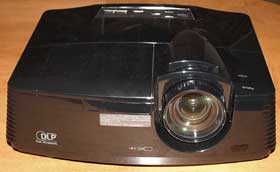
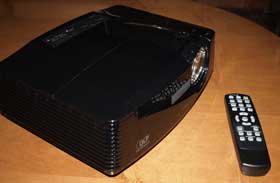
An excellent entry level home theater projector, the Mitsubishi HC3800 is a DLP projector, with 1080p native resolution. This review of the HC3800 projector is based on an early engineering sample.
The Mitsubishi HC3800 was awarded the Best In Class Runner-Up Award in our annual Home Projector Comparison Report -April 2010.
Update: We recently reviewed the Mitsubishi HC4000, the replacement of the HC3800. Click here to read the projector review of this new award-winning Mitsubishi projector.
September 2009 - Art Feierman
|
|
![]() |
Mitsubishi HC3800 Projector Overview
First things first. This HC3800 projector is extremely bright in best movie mode, and it's got impressive color. And a low cost of operation! And other things! The end result is it deserves our Hot Product Award!
Here's a lower cost projector, in the form of the Mitsubishi HC3800, that like the recently reviewed BenQ W6000 has the ability to handle larger screens or some ambient light, and still provide a really good looking picture.
It's a rare thing for us to complete a review of a home theater projector based on working with an early engineering sample. Yet, that's exactly the case here with our HC3800 projector review. We received the HC3800 about a week before the CEDIA show where the HC3800 was to be officially announced. In fact, this unit had to be shipped back to Mitsubishi, for the CEDIA show, so folks could see it. Mitsubishi returned the HC3800 to me the week following the show, and work resumed.
In the course of reviewing, I get a chance to work with a number of pre-production projectors, but the even earlier on engineering samples are rare. Generally with an engineering sample, many things don't work at all, and performance is quite often iffy. As an example, I also have here, at the time of this writing, an engineering sample of the new InFocus ScreenPlay 8602. Unlike the HC3800, we decided that the InFocus 8602 simply wasn't finished enough to complete a good review. Thus, only a blog was done for now, until they send me a fully updated projector.
In the case of the Mitsubishi HC3800, it is a true engineering sample. For example, only one input works, fortunately, that's HDMI. Component video, composite, etc. - all inoperative. Not surprising at all for this early a unit.
I'll discuss, in the course of this review, the things that don't yet work, and will try to anticipate differences between this HC3800 and a full production HC3800. Mitsubishi has already committed to get me one of the first production HC3800s, so I can update this review when they ship. The reason for this is that the color tables on this unit are not finished and will change. For that reason, I'll need a production unit, to re-calibrate, so we can post all of our calibration settings for you. The ones we came up with for this sample, would likely be of no help to owners. One thing that I think we can count on, is that a production unit will be at least as good, at everything.
This HC3800 though, is very impressive, it's combination of picture quality brightness, price and general performance earns it our Hot Product award, so, any improvement found in the later production projectors is just an added bonus!
OK, that's enough background. Let's see what we have here. The HC3800 is a $1499 MAP (minimum advertised price) DLP projector with 1080p resolution. As one of the lower cost 1080p projectors (the lowest are coming out at $999), it is a basic home theater projector in several ways. For one, it has the usual rather limited placement flexibility of most lower cost DLP projectors. Also, while the HC3800 does respectable black level performance, it lacks the dynamic iris which, today, most projectors now have to increase contrast and black levels.
On the other hand, the Mitsubishi HC3800 projector is particularly bright, in its best movie mode, has a longer than average lamp life (keeps long term ownership costs down), and has rather excellent picture quality, with most impressive skin tones - and that's without finished color tables. This is an affordable projector that should please some rather picky potential owners, especially those into picture quality.
Mitsubishi HC3800 Projector Highlights
- Very good skin tones, both natural and rich looking (very classic DLP) post calibration, and impressively good right out of the box
- Extremely bright in "best" mode, with over 600 lumens
- Brighter than average in "brightest" mode too
- Good black level performance, considering no dynamic iris
- Typically limited placement flexibility as a DLP projector, with limited zoom range, and no lens shift
- Dual anamorphic modes allow use of anamorphic lens for Cinemascope viewing (no letterbox) without needing an expensive motorized lens sled
- With a projected selling price under $1500, this may well be the projector to beat in its price range, in terms of overall picture and viewing enjoyment!
Specs for Mitsubishi HC3800
MSRP: MAP $1495
Technology: Single chip DLP
Native Resolution: 1080p (1920x1080)
Brightness: Manufacturer claim: 1300 lumens
Measured Brightness: "best mode": 600+ lumens, "brightest" 1100+ lumens
Contrast: 4,000:1
Zoom Lens ratio: 1.5:1 Manual zoom and focus
Lens shift: None
Lamp life: 3000 hours at full power, 5000 hours in eco mode
Weight: 7.7 lbs. (3.4 Kg)
Warranty: 2 Year Parts and Labor
Mitsubishi HC3800 Special Features
HC3800 Lamp Life
Lamp life may not be as exciting as black level performance, but it usually is of particular interest to those buying relatively entry level priced projectors. Afterall, if cost wasn't a consideration, you would probably be reading a review of some $4000 or $8000 projector now, not one that's under $1500.
Most lamps are rated 2000 hours at full power, and 3000 in low, or "eco-mode" power.
The Mitsubishi HC3800, however is rated 3000 hours at full power, and an extremely long 5000 hours in low power mode. Combine that with a the Mitsubishi's very bright "best mode" and a lot of folks will be running in "eco-mode" for their movie watching, while with another projector, they might be at full power, getting only 2000 hours, instead of 5000 hours. That trade-off can save you hundreds of dollars in a year or three, depending on how much you use your projector. For example, compared to the lower cost Optoma HD20, if both are used with lamp at full power, and you watch 20 hours a week, you will have used 2 additional lamps for the Optoma by 6000 hours, but only 1 for the HC3800 - bingo, you've just saved over half the cost difference between the two projectors, assuming typical lamp pricing. Of course 6000 hours, represents 40 hours a week for 3 years, not an unreasonable amount for those of us who use our systems as our general TV, as well as for movie watching.
1.5:1 Zoom Lens
The HC3800 is one of a new crop of DLP projectors that are finally offering more than the absolute minimal 1.2:1 zoom lenses. Finally, you'll have a bit of placement flexibility if you need it. I'm not sure how many people buy 3LCD projectors over DLP projectors simply because of placement flexibility advantages of the typical 3LCD projector. That said, the HC3800 still lacks adjustable lens shift so it can't be rear shelf mounted, although with the longer zoom range, in some rooms that aren't too deep, you could mount the projector under a shelf on the rear wall, or a mount coming from the rear wall. Ultimately, though, a projector either works in your setup or not. The HC3800 has more chance of working, then, say the lower cost Optoma HD20, which is more limited.
Related to the zoom lens, is the HC3800's compatibility with using an anamorphic lens, which it does. The HC3800 projector however has two anamorphic modes, the usual, designed to work with the lens for Cinemascope movies, and the second mode, so you can watch everything else without removing the anamorphic lens. In other words no motorized sled needed). This is discussed further in the Performance section of this projector review.
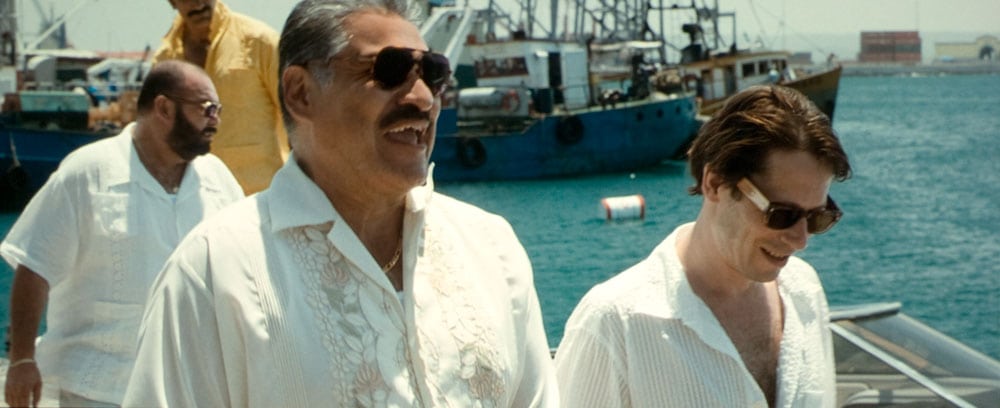
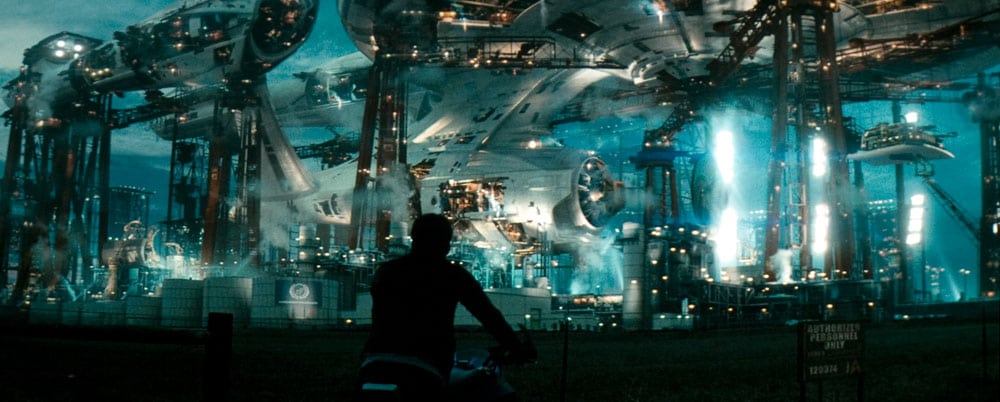
Image below - from the trailer for this past summer's new Star Trek movie: