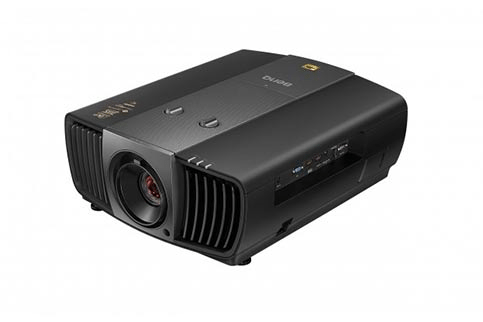
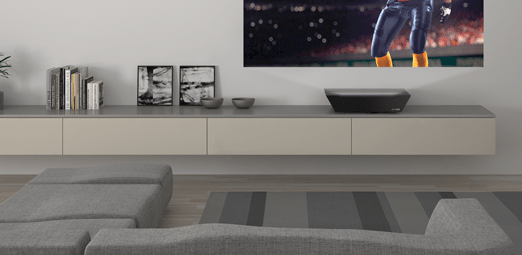
The BenQ HT8050 is a $7999 home theater projector, that uses TI's new 4K UHD DLP chip. It claims 2200 lumens. It's on the large size - for those of you familiar, not to different than the JVC projectors, or some of the Sonys. It will primarily be sold through local installing dealers here in the US.
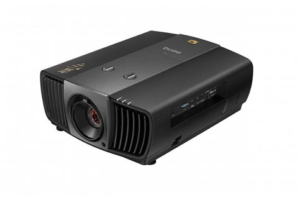
The BenQ HT8050 is a pixel shifting home theater projector with 2516x1528 x2 native resolution, which allows it to claim 4K UHD status.
The BenQ is a lamp based projector. There's a companion solid state projector - the HT9050 coming out shortly, I'm not certain about the price of that one, but I'm pretty certain, under $10,000. I'll update this when I confirm.
BTW I just shot my first batch of photos of the HT8050 in action. As you can see, I dropped a few in here.
I'll get into some more details but first I must address resolution.
To paraphrase Shakespeare: 4K or Faux-K, that is the question.
Here's a link to another blog I just wrote discussing the credibility of treating 4K UHD the same as true 4K, without clarifying. I think the oft used term of Faux-K is the term that applies. Oh, and while I'm at it, Ron, our most technical reviewer, just put up another blog, relating to 4K viewing, this one on HDR, which he's blogged about before.
So, short version, I don't count the BenQ HT8050 or other new 4K UHD projectors
(more…)Greetings projector fans. The 4K - and Faux-K projectors are coming, no, a number of them are here now to be reviewed!
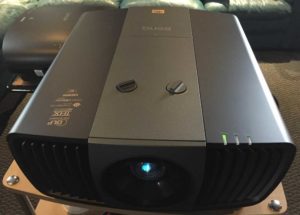
BenQ HT8050 4K UHD Projector
I've been basically slammed the past couple of months, between writing projector reviews,planning an update to the site, and also growing our newer site: smarterhomeautomation.com, so sorry for not writing sooner.
Those pesky 4K UHD DLP projectors that were first promised in the 2nd half of last year, then earlier this year, and finally starting to arrive on the scene, and we can't wait. Two are in house! First, though,
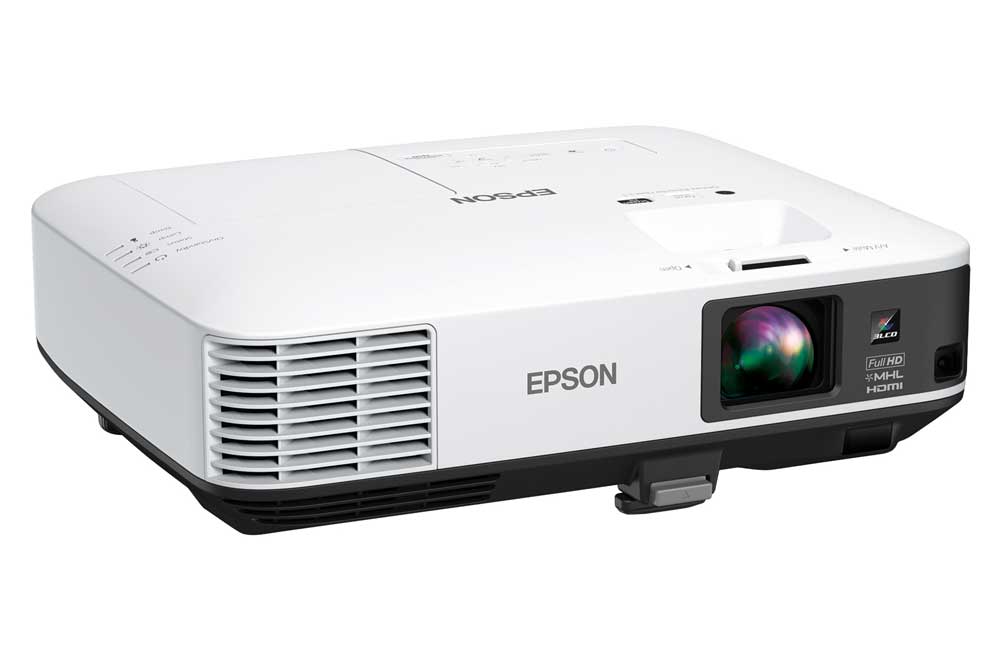
(more…)Today Epson announced the Home Cinema 1450 - a "Bright Room" projector that replaces their HC1440. The Home Cinema 1450 has the same feature set as its predecessor, but has managed to up the value proposition.
This is a seriously bright projector claiming 4200 lumens, for $1499. That's enough to tackle almost any room when paired with a proper screen (one designed to work in brighter rooms - often called ALR screens).
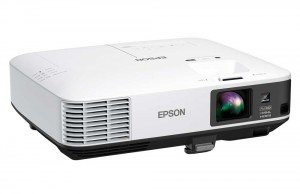
Epson Home Cinema 1450 - 4200 color, and white lumens of bright room home entertainment for $1499!
The major news - the two most significant differences between the HC1450 and it's predecessor are:
1) Increased lamp life - the Epson now offers 5000 hours at full power! And 10,000 hours in eco mode.
2) The HC1450 projector's price of $1499 represents a $200 decrease from it's predecessor.
For your consideration, laser and led light engine projectors typically claim about 20,000 hours at full power, but cost far more). In other words, even if you are running full power, and use your projector 40 hours a week, 5,000 hours translates to 5 years before you achieve the projected lamp life. (Note: claims are to a 50% reduction in brightness - not to failure - some lamps fail a lot short of claim, some last a lot longer, but most folks should get about what the claim is, or close to it. That is, most of you folks will never need to replace a lamp, rather, you'll be on to your next projector by then.
On the other hand, the 4200 lumens claimed is 200 lumens less than the HC1440, so, Epson may very well have reduced the brightness (by less than 5%) as one of the methods to get the major improvement in lamp life.
An HC1450 paired with an ALR screen - say 100" or 110" diagonal, can definitely do "battle" with LCD TVs in terms of looking great in rooms with a fair amount of ambient light. And most certainly, the cost of, say, an 80" LCD TV is far, far, more than this projector, plus an appropriate screen. This is not a projector for a fully darkened, dedicated home theater or cave, but one for "real rooms" around your house. Remember, like all Epson 3LCD projectors, the HC1450 has an equal number of color and white lumens, which goes a long way into cutting through ambient light with good/great color. This will give it an advantage over the typical single chip DLP projector with the same number of white lumens, as those tend to have color lumens between 1/3 and 2/3 of the white lumen counts.
The HC1450 has good contrast for this class of projector, which should provide respectable performance in a room with more than a little ambient light.
The HC1450 will be available shortly, both online and through local dealers. A real wall melter, for sure. We liked (and awarded) the HC1440. Considering the relatively minor changes, all for the better, the Home Cinema 1450 should prove to be at least as popular.
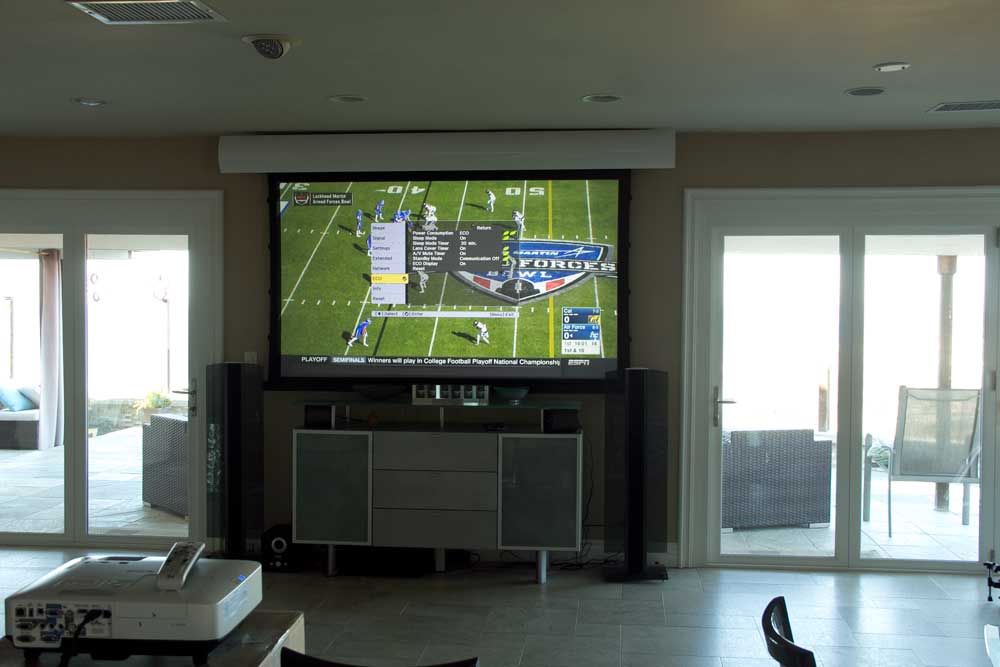
The image below is from the older HC1440, taken in a bright room environment:
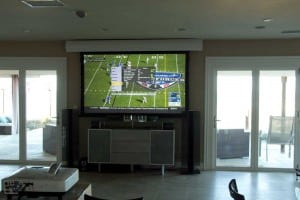
The HC1450's predecessor, the HC1440, is shown here, temporarily setup table top, projecting to my ALR screen on a bright day, in a bright room.
A final note: I'm a big fan of projectors moving into brighter rooms. It's the large screen sizes that immerse you in the content, whether sports, a movie, general HDTV, streaming or gaming. I currently have a motorized ALR screen (Screen Innovations Slate) in my living room where it's paired with a projector just slightly brighter than this one. Although I have much higher end equipment in my dedicated home theater which is used more, my living room setup gets used almost every day for an hour or two, with great success, and with friends for major events such as the March Madness championship game. -artThe Home Cinema 5040UB was a top award winner in last year's Best Home Theater Projectors report published late September 2016. Until now, the HC5040UB has had an official UMAP (essentially "street") price of $2999.
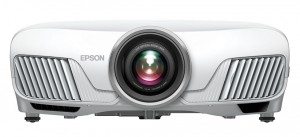
Epson's HC5040UB - 4K Content Handling, Pixel shifting, Lens memory, more, now for $2699!
This week Epson announced a 10% price cut on the the pricing of the
(more…)There have been rumors for months that JVC would have some new model announcements at CES. I visited JVC's Suite at the Venetian where they again demonstrated their RS4500, their first, and only true 4K consumer projector, with 3000 lumens with a price tag of $34,999. It looked spectacular (again), running various clips including some animation.
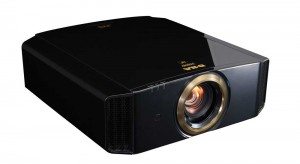
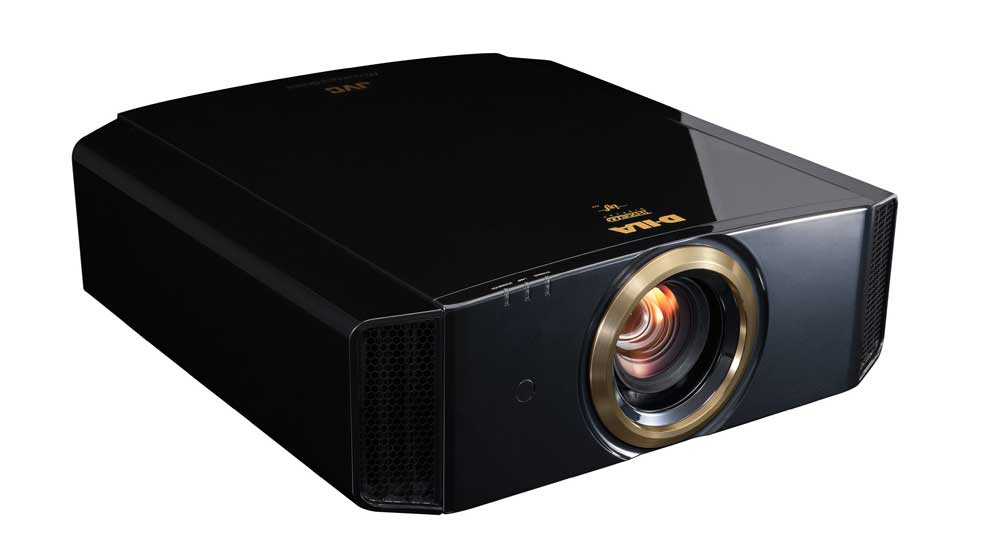
JVC's Pro DLA-RS620 looks identical to the X series, except for the trim. Note the gold anodized trim here.
But the real news is that there are updated projector models due in the upcoming months. Look for the DLA-RS420 aka X570R, to replace the RS400 and X550R. Pricing remains at $3999. All the new JVC models are claiming 100 lumens more than their predecessors, so, for example, the two new projectors get a 100 lumen boost over their predecessors to 1800 lumens.
Moving up, the DLA-RS520 and X770R replace the DLA-RS500 / X750R. ($6999) (Now 1900 lumens) The top of the line of the 4K UHD models will have the DLA-RS620 and X970R replace the DLA-RS600 and DLA-X950R ($9999). (Now 2000 lumens)
The reason there are two different models at each price is a marketing channel "thing." For years the two series projectors at the same price have been effectively identical models, except for some trim variations. In other words, between RS and X series, buy the one that's the most convenient, the performance is identical.
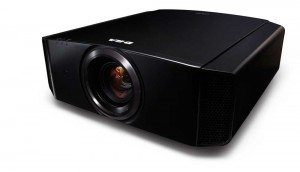
JVC's DLA-X570 projector, is the "consumer series". Note the silver trim. This model has 1900 lumens at $6999
So what's new with these projectors? Figure overall performance remains virtually identical. Talking to the folks in the JVC suite, there are minor performance enhancements, as one would expect from any upgrade. There are, however, two significant improvements.
Of course we'll need to bring in these projectors to review to confirm, but, here are the real reasons you might want to hold off a month (or two?) to get the RS420 instead of the RS400, etc.:
- Hybrid Log-Gamma - got to love the term, pure techie gobbly-gook sounding for everyone but engineers - Hybrid Log-Gamma is a new standard rolling out for streaming 4K content. It's not the only way to do it, but it's gaining traction, even if content from 4K streaming sources are few and far between at this time. Will it be the only standard, or the dominant one in a few years, I sure don't know. Still, this a a new feature to look for. Sony offers it only on their $15,000+ true 4K projectors, so far. I believe at least some of the first crop of DLP 4K UHD projectors with pixel shifting will have it too, but please don't quote me on that.
- Low latency mode for gaming. Over the years JVC has been a laggard when it comes to delivering low input lag times desired by gamers. It's nice to see that these new projectors should be fast enough to satisfy many serious gamers. Unfortunately, I didn't see an input lag number though, for these new models. When we get the first one in for review, we'll measure the input lag and report.
That folks is about it. Of course, these improvements (except for gamers) are minor, although Hybrid log-gamma might prove important to some. Personally, I count streaming as the lowest quality content source (at this time). As such, I buy lots of Blu-ray UHD movies. (I'm up to 40 probably by now.) In other words, while hybrid log-gamma may have real benefits for streaming, I'm not exactly sure all the folks who buy high priced projectors - serious folks - would be willing to watch poorer quality content for the sake of streaming, but I expect there will be plenty of folks who, in the future, will stream at least some of the time.
We're looking forward to reviewing, but truth is, top priority is getting in the DLA-RS4500 - the true 4K projector for review. Unfortunately, that maybe extremely difficult to obtain. More often than not, we borrow JVCs from dealers, but it is most unlikely that a dealer will order a $35,000 projector for inventory. Believe me though, I will be totally disappointed if I can't get a chance to at least review the RS4500, especially since I have just enjoyed a two month stint with it's direct competition, the $60K Sony VPL-VW5000ES. For those interested, I should be posting that review in the next two weeks. Boy it would have been fun to have both at the same time but that RS4500 still isn't shipping yet, the Sony's been out a year! (BTW the Sony was the first projector to support Hybrid Log-Gamma, in case anyone cares.)
Bottom line, the enhancements overall in these new models may be minor for most folks (certainly 5% increases in brightness is as minor as one can get), but it's great that JVC is staying on top of the latest standards rolling out for 4K. Can't wait!There were new projectors shown at CES, including a number of 4K UHD models, some from the brands we're all most familiar with. I will post blurbs on a number of them in the next few days, as I have another day filled with appointments (and some partying at night.) Few projector manufacturers are exhibiting on the show floor, rather choose to have a smaller presence, with setups in suites at nearby hotels.
Let me just mention a few.
Optoma shows new projectors
Optoma had a suite next to the Las Vegas convention center. They were showing new short throw, very short throw, and ultra short throw home models. A couple of them are direct replacements of existing ones. I'll definitely post info on those.
Nebula Projector from Ankar
The Nebula projector is an ultra short throw home theater projector - DLP - that is certainly more attractive than most. It's a 1080p ultra short throw, and given it was shown on the show floor, looked pretty good. This was my first contact with the company. I'll follow up with them post show.
HiSense Projectors
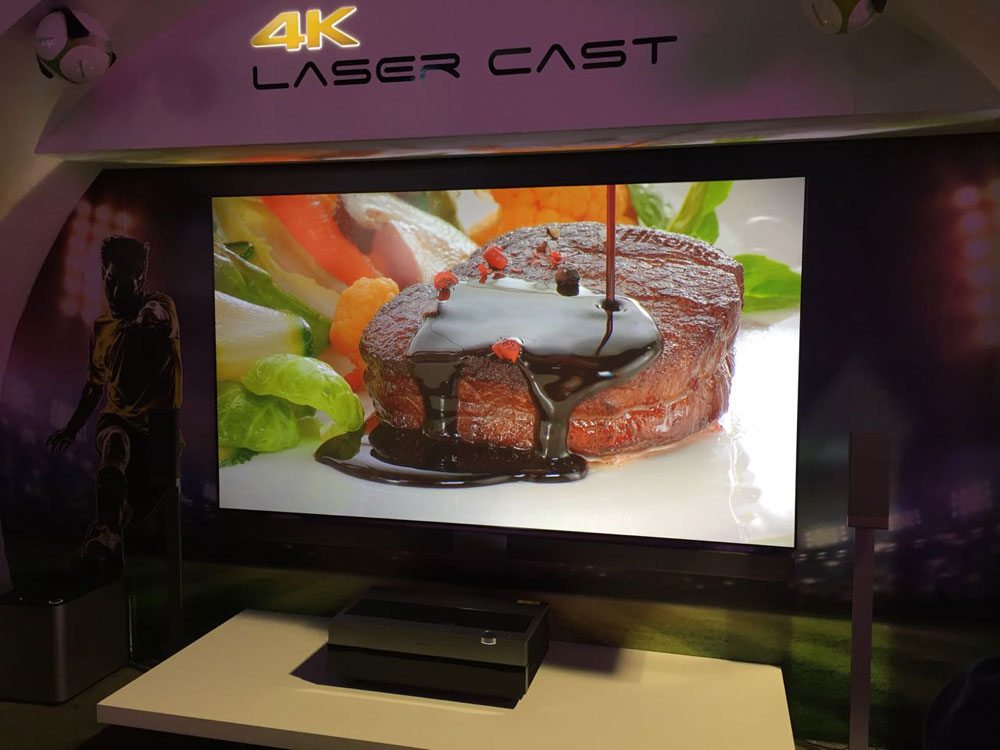
HiSense is a name that's been around for about eight years. But not for projectors. No problem. They showed a pair of laser ultra short throw projectors - one a single the other a dual laser. Prices start at $12999 but that includes an audio system and a light absorbing (ALR) screen designed for ultra short throw projectors. Both are 4K UHD models using the new TI DLP 4K UHD chip set.
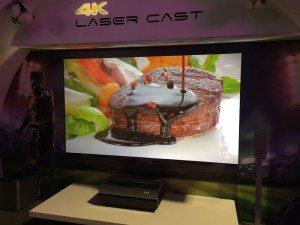
HiSense 4K UHD Laser Projector - will come with screen and speakers for $12999.
Like just about everyone else, Casio was showing off technology not yet shipping, in fact, call them concept pieces, which means we may never see them get to market. But two such products, are worth noting. One is a small camera system that works in conjunction with their projector. It allows the projector to projector on any wall. Yes, ANY WALL. Do you have an exposed brick wall in your living room, or maybe you need to project onto an uneven surface, even a cloth one with pleats. No problem. The camera captures the image to properly set up. It analyses the surface - such as brick and eliminates it so that when you watch content, it appears just like if you were using a white screen!!! Even projecting onto a pleated surface with folds more than an inch deep were not a challenge.
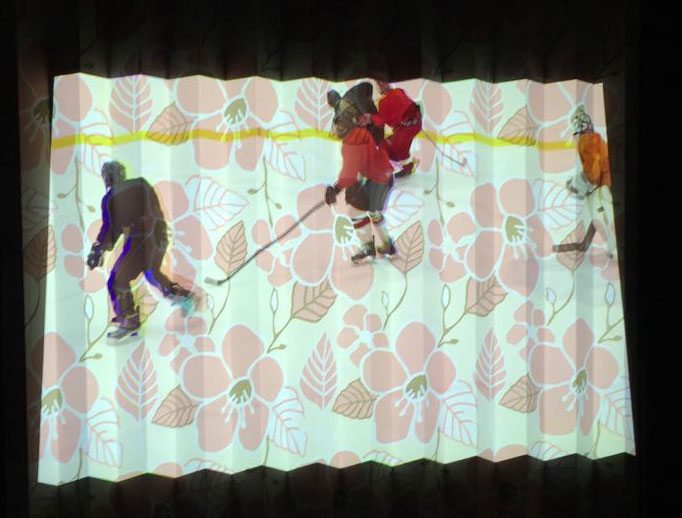
Casio projecting hockey on "pleated, colorful surface"
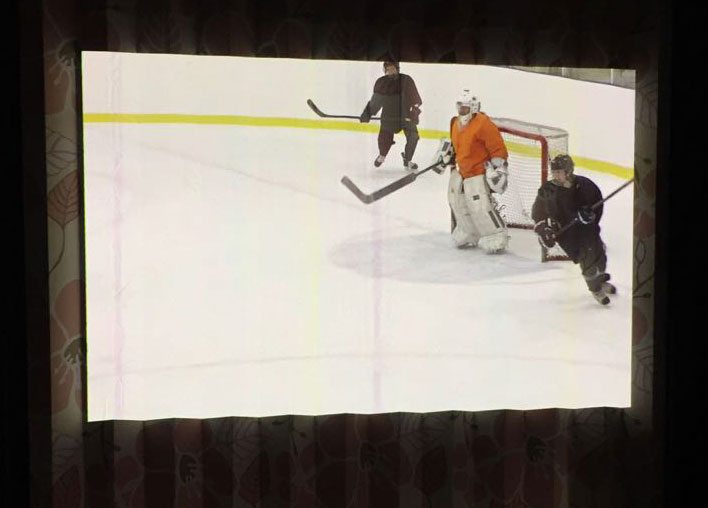
Casio after compensating for surface. Pretty Cool. Works just as well on a brick wall.
Then there is a concept pocket projector - with vertical stand, and an ultra short throw design. The concept model, I believe is about 500 lumens. Very interesting with lots of application including turning a table top into a projection surface so you can watch TV or movies.
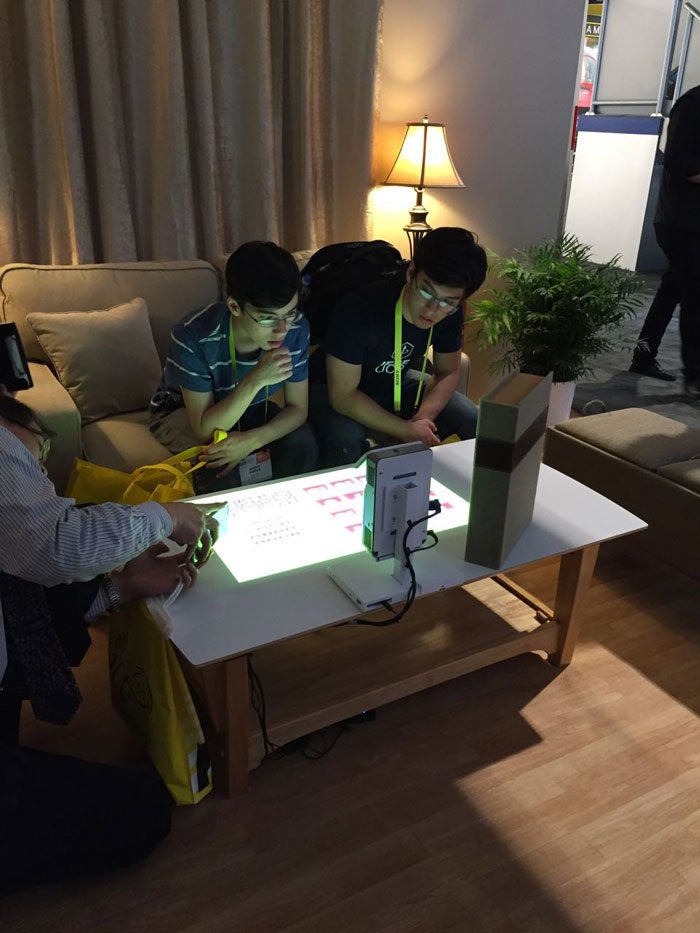
Casio's concept/prototype LED ultra short throw projector
LG rolled out another 1080p pocket LED projector, the ProBeam HF80J. This was announced a couple of weeks ago. I cruised the LG booth, which is gigantic (probably 1000 people in it yesterday at one time), but never found the projector. I'll catch up with it. I already have specs so I'll save that for later. We've been impressed with LG's pocket LED projectors, so I expect we will review this new one.
That's all the time for now. I'm off to the BenQ and JVC suites to see what they have in new projectors. But mostly the rest of today is looking at smart home, home automation gear, for our SmarterHomeAutomation.com site. Happy New Year from Las Vegas! -art
The Sony VZ1000ES laser projector is not the first ultra short throw true 4K projector, but it is the first designed for the home. Sony has previously launched two of commercial models, this one's for your home. This may be the projector everyone will be dying to own, but with a $24,999 list price, it won't fit everyone's budget (for sure)! Important to note, although the VPL-VZ1000ES isn't shipping yet, Sony dealers are now taking orders.
Yes he VPL-VZ1000ES is a home theater projector! But it's really not limited to a home theater and that's very important!. Being ultra short throw, it redefines where projectors can be used at home. Sure you can place this projector in a dedicated theater. Certainly you can watch under low light to near pitch black conditions, like other home theater projectors in a home theater, but it's designed to work in most rooms.
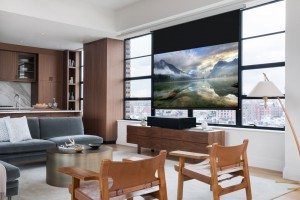
Pair the VZ1000ES with the right screen, and look what is possible!
I'll spend some time below explaining, because this aspect of the VZ1000ES, allows it to take on those tiny 71" and 80" LCDTVS in the same types of rooms that normally projectors could not play in. BTW, you can expect to see more and more ultra short throw home theater models over the next couple of years, from a number of manufacturers. This Sony is designed to let you watch, and be immersed in the "big screen" experience, so you'll probably be going with a screen size of 100" diagonal, or maybe 120". That should impress.
Before I expound on the virtues of ultra short throw combined with 4K (and the right screen), let's take a quick look at the VPL-VZ1000ES projector.
VZ-1000ES Projector = State of the Art Bright Room Projector
This is a true 4K projector. Yes, it meets the UHD specs, but is twice as high resolution, as the minimum for 4K UHD: 3840x2160 resolution. That works out to 8 megapixels), no pixel shifting 1080p, or for that matter, it's also much higher resolution than the new 4 Megapixel DLP (UHD) models just starting to ship. Even those new DLP's suffer from their pixel size being twice that of this Sony. The bigger the pixel, the less detail. As of CES 2017, Sony, I believe is still the only company shipping true 4K to the home market, although JVC has announced one of their own - for $10,000 more than this projector!
Of course the VZ1000ES supports HDR, and true 4K, BT2020 color space, etc., as do the other Sony true 4K projectors - which start with the VPL-VW365ES at $9999. The HDR and BT2020 color space simply dramatically up the picture quality compared to 1080p, so you are getting far more, than "just" true 4K resolution.
VZ-1000ES Basics
As previously mentioned, the VZ1000ES is a laser projector. That means it will go years without significant loss of brightness (a problem for lamp based projectors), and even better, color accuracy will hold, whereas lamps change color balance over time measured in hundreds of hours. There are a number of other advantages to lasers as well (including no replacement lamps to buy).
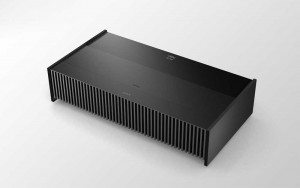
Sony VPL-VZ1000ES - 2500 lumens of true 4K, ultra short throw projection, designed to work in a wide range of rooms.
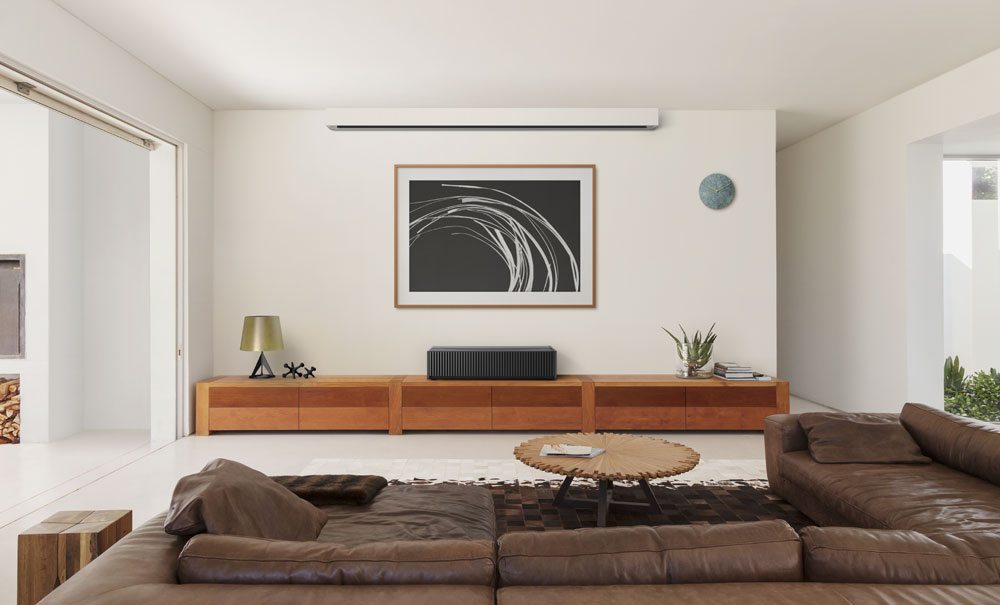
This Sony projector's footprint is 36 inches wide, by 20 inches deep, and 9 inches tall. (WxDxH, 925 x 494 x 219mm). It places as close as 6 inches from the screen wall.
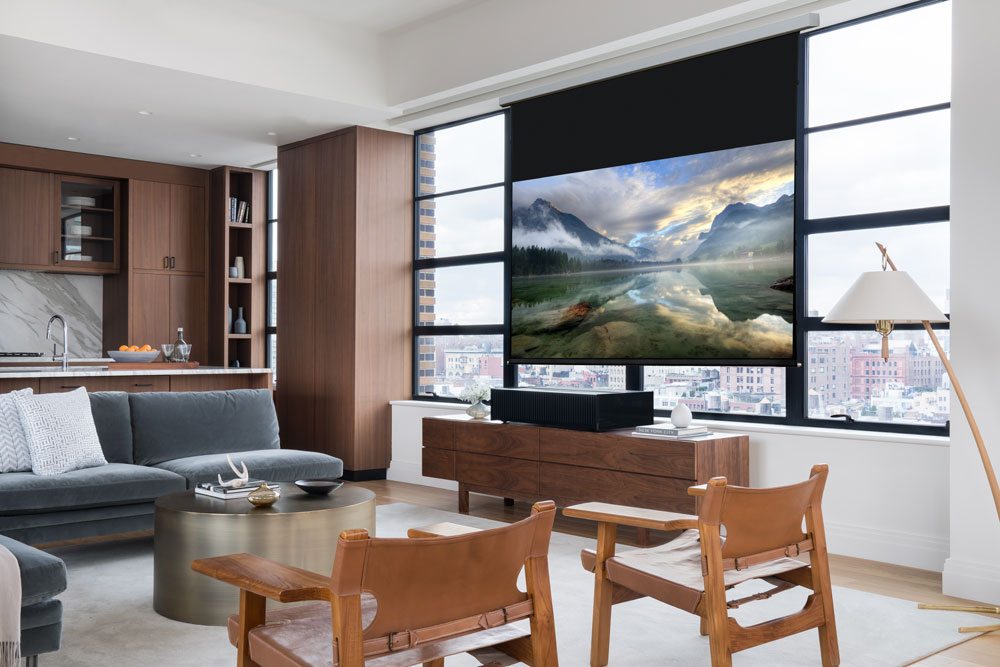
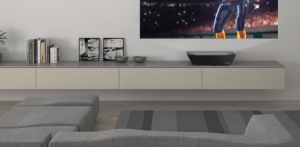
As you can see from the images, that's a reasonable size to place on a credenza or other piece of furniture that will be below your screen. Of course, if you are putting this in a non-home theater, you'll probably want to pair it with a motorized screen so the screen isn't visible when you aren't using the Sony. This is no portable, weighing in at 77 pounds (35kg).
Screen Magic - Using the VZ1000ES in a Bright Room
We've discussed and created a video about how the right screen with the right projector can tackle rooms thought to be impossible for projectors just a few years ago. Basically, a class of screens sometimes called ALR or "light rejecting" or more accurately "optically light absorbing" screens, is the secret to success. These screens were first popularized by Screen Innovations (I use their Slate 1.2 in my bright living room). Today though, ALR type screens are available from a number of companies, and vary tremendously in price - although even the more expensive ones won't be considered a major expense by folks that can afford the VZ1000ES.
The idea behind these screens, is that only light hitting them from a very narrow angle gets reflected, the rest gets "absorbed". Thus, with a normal projector and an ALR type screen like the Slate, light from the sides, lights almost above the screen, is pretty much absorbed, not reflected back at you. Now with a normal throw projector, there's still the issue of light coming from around the projector (i.e. a window behind the projector, or lights, for that matter). You'll see that affect in my video.
But with the VZ1000ES, combined with an ALR screen specifically designed for ultra short throw, there just isn't going to be any significant light coming from right below the screen (except, of course from the projector), so almost no ambient light affects the picture. Awesome.
That's the ticket to bright room projectors. One thing of note, I said many screen companies offer ALR screens. True, but as of this time, only SI has figured out how to design an ALR screen that can be retracted. That is, they have the only motorized one on the market.
Since the idea is not to have a visible screen in your living room or media room, when not watching, at this time only SI has a viable solution in the form of their motorized screen for ultra short throw.
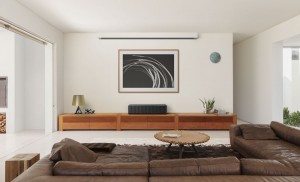
Sony VPL-VZ1000ES shown on a wall unit, with a motorized screen. Screen is retracted to show what the setup might look like when not in use.
Boy am I looking forward to reviewing this projector! In the meantime, I'll check it out here at CES. BTW, I'll be publishing my full review of Sony's flagship 4K projector, their $60,000 VPL-VW5000ES, in the next couple of weeks. There will be a lot in common between the two, although the 5000ES is not short throw.
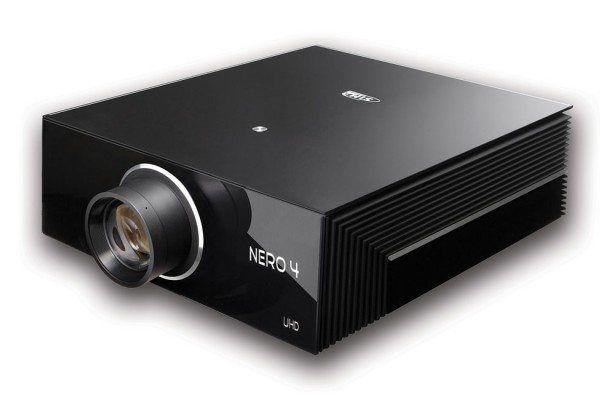
That's it. Although I haven't seen it in action yet, I'm pretty sure I want one. Donations to help make that possible are appreciated. OK, that's not going to happen, but Happy New Year. Make this your year to move up to a 4K projector. -artSIM2, the stylin’ Italian projector company best known for small, often sexy looking high end projectors announces the Nero 4 home theater projector. (Ok, it's not one of their sexy looking ones - until you watch what it can do.) SIM2 offers – both single and 3 chip DLP models, and looks to have beaten the field of DLP projector manufacturers in terms of offering a projector using TI (Texas Instruments) 4K UHD chip set.
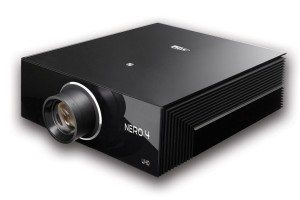
The Nero4 was demonstrated in the typical really dark trade show booth theater. Pretty Impressive
What we’re talking here is a 4 megapixel chip. By comparison true 4K, is 8 megapixels. Still, some folks created the UHD standard, which works 4K into the name, but has pixels twice the size of true 4K. That’s why many of us refer to these and 1080p projectors that can accept 4K content as “Faux-K”. Still, this one’s half way between 1080p and 4K. The TI chip, and therefore the SIM2 Nero 4, uses pixel shifting, a technique to improve detail, that was first popularized by JVC, and is now found in all of Epson’s best home theater projectors as well.
Ultimately, though the SIM2 advantage is that their pixel shifting Nero 4 still starts with pixels half the size of those 1080p pixel shifters.
SIM2’s looking to price this projector around $30,000, but keep in mind, as they are a high end company, you are entitled to some wonderful support, from a group of highly trained, "high end" installing dealers.
It’ been several years since we got to review a SIM2, but I’m hoping, after early contact with the folks at SIM2, that I may just be able to get my hands on this one. Or if not me, then Ron who lives in Florida, only a hundred miles or so from SIM2's US operations location.
That it is likely to be the first 4K UHD projector available, shipping, hopefully in November, although companies such as BenQ, Vivitek, and Optoma have discussed bringing out 4K UHD projectors as far back as CES 2016 this past January. As it turns out (update), I did find other 4K UHD projectors at the show, and already did a Facebook Live video about one of them, the Vivitek
SIM2 isn’t done just yet.. A second new projector launched at CEDIA is the SIM2xTV.
SIM2xTV: Place it on the furniture, or recess it into your cabinet so that it is flush, and therefore barely noticeable.
This one is an ultra short throw projector boasting 2900 lumens, and it uses a laser light engine (laser phosphor, as is typical) that will sit inches from the screen. This will be a 1080p projector with a base price in the US of $15,000. It uses a “hybrid” laser engine, and can project images up to 110” diagonal. There’s even an “invisible” version for installation, that is $18,000. It's angled, and designed to be dropped into a "cutout" in a piece of furniture so that it's flush with the top of the unit. Very interesting, and a bit more affordable than I would have expected from SIM2. I’ll update you folks regarding these new home theater projectors, as they start shipping... -artThe LS10500 dual laser home theater projector from Epson will ship this fall 2016. In most ways it is the same as it's predecessor. The LS10500 is a $7999 list price projector sold through Epson's authorized installing dealers in the US. This model adds additional 4K support. When the older version
(more…)What better time to tell you about BenQ’s sleek new flagship home theater projector, the HT6050, than as I’m heading to CEDIA.
Here’s a twist, BenQ won’t be exhibiting at CEDIA this year. Officially, the HT6050 was first announced mid-July, Still, now is when home theater enthusiasts are “paying attention” due to the other announcements at the show.
Let's start with the basics - single chip DLP projector, boasting 2000 lumens, multiple lens options and 1080p resolution.
(more…)