The Elite CineTension projector screen earns our Hot Product Award for Value. I found no real issues, with the screen, with perhaps the biggest "failing" being the slight shift in color temperature, but then, first, its a small shift, and two, it's easily correctable with a basic user calibration disk.
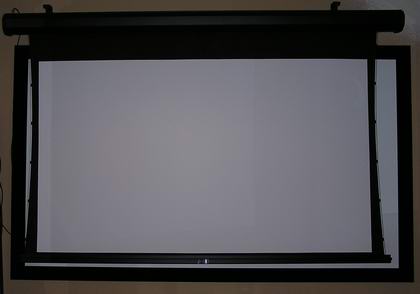
The image above shows the Elite CineTension 92" projector screen in the down position. You can see the Carada Brilliant White Criterion fixed wall screen (106") behind it.
What I really liked was the cost proposition - These Elite tensioned screens basically cost half or less of the "big name" brands like Da-lite and Draper, and far less than Stewart.
For many, they may choose to buy the Elite, with tensioning, for about the same price as a motorized Da-lite screen with similar surface, but no tensioning at all.
One key point - the purpose of a tab-tensioned screen is to maintain a very flat surface without waves or creases, on motorized or pull-down screen after years of opening and closing. Of course, I have no way to really test how the tensioning will hold up over several years, but I am heartened to know that the tensioning is adjustable.
Also, as mentioned, I had for the most part, left the screen in the up position for most of 2 months, and the screen exhibited no unevenness issues once I started using it for this review.
In addition to affordability, the Elite Cinetension projector screens come with two remotes - who could ask for anything more, and with 16" of drop, above the screen surface, it will work in most rooms.
Screen sizes available (16:9), for the matte white and gray surface are currenly:
84", 92", 100", 106" 121", and 135" diagonal.
In addition there is a high gain surface (1.5 gain), but as of the Elite price list I have (about 5 months old, they were only offering the 1.5 gain in 84", 92", and 100", although I wouldn't be surprised, if they haven't added the larger sizes by now.
Personally I still slightly favor the Carada Brilliant White Criterion fixed wall screen mounted behind the Elite, primarily for its slightly higher gain, and the knowledge that it's colors are a touch more accurate, but then my fixed wall Carada, costs about as much as the Elite Cinetension. Since I don't need a motorized screen in the testing room, the Carada works out just fine. Apples to Oranges. If, however I did need a motorized screen in the room, I would have to say at this point, I would probably be very happy with this Elite, or, if I was feeling really rich, I'd opt for a motorized and tensioned Stewart Studiotek 130. Of course the Stewart would be more than three times the price.... Not a bad compromise!
With no real flaws, what appears to be good build quality, and all those extras, the Elite CineTension is going to be hard to beat for those wanting a screen (washable surface- I think I forgot to mention that, earlier), that should last for years, and stay nice and flat!
So, overall, I think Elite has done it again, provided a great value, and allowing people to have a very good screen at a price that lets them throw a lot more money toward their projector or other parts of their home theater. Just think - between the Elite, and brands like Da-lite, the savings are enough to buy you an HD-DVD player, and more than a dozen HD movies... Hmmm.... not bad.
PS. My thanks to Dave Rodgers from Elite. He had been lobbying me to review the CineTension screen for many months - and I kept telling him I didn't have a good way to set up motorized screens easily for review.
Fortunately Dave doesn't live that far from here , he's the one that came down, and mounted the Cinetension for me, in my Testing room. He installed all the brackets, etc. But, more to the point, he also set things up so I can easily take it down and put up other motorized screens - even from other manufacturers. I hope Da-lite and others appreciate his help, because, without it, it would be a much longer wait until I reviewed another motorized screen in the testing room. All that work makes for a pretty good bribe, and I promised him the CineTension would be the next screen reviewed! We're even now!
The next projector screen being reviewed (Which I was going to do before the Cinetension), is my all time favorite screen, the motorized Stewart Firehawk G3 128" diagonal, which is now the permanent screen in my theater (referred to as the Viewing room in my reviews).