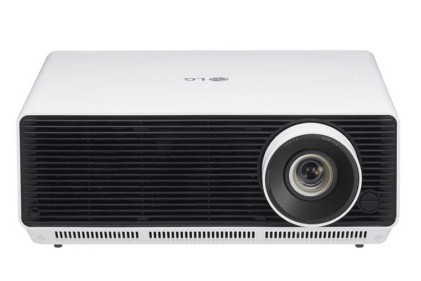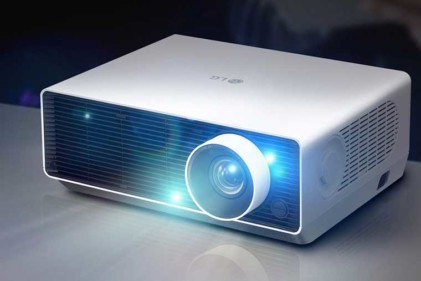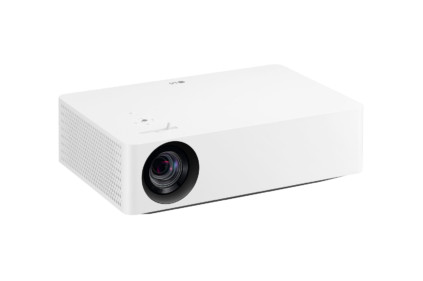
3D Projectors: LG CF3D Projector Review
Welcome to our in-depth projector review of the LG CF3D 1080p home theater projector. As always we are rushing this to you, because we know you are waiting! Enjoy!
A quick note: One of these CF3D projectors, was the first 3D projector to come in. LG provided me an early engineering sample back in Q1 of 2010, which I played with for a while, while trying to gather up some 3D content. LG sent me a full production CF3D projector for this review, late September.
November 2010 - Art Feierman
|
|
![]() |
LG CF3D Projector Overview
At first glance I considered the LG CF3D to be an early 1080p 3D home theater projector. While it's getting a longer review - as home theater projectors do, ultimately, the projector should be considered a commercial 3D projector. It can be, and is going to be used in home theaters and screening rooms, for its 3D abilities. As a 2D projector for home theater, though, it's really, really expensive. It will be because of 3D use, be it business, education, entertainment or home theater usage, that this projector will be purchased. (Are there any gamers out there prepared to drop $15,000 for a projector for 3D gaming? I'll bet there are!) This projector should find itself in the halls of higher education, and many scientific and engineering applications as well.
The CF3D might be called a passive 3D projector - in that it uses passive 3D glasses, not active ones. That also means, however, you need a screen optimized for 3D. For our review, I got to use two screens at different times. One was a Da-lite 3D screen, that really had a noticeable hot spot, which is easy to see on many of the images I took. (Quite honestly, the hot spot was "over the top" but, not as bad as the pictures would make it seem - especially the menu photos.) The second screen, though was a much brighter 3D screen from Stewart, which was drastically superior with virtually no hot spot at all. The brighter screen has less contrast, but still was a major impovement. The point, of course, is that 3D screens are going to be improving a lot over the next couple of years, as well.
Since you automatically lose more than half your brightness with 3D systems, the CF3D projector separates itself from the announced home theater 3D projectors, like the Sony and the JVCs, by offering a serious jump in brightness, claiming 2300 lumens compared to the announced Sony's 1000 lumens and the JVCs all claiming 1300. While I don't have any accurate measurements, I'm figuring for general discussion, at least 60% drop in lumens for 3D viewing. While that reduces the Sony to less than 400 lumens in its brightest mode, the LG would be just below 1000 lumens. That's a huge difference.
The point is, if you want a 3D projector in a home-like environment and screen size, the LG has the muscle to do the job, and even on a decent sized screen, something the others aren't quite up to.
The CF3D might just find itself comfortable in your home theater, but I see it far more at home in university scientific, medical or engineering applications. Years ago my old company equipped a number of command and control rooms with projectors - for oil companies like Arco, and we also did command and control for the US Navy, including the Bonhomme Richard, which was the primary command and control in the Indian Ocean, for years relating toAfghan operations. All of those applications begged for 3D displays, but no practical technology at the time. I could definitely see many of those projectors replaced with 3D models like the LG, as long as they have the necessary 3D software for their applications. Let's face it, for architecture, molecular modeling, brain scans, teaching the solar system, and a myraid of other purposes, 3D offers tremendous advantages.
Let's get started.
CF3D Projector Highlights
- Brighter than most 3D projectors currently available
- Full 1080p resolution, and HDMI 1.4 support, for future compatibility
- Picture tends to be cool (shift towards blue) out of the box
- Projector calibrates very nicely with really very good color accuracy
- 6 panel LCoS design - basically two projectors sharing a lamp and lens
- 3D with passive glasses look anywhere from very good to so so, depending on the quality of the 3D production.
- Very large projector
- A bit noisy for a home theater environment
- Excellent for serious commercial 3D applications
Projector Specs for the LG CF3D
MAP: $14999
Technology: LCoS (6 chip)
Native Resolution: 1080p (1920x1080)
Brightness: 2500 lumens claimed (our testing show it getting awefully close)
Contrast: 7,000:1
Zoom Lens ratio: 1.3:1, manual
Lens shift: Vertical - manual
Lamp life: 3000 hours at full power, 3500 at low power, dual lamp system
Weight: 46.4 lbs. (20.7 Kg)
Warranty: 2 Years Parts and Labor
Click for more complete specs and brochure: LG CF3D
CF3D Projector - Special Features
CF3D 3D Projector uses Passive Glasses
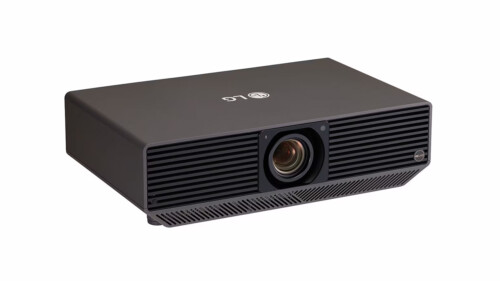
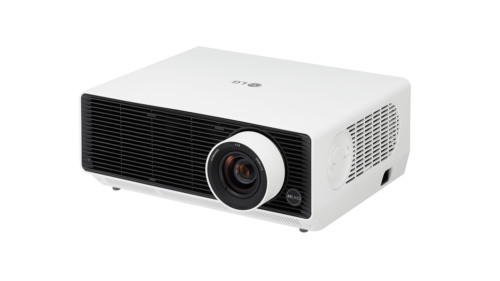
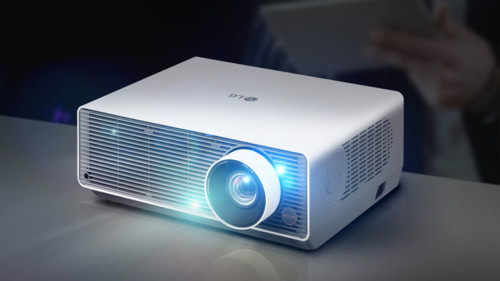
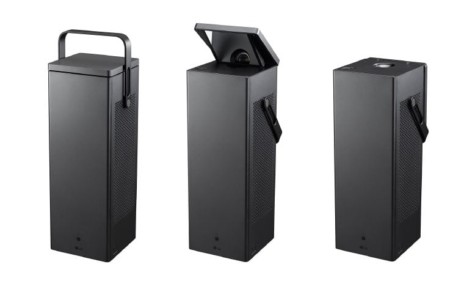
What a machine - basically the reason it's physically large, is that it has two projectors in one box, each with its own lamp, its own R,G,and B LCoS panels, but then combines all that, and shoots a bright image out the single 1.3:1 zoom lens.
The CF3D was not only the first 1080p 3D projector that we've received for review, but it is also one of only two that runs with nice, low cost passive glasses. In fact, the projector comes with six pair, and if you need more, while I'm not sure of the pricing, figure you can probably pick up the extra two dozen passive glasses you would need for a 30 student classroom, for no more than the price of one, or two active glasses needed by most other 3D projectors.
As to which system - 3D active, or passive, is ultimately better, I think the final determinations will be at least a year out. It's quite possible that some of the advantages of one system, might end up becoming the advantages of the other. Never can tell with early technology. Consider, for years, DLP dominated contrast and black level performance, but these days, 3LCD projectors like the Epson's and LCoS projectors like the JVC's (I'm now talking home theater space where blacks are a key performance factor), now exceed the performance of today's DLP projectors.
This past summer, we had 8 people at one point, checking out the LG doing 3D material in the old testing room. (I have a number of pair of my own passive glasses). Let's just say, at current prices, if you have a projector needing active glasses, that could easily have been an extra $600 to $1500 for some glasses. (Today, late 2010, it still takes a about $3000 to equip a classroom with active glasses for 3D, although those prices will plummet over the next two years.)
I will have discussed the trade-offs between active and passive - glasses, and projector designs, in the 3D Report.
Creative Frame Interpolation: TruMotion
The CF3D projector is another LG projector sporting creative frame interpolation, for motion smoothing. Like the previous LG reviewed, the CFI is not as smooth as some. It's functional, and for example very usable for sports, but, while I normally say, you can use CFI for movies but it changes things from the director's intent, so best not to. That said, many will run it for movies, just like most people leave it on, on their LCDTVs that sport the feature.
For movies, I found some minor artifacts, as well as the whole "soap opera or live digital video look".
For more commercial applications, however, it may be of greater use, as most of the content would likely be digital to start.
Color Management System (CMS)
The LG is fully equipped with a CMS system to adjust the individual primary and secondary colors. There are two savable "Expert" modes: Expert 1, and 2. We used those to save our "best" mode settings (color temp = warm), and for a quick-calibrate, based Expert 2 on Normal color temp.
LG CF3D Projector: Dynamic Iris
The real bottom line is that the black level performance of the CF3D is very respectable for a commercial projector, and even a screening room. I can't think of more than a handful of commercial/business/education type applications where the black performance wouldn't be just fine.
On the other hand, if you are planning to use the CF3D as a home theater projector, the 7000:1 contrast ratio gives you a clue. Black performance is very entry level for a home theater projector in 2D. The whole 3D process darkens everything, and may also be improving black levels somewhat, but certainly not enough to catapult the CF3D projector's blacks into the same class as any of the ultra-high contrast home theater projectors - some of which are as little as $1800.
On most bright and mid scenes, you won't notice the black level performance, but if you must view a lot of dark images, that's where the so-so blacks will come up short. For movie viewing, I found the blacks to be a good bit disappointing, but then, every projector we've looked at so far, that can do better blacks - can't do 3D at all. That, however will change shortly, with new reviews coming of the 3D JVC and Sony home projectors, neither of which are even close in brightness.
Overscan Feature, and Edge Masking Issues
The LG CF3D only offers overscan, and not edge masking (that's very common.) I like to see both on projectors, as edge scanning allows you to crop any edge noise, without giving up the 1:1 pixel mapping (each of the 1920x1080 pixels of the data map directly to the 1920x1080 pixels of the projector). Giving up the 1:1 for overscan (enlarging most of the image, then cropping off what's larger than the screen size), tends to soften the image slightly. I'd rather not quite fill the screen, and maintain the 1:1. This would be true for any precision applications, such as architecture, scientific modeling, etc.