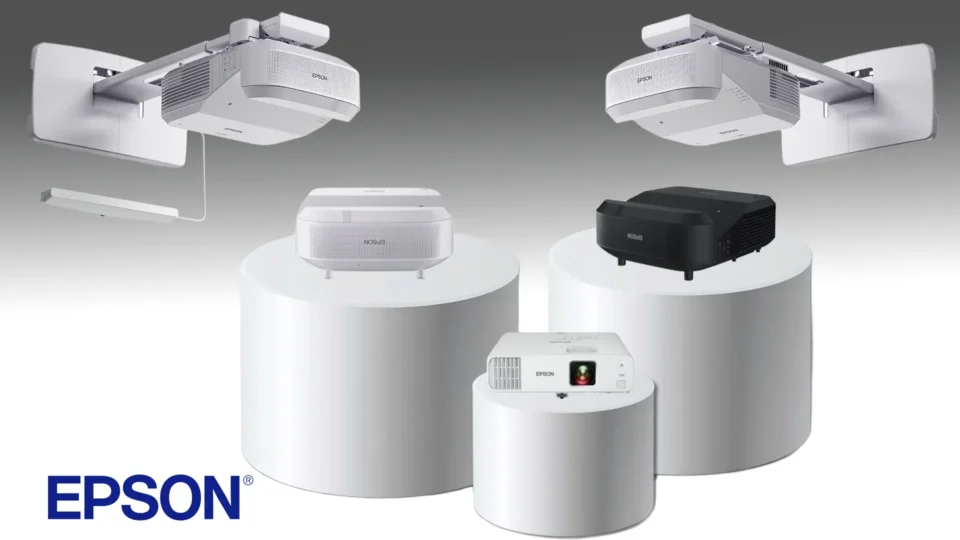
Epson has announced its most significant education and business projector refresh in years. There are 10 new PowerLite and BrightLink models, spanning ultra-short-throw, standard-throw, and portable form factors. The lineup will make its trade show debut at InfoComm 2026 in Las Vegas in early June, where buyers and IT teams can see the full range in action.
Like all Epson projectors, these new models utilize their 3-Chip 3LCD technology. Since each of the three chips handles one primary color (red, green, or blue) simultaneously, Epson projectors can deliver equal amounts of color and white brightness. In well-lit classrooms and conference rooms, this translates to images that remain vibrant under ambient light rather than appearing washed out.
Most of the new models are also equipped with Enhancement Technology (4Ke). While the native resolution of the LCD panels is 1080p (1920 x 1080), this pixel-shifting technology effectively doubles the pixel count on-screen to 4.1 million, which is twice the resolution of full HD. This feature produces images that are meaningfully sharper than straight 1080p, and it accepts 4K source content.
Laser light sources are used across the full lineup to provide up to 30,000 hours (in Extended Mode) of nearly maintenance-free operation. At eight hours per school day, that's roughly 15 years of operation before brightness drops to 50% of the original output — a compelling argument for IT departments managing large projector fleets where lamp procurement and replacement labor represent ongoing costs.
Epson also offers two versions of its Connection and Control Pad. There is an HDBaseT model (ELPCB04HD) that is bundled with the 870Ei or available separately for the 870E and 875E, and a non-HDBaseT model (ELPCB04) that is optional for the 780Ei and 780E. Both versions provide classroom-ready input switching, USB-C connectivity, and streamlined cable management. Both versions are also compatible with a range of existing PowerLite and BrightLink models, so IT teams can upgrade room control infrastructure without replacing projectors.
The models are also compatible with Epson Classroom Connect, which allows wireless casting from up to 50 devices simultaneously and displays up to 4 sources at once with teacher-controlled moderation. This feature works across PCs, Macs, Chromebooks, and iOS devices, and on select BrightLink models, it enables teachers to wirelessly save annotated content directly to OneDrive or Google Drive.
All the projectors also support Wi-Fi 6/6E with WPA3-Enterprise, providing both the speed for reliable screen mirroring and the enterprise-grade security protocols that school districts and corporate IT departments require.
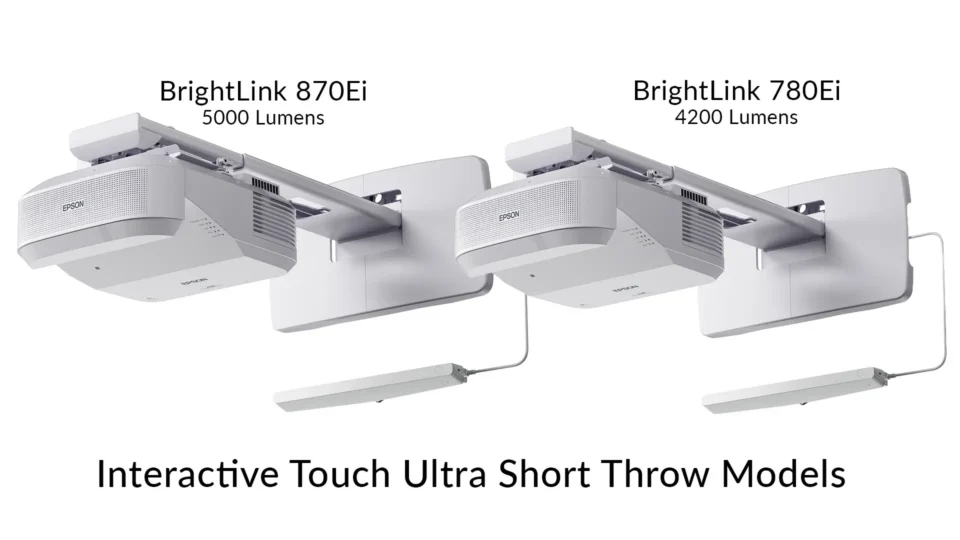
Interactive Ultra Short Throw: BrightLink 870Ei and 780Ei
The BrightLink interactive ultra-short-throw models are Epson's flagship classroom displays, combining large-format projection with full pen and touch interactivity. Since they are UST models, they can project a massive image from just inches off the wall, eliminating shadows and keeping bright light out of students' eyes. The new BrightLink models offer a variety of annotation tools and connectivity designed around how teachers actually work.
BrightLink 870Ei
The 870Ei is the most comprehensively equipped model in the entire new lineup. It delivers 5,000 lumens of equal color and white brightness with 4K Enhancement and ships with an infrared interactive touch module included, enabling up to six simultaneous touch points on screens up to 100 inches. The system supports up to two pens simultaneously. When the stylus is charged for 4 minutes, it will last 50 minutes, and a fully charged pen will deliver 180 minutes of use.
The 870Ei comes bundled with an HDBaseT Connection and Control Pad (ELPCB04HD) wall-mounted panel that gives teachers direct projector control, USB-C display and charging for connected PCs, and multiple HDMI inputs without reaching for a remote. The panel communicates via CAT6 cable up to 40 meters in 4K or 70 meters at 1080p.
The OS-agnostic interface works directly with Chromebooks, Windows, and Mac devices, making it compatible with Google Workspace and Microsoft 365 environments out of the box. K–12 and higher-ed classrooms that require touch and pen annotation, maximum brightness, and an all-in-one control panel solution will find the 870Ei to be the most complete interactive display package in the lineup.
BrightLink 780Ei
The 780Ei offers many of the same interactive capabilities, but the lower brightness (4,200 lumens) results in a lower cost of entry. Interactive display size reaches up to 130 inches with the pen and 100 inches. While it is included with the 870Ei, the optional Finger Touch Module (ELPFT01) is sold separately.
One rechargeable pen is included; a second can be purchased for simultaneous dual-pen annotation. The 780Ei supports the same Wi-Fi 6/6E with WPA3-Enterprise, NFC fleet configuration, AirPlay, Miracast, and Epson Classroom Connect as its higher-brightness sibling. This unit should appeal to schools where interactive functionality is a priority, but the 4,200 lumens is a workable brightness level.
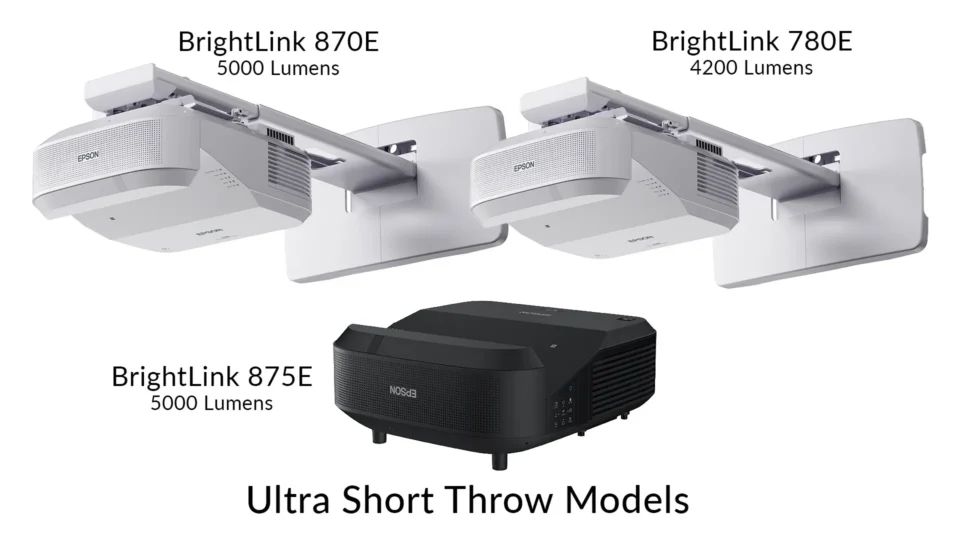
Ultra Short Throw Displays: PowerLite 870E, 875E and 780E
Espon also introduced three new non-interactive UST models. All three support 4K Enhancement, 360-degree placement, and the full suite of Epson wireless casting and fleet management tools.
PowerLite 870E /875E
The 870E and 875E are non-interactive UST projectr that can deliver 5,000 lumens of equal color and white brightness and include 4K Enhancement. The main difference between the models is the color or their chassis. While he is white, white the 875E is black.
They can project an image up to 180 inches, which is five times the screen area of a 75-inch flat-panel display. Thier throw ratio of 0.25–0.35:1 means they can fill a 100-inch screen from roughly 2.5 feet away. They also support 360-degree placement and ceiling, wall, portrait, or landscape mounting along with edge blending and split-screen capability for multi-projector immersive configurations.
The HDBaseT port allows signal transmission over a single CAT6 cable up to 40 meters, simplifying cable runs in larger rooms. For IT teams equipping large classrooms, lecture halls, and conference rooms where maximum brightness and image size are the primary requirements, the 870E is the logical non-interactive anchor of the UST lineup.
PowerLite 780E
The 780E delivers 4,200 lumens, 4K Enhancement, and a maximum display size of 180 inches. Its feature set mirrors the 870E, which includes AirPlay, Miracast, Epson Classroom Connect (supporting up to 50 connected devices and four simultaneous displays with moderator control), NFC fleet configuration and Wi-Fi 6/6E. There is also pending HDBaseT capability and an optional Control Pad (ELPCB04, sold separately). For classrooms and conference rooms with controlled lighting or limited natural light, 4,200 lumens delivers more than adequate image quality at a lower cost of entry than the 870E or 875E.
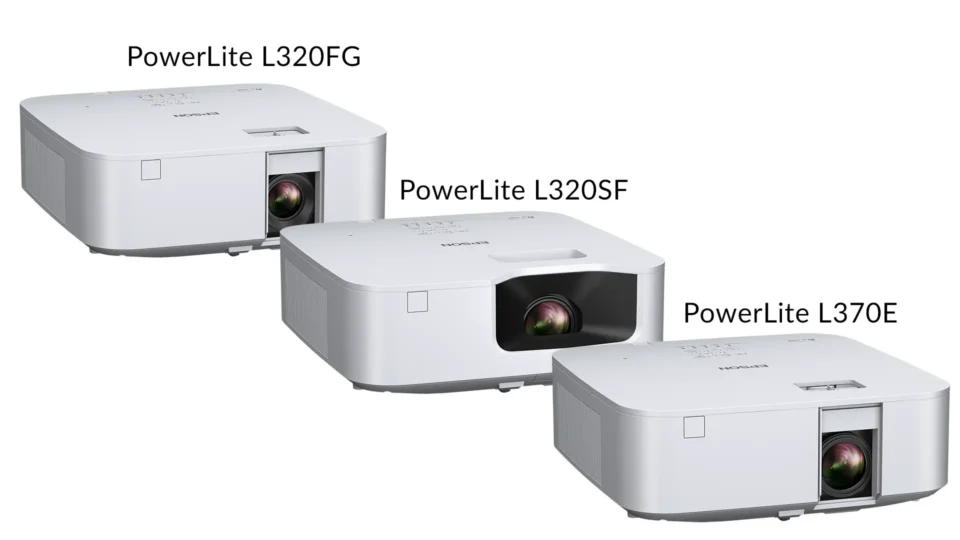
Portable Standard Throw: PowerLite L370EG, L370E, L320FG and L270F
The standard throw L-Series models are great options for ceiling- or table-mounted applications due to thier ultra-portable bodies weighing under 10 lbs. They're designed for flexible multi-room deployment, permanent installation in standard-ceiling-height spaces, or venues requiring exceptionally large image sizes.
PowerLite L370EG and L370E
The L370EG and L370E are the 4K Enhancement-equipped portable models capable of projecting up to approximately 500 inches, so they are a good choice for large lecture halls, auditoriums, and immersive venue installations. Both include built-in wireless connectivity with Miracast and moderator control, 16:6 ultra-wide aspect ratio support, split-screen viewing, dual HDMI inputs, a 16W built-in speaker, and a 30,000-hour laser light source.
PowerLite L320FG
The L320FG delivers Full HD 1080p while sharing the same core feature set as the L370E, including 30,000-hour laser, built-in wireless, dual HDMI, 16:6 support, split-screen, but without 4K Enhancement. This model is good for applications where 1080p is fully sufficient, and budget is a consideration.
PowerLite L270F
The L270F delivers Full HD 1080p with 5,200 lumens of equal color and white brightness from a compact 9.5 lb body. Its throw ratio of 1.32–2.12:1 and 1.6x optical zoom provide installation flexibility for a wide range of room depths, projecting from 31 to 310 inches.
Wireless connectivity requires the optional ELPAP11 module (sold separately), keeping the base price lower for wired-only deployments. Epson Projector Management software supports monitoring up to 2,000 networked units. For budget-conscious classroom deployments and large-venue applications where raw brightness matters more than 4K Enhancement, the L270F offers a strong value proposition.
Model
Category
Lumens
Max Image
Interactive
Availability
BrightLink 870Ei
Interactive UST
5,000
130" (interactive)
Yes
Fall 2026
BrightLink 780Ei
Interactive UST
4,200
130" (interactive)
Yes
Summer 2026
PowerLite 870E
Ultra Short Throw
5,000
180"
No
Summer 2026
PowerLite 875E
Ultra Short Throw
5,000
180"
No
Summer 2026
PowerLite 780E
Ultra Short Throw
4,200
180"
No
Summer 2026
PowerLite L370EG
Portable Standard Throw
TBD
~500"
No
Fall 2026
PowerLite L370E
Portable Standard Throw
TBD
~500"
No
Late 2026
PowerLite L320FG
Portable Standard Throw
TBD
~500"
No
Fall 2026
PowerLite L270F
Portable Standard Throw
5,200
310"
No
Summer 2026
PowerLite L320SF
Portable Short Throw
TBD
TBD
No
Fall 2026
For interactive classroom deployments, the choice between the 870Ei and 780Ei comes down primarily to the brightness required and whether bundled touch functionality justifies the 870Ei's price premium. For non-interactive UST, the 870 and 875E suit brighter rooms and larger spaces, while the 780E offers a lower cost of entry for controlled-lighting environments.
In the portable standard-throw category, the L270F leads in brightness-per-dollar, while the L370 tier steps up with 4K Enhancement and the largest possible image sizes. The L320SF fills the short-throw niche for rooms where neither UST nor standard throw is an ideal fit.
All models are available through authorized Epson resellers. For full specifications and pricing, visit www. epson.com/projectors.