In this report, we take a look at the wide variety of projection screens available for both professional and home theater use. Whether you are setting up a boardroom, building a backyard movie experience, or designing a dedicated home theater, you should be able to find a screen option that fits your budget and application.
There is more to designing a projection system than just picking a projector. Other things like the environment and screen can have a major impact on picture quality. Many screen manufacturers offer dozens of different screen formulations to help you maximize your entertainment experience in your space. These include high gain, ambient light rejecting, and acoustically transparent options, to name a few. To learn more about choosing the right material for your projection screen check out our article entitled, Maximize the Viewing Experience With the Right Screen Material.

Projection screen sizes can range from relatively small to absolutely massive. While many users may want the biggest screen that fits on their wall, sometimes bigger may not be better. Factors like room size and sitting position, along with your projector’s brightness, resolution, and lens throw ratio, all need to be considered when determining screen size.
In addition to choosing the proper screen size, you also need to select the right aspect ratio to fit your needs. Many home entertainment projectors have a 16:9 aspect ratio to support most movies and broadcast content. This will be the most dominant aspect ratio for years to come since 4K UHD (3840 x 2160) and HD (1920 x 1080 or 1280 x 720) content is mastered in 16:9 (also referred to as 1.78:1).
Widescreen 2.35:1 or 2.4:1 aspect ratios are popular with hardcore movie enthusiasts because the majority of blockbuster movies are shot in this format. These aspect ratios are noticeably wider than the 16:9 (1.78:1) aspect ratio used for HDTV broadcast.
Lastly, the 16:10 aspect ratio is still heavily utilized in business and education applications. Commonly used resolutions with a 16:10 aspect ratio include WXGA (1280x800) and WXUGA (1920x1200).
To read more about aspect ratios and how to pick the right screen size, check out our article, Choosing The Right Projector Screen: Screen Size and Aspect Ratio.

Screens can be fixed, mounted, or retractable. Fixed-mounted screens are usually less expensive than motorized retractable screens using the same material. Fixed screens take up wall space even when they are not being used. While this is fine in a dedicated theater, many users do not want a massive screen dominating their living or family room 24 hours a day.
Retractable screens can be manually operated or motorized. These types of screens can lower from the wall/ceiling or rise from the floor. The main benefit of these types of screens is that they retract out of the way when you are not using them, so they don’t dominate your room when not in use. You can even mount a flat-screen TV behind the screen or a whiteboard for meetings to take advantage of the available wall space when the screen is retracted. To learn more, check out our article on Fixed or Retractable Screens.
There are so many projection screen systems on the market that it would be impossible to cover them all in a single article. This guide includes all the projection screens we have reviewed over the past few years, as well as notable screens we hope to review in the future. In this year's report, we have broken the screens down into these categories:

While you can point a projector at a blank white wall or even a sheet and watch a movie, you should utilize a screen for maximum picture quality. A wall or sheet isn’t usually a flat, smooth surface which can cause the image to look distorted.
In addition, outdoor screens are offered in various materials so you can choose the best material to maximize the viewing experience in your space. For example, combining a bright projector with an ALR (ambient light-rejecting) screen can help combat any surrounding ambient light.
Inflatable screens are a budget-friendly option that comes in extremely large sizes. Since they are often waterproof, they are a great option for outdoor environments with unpredictable weather. They are also easy to store and set up, and most of them can be inflated and deflated without needing a manual pump.
Freestanding folding frame screens are the most portable option. Since the screen is fastened onto a rigid frame, the material is pulled tighter than an inflatable screen, resulting in a consistent and flat surface for projecting images, even in outdoor or windy environments.
This reduces image distortion caused by a saggy or wrinkled screen. However, large folding frame screens are more expensive than inflatable screens. While framed projection screens are less portable than inflatable screens, they are still relatively easy to transport.
Ultimately, choosing between a framed projection screen and an inflatable screen depends on your specific needs, budget, and intended use. A framed projection screen may be a better option if you prioritize stability, durability, and image quality. However, an inflatable screen might be more suitable if portability and quick setup are crucial.
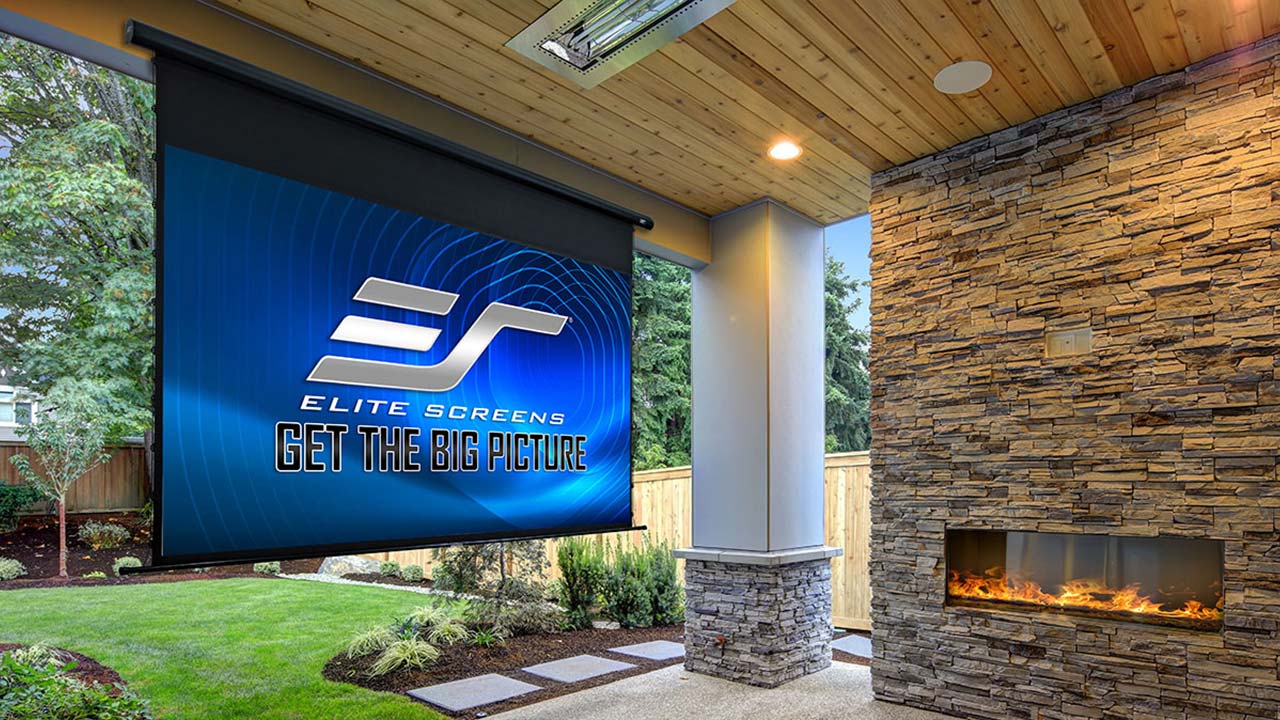
Lastly, we are seeing more weather-resistant retractable screens rated for outdoor applications. These screens can be mounted on the wall in the backyard or hung from a pergola. When not in use, it can be retracted so it is out of view. Retractable screens can be retracted manually or motorized. Companies like Elite Screens are even offering weather-resistant motorized screens with a built-in battery that can power the screen up/down for several months between charges. Since motorized screens need to be weather resistant, they are the most expensive outdoor screens on the market.
So let’s talk about some outdoor screens.
If you are interested in purchasing the projector mentioned in this article, we always appreciate it if you use one of the links in the article because Projector Reviews earns a small commission on the sale at no cost to you.

The Yard Master Tab-Tension Wireless is a battery-operated outdoor 125″ in 16:9 projection screen. The built-in rechargeable Li-on battery can last up to 200 cycles on a single charge.
It is IPX3 rated for water protection making it ideal for backyards, patios, pool decks, and recreation room installations. The tab-tension design provides uniform tension on all sides for a flat and taut projection surface.
The CineWhite® front projection surface provides excellent brightness uniformity, and color reproduction with superb image clarity for nighttime movie presentations. This material is compatible with a wide variety of projectors including ultra-short throw models.

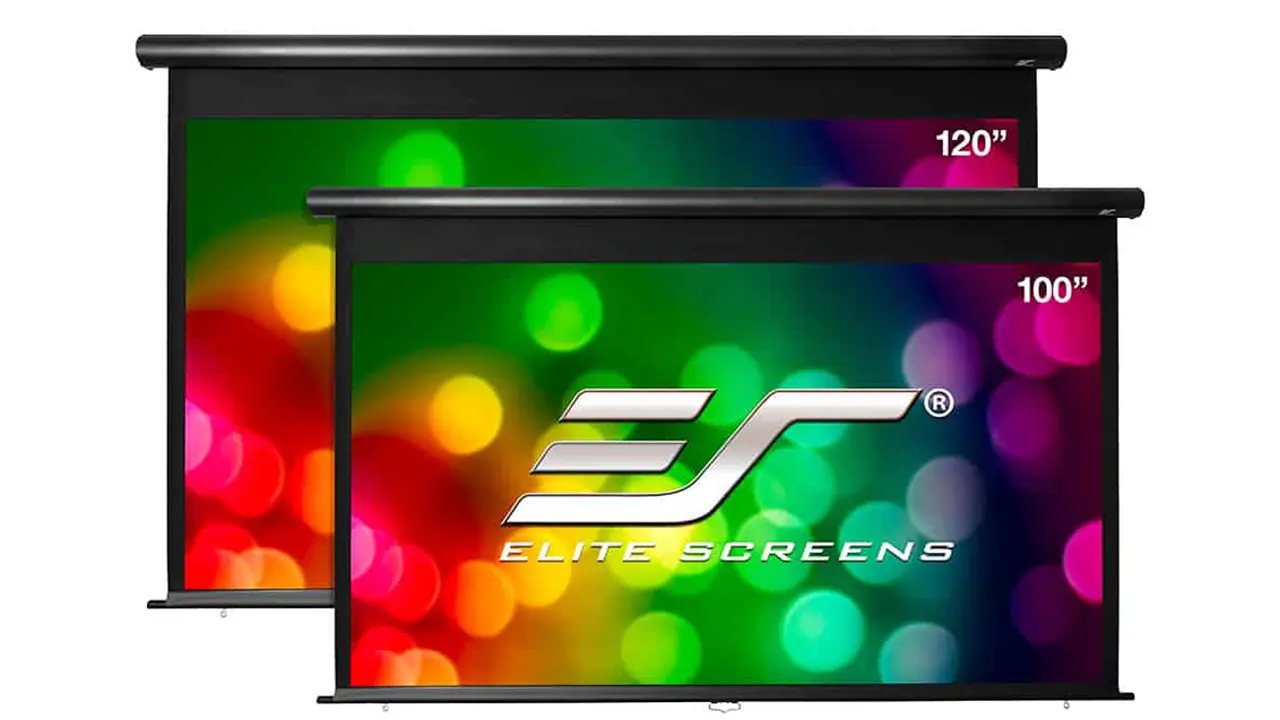
The Yard Master Series is a manual pull-down screen that is IP65 rated for water protection for outdoor applications.
It is ideal for backyards, patios, pool decks, and recreation room installations. This 16:9 screen is offered in both 100” and 120” sizes. The slow-retract system allows hands-free operation during screen retraction
The 1.1 gain MaxWhite® projection material is ideal for the outdoors while it provides a wide viewing angle that will accommodate your entire viewing audience
This material is not compatible with Ultra/Short-throw Projectors

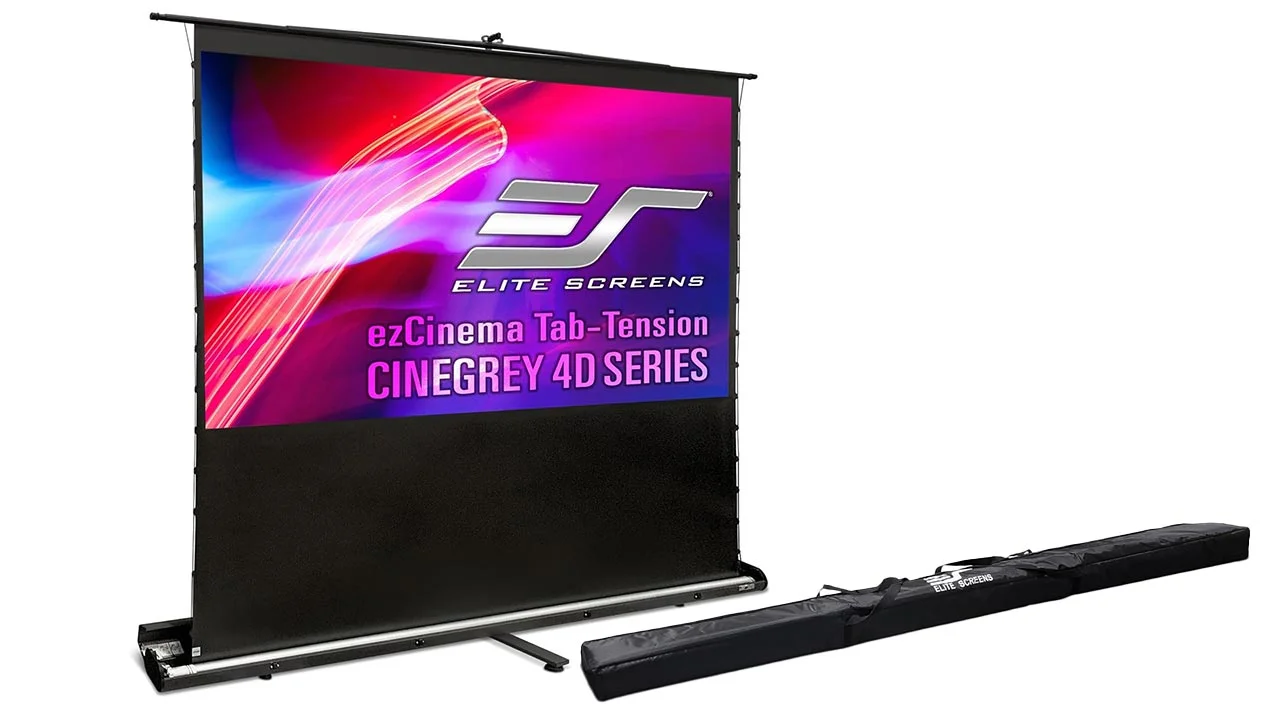
The ezCinema Tab-Tension CineGrey 4D Series is a high-quality portable projection solution that is easy to set up and use in a variety of environments.
Its manual floor pull-up design that eliminates the need for wall or ceiling installation.
The screen we reviewed was equipped with CineGrey 4D ALR material which has 1.1 gain. Since its angular-reflective technology rejects light from the ceiling, floor, and sides the material offers 63% ambient light rejection.
The material is also ISF-certified, meaning it meets Imaging Science Foundation standards for accurate color reproduction.
The ezCinema Tab-Tension CineGrey 4D is designed for standard-throw projectors and is currently available in four sizes.
Read our full review here.

The Yard Master 2 is a fast-folding-frame outdoor projection screen. Its lightweight aluminum frame allows it to be set up in minutes.
Elite offers front- or rear-projection materials. For front projection applications, the Yard Master 2 ships with 1.3-gain CineWhite screen material.
The Elite rear projection application offers 2.2 gain WraithVeil rear projection screen material, ideal for events such as clubs, restaurants, trade shows, meeting rooms, and outdoor evening presentations.
The Elite Screens Yard Master 2 series is available in various aspect ratios, screen sizes, and screen material choices, depending on your specific needs.

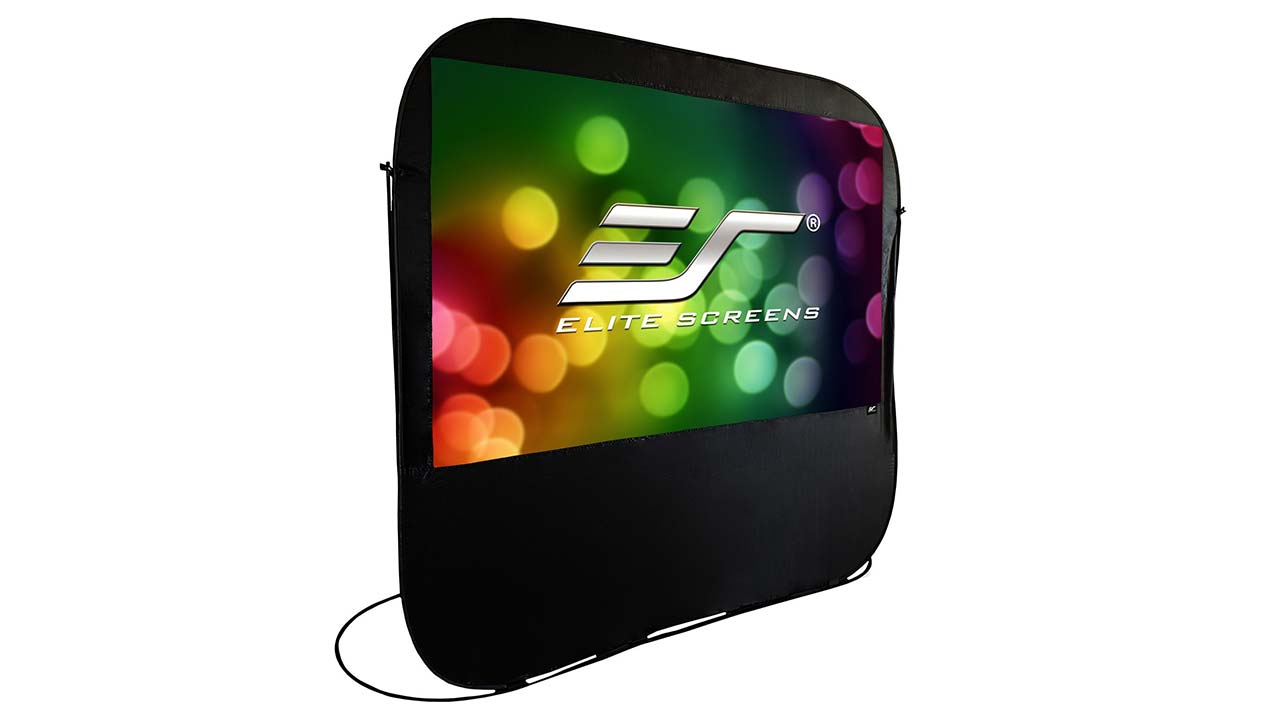
The Elite Pop-Up Cinema Series is a portable spring-framed fast-folding projection screen for instant setup for outdoor or indoor environments.
The lightweight spring metal construction allows the material to “pop-up” instantly while supporting the SilkWhite material and its black-mesh border.
The SilkWhite screen material is compatible with both standard and short-throw projectors. It has a 1.1 gain and delivers a wide viewing angle.
The SilkWhite projection material is a synthetic fabric designed for the rigors of outdoor use while also doubling as an exceptional projection surface for indoor presentations as well.

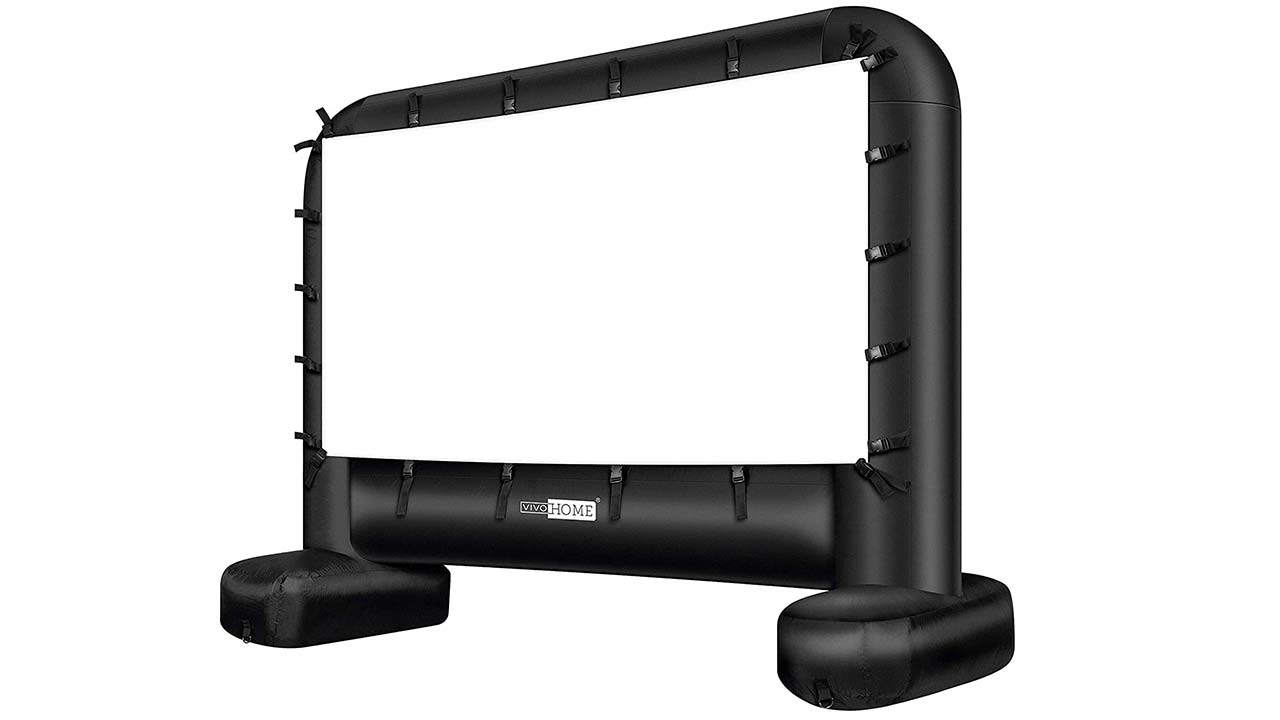
The VIVOHOME screen is easy to set up and it is available in several sizes ranging from 14ft to 24ft. This affordable inflatable movie screen is made of high-quality, durable cloth and is seam-free to ensure a quality viewing experience.
It includes a quick blower that can blow up the movie screen in a few minutes and, when plugged in, keeps it inflated throughout the show. The fan pump is quiet to ensure that the screen stays expanded without adding distracting noise.
The most significant benefit of a blow-up screen like the Vivohome they offer a massive screen size but can be stored in a compact package when not in use.
Fixed screens are attached to the wall and they are usually less expensive than a motorized retractable screen using the same screen material. Fixed wall screens are a great option for rooms intended specifically for viewing, for example home theaters and media rooms. Since they are permanently mounted, they are screens that are normally the focal point of a room and the rest of the design needs to work around it.
While this is fine in a dedicated theater, many users do not want a massive screen dominating their living or family room 24 hours a day. However, fixed screens are extremely popular because the installation process is relatively quick and easy, and they deliver the best performance-to-value ratio.

The screen material is attached to a rigid frame in a fixed screen. Since the screen is tightly tensioned, it is wrinkle-free and perfectly flat, which results in a distortion-free image. Once correctly installed, the fixed screen will remain stationary and will not move or vibrate during use. In contrast, a retractable screen might move slightly or oscillate due to wind or vibration, impacting picture quality.
If you are looking for a really large image, fixed-frame screens are usually the best solution. Many manufacturers offer fixed frames in sizes exceeding 250 inches.
If you are interested in purchasing the projector mentioned in this article, we always appreciate it if you use one of the links in the article because Projector Reviews earns a small commission on the sale at no cost to you.

The Balón Edge series features a thin edge, creating a sleek and modern look. In addition, the series includes a range of screen materials optimized for various applications, including ambient light rejection, ultra-wide viewing angles, and more. For our review Stewart Filmscreen equipped the screen with their proprietary MicroPerf X² THX-Ultra perforation pattern, improving sound transmission while maintaining image quality.
It is particularly well-suited for use in high-end home theater and media room installations and in conference rooms, boardrooms, and other commercial settings where high-quality projection screens are required.
The Balón Edge is a good choice for those who want to create a truly immersive and engaging viewing experience and are willing to invest in a high-quality projection screen to achieve that goal. Balón Edge includes a half-inch black border to reduce unwanted overscan. There is also a Balón Borderless version which eliminates the black border, allowing the image on the screen to appear to float in the room.
Read our full review here.

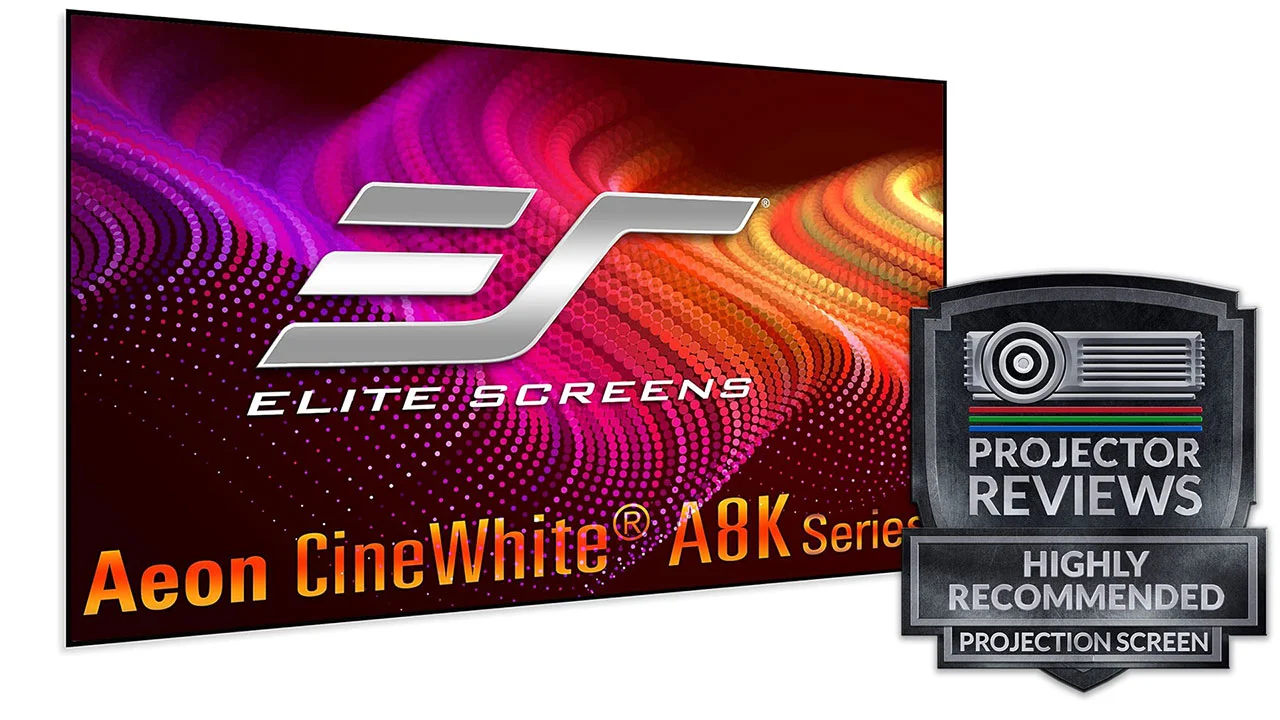
The Elite Screens Aeon CineWhite A8K is an acoustically transparent screen system, and it is available in 16:9 and 2.35:1 aspect ratios. The Aeon CineWhite A8K targets home theater enthusiasts who care about sound as much as video quality.
Compared to other high-quality acoustically transparent screens, the Aeon CineWhite A8K is quite affordable. The screen woven structure minimizes sound attenuation and preserves audio fidelity.
The CineSite A8K material is matte white with a gain of 1.1, and it offers a 170-degree viewing angle. It is an ISF-certified material that delivers accurate color reproduction.
The ultra-thin black aluminum bezel also provides a polished, modern look you want to enhance your screen's appearance further, there's an optional LED backlighting kit, though it is sold separately
Read our full review here.

The Screen Innovations Fixed 2 is a fixed screen available in a wide array of screen materials, including ambient light rejecting, acoustically transparent, and ultra-short-throw options.
Like all Screen Innovation models, the Fixed 2 is hand-built. It offers outstanding performance at an approachable price and can be utilized in both residential and commercial applications.
The Fixed 2 features a 2-inch velvet-wrapped aluminum frame to hide any projector “overspray,” improving visual contrast and ensuring a distraction-free viewing experience.
In addition to several materials, the 5 series is also available in sizes up to 250 inches and in four aspect ratios: 16:9, 16:10, and 2.35:1.
You can pair the screen with Alexa or Phillips Hue to customize the backlighting

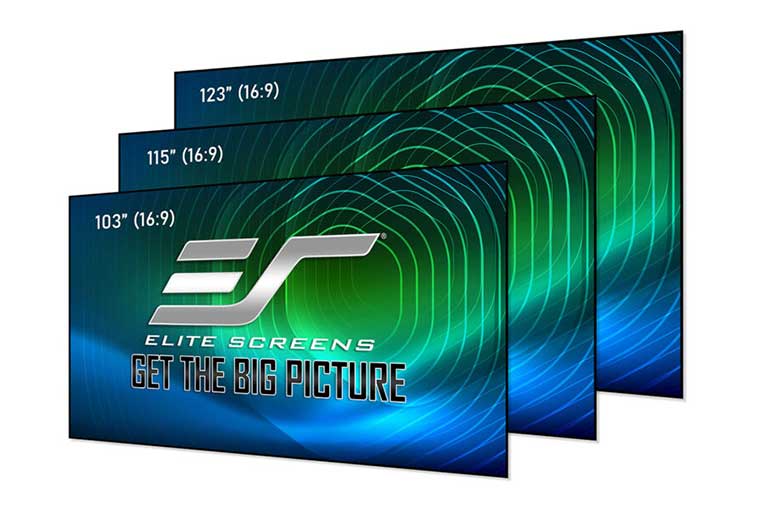
The Aeon CLR3 is a series of fixed-frame screens created specifically for table-top ultra-short-throw projectors. The Aeon CLR® 3 is available in three sizes: 103”, 115”, and 123”.
It uses StarBright CLR® 3 material, which features a Microserriform optical structure to filter out up to 90% of overhead lighting. It also provides an ultra-wide viewing angle of 180°.
The "edge-free" bezel, which is less than 1/2 inch wide, creates the effect of a massive high-end LCD TV, a beautiful, clean, modern look on the wall. Elite offers an optional LED backlight kit.
Read our full review here.

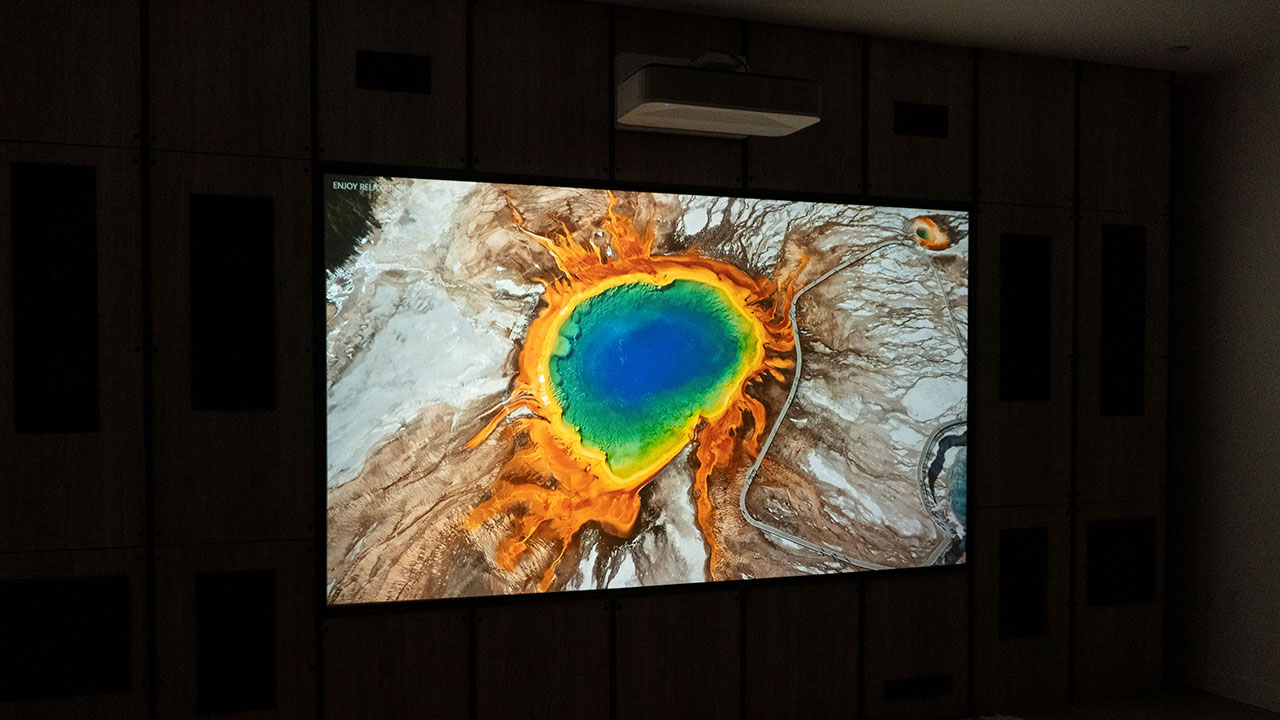
The EPV Screens DarkStar® UST 2 eFinity is an ambient light-rejecting screen designed for ultra-short projectors.
EPV Screens provided a 123-inch 16:9 screen with a gain of 0.8, and it can reject up to 85% of overhead lighting, making it a great option for many Laser TVs.
Compared to a matte white screen, DarkStar® UST 2 eFinity notably improves black level and contrasts in a room with ambient light. The "edge-free" bezel, which is less than 1/2 inch wide, creates the effect if a massive high-end LCD TV, a beautiful, clean, modern look on the wall.
If you have a table-top ultra-short-throw projector and you are looking for a high-quality ceiling light rejecting screen, check out the EPV Darkstar UST 2 eFinity from EPV Screens.
Read our full review here.
Retractable screens can be mounted on walls or ceilings, providing enhanced placement flexibility. One of the main advantages of a retractable projection screen is its ability to save space. When not in use, the screen can be conveniently rolled up or retracted, allowing you to reclaim the wall or ceiling space for other purposes. This feature is particularly beneficial for multipurpose rooms or spaces where the screen is not always needed.
When not in use, retractable screens are hidden from view, which is great in rooms where a fixed screen's presence might disrupt the aesthetics or décor. When the screen is retracted, it is also protected from potential damage. It reduces the risk of scratches, tears, or accidental spills if the screen was constantly exposed. Retracting the screen also helps keep it clean and dust free.

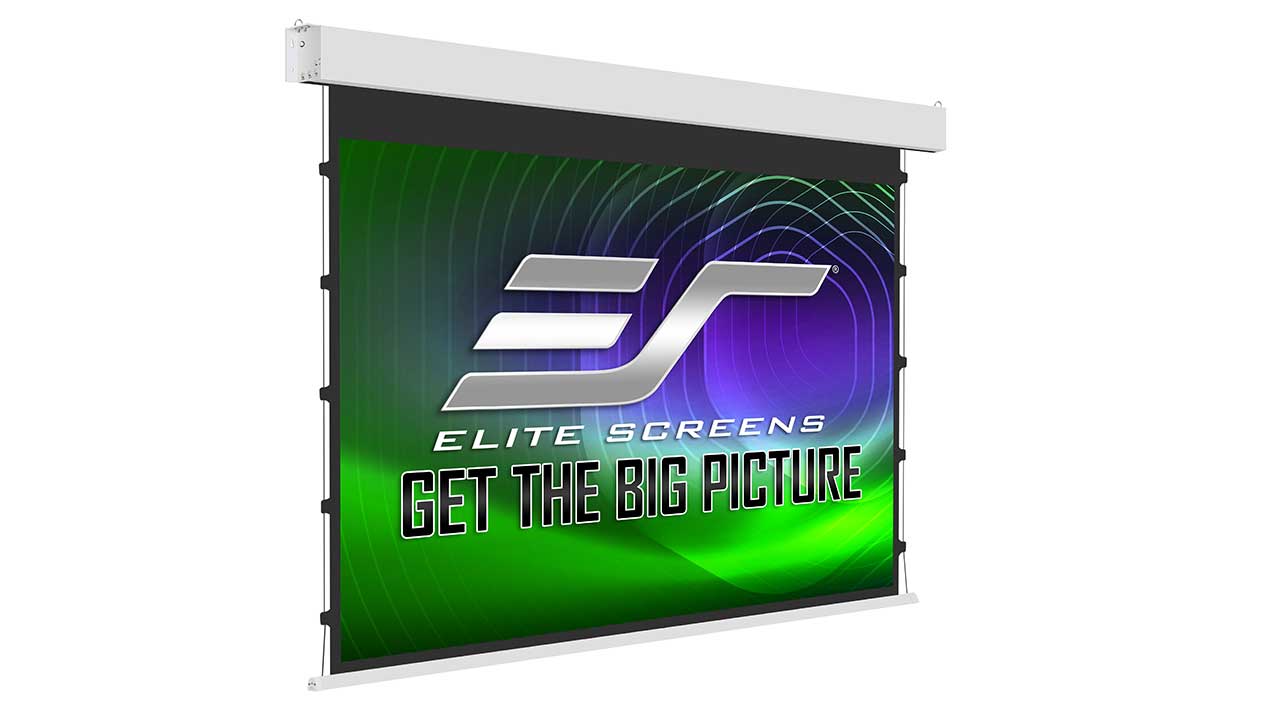
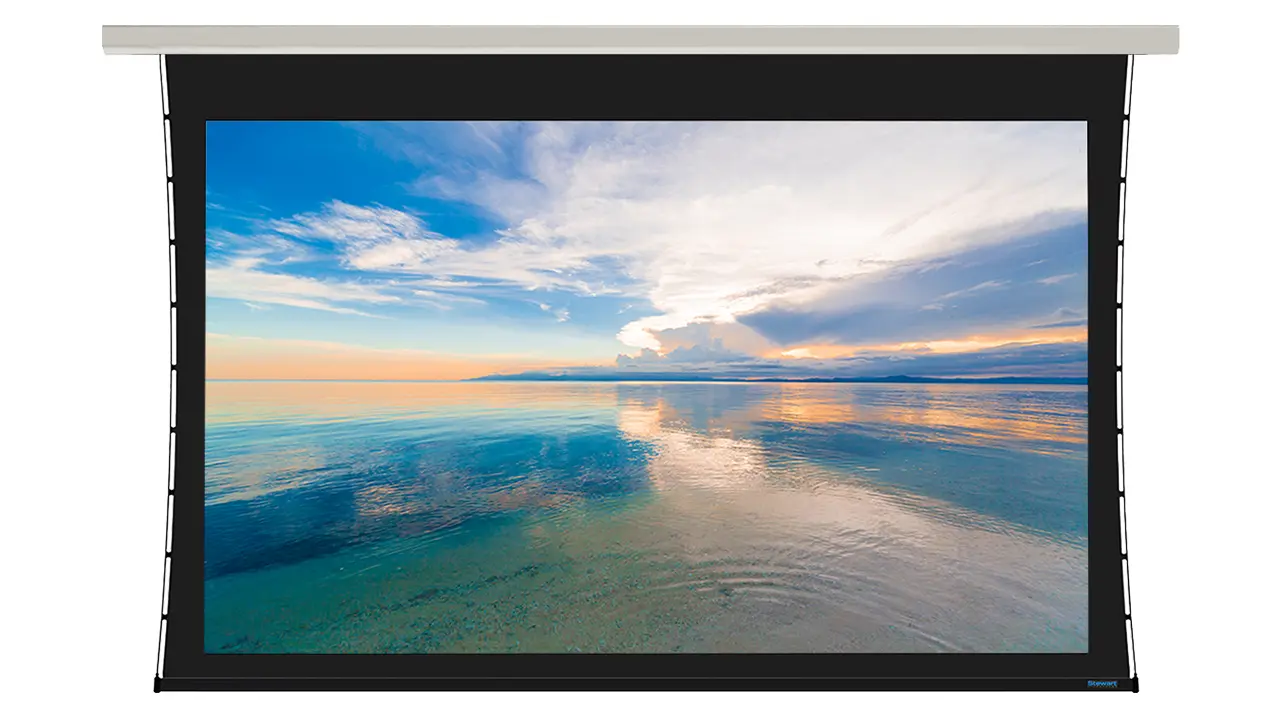
Retractable screens are available with or without tab tensioning. Tab tensioning is a system in which tensioning cables or tabs are attached to the sides of the screen material to keep it taut and wrinkle-free.
While tab-tensioning increases the cost of a retractable screen, this design feature ensures that the screen surface remains perfectly flat, providing optimal image quality and eliminating any distortions or waves that can occur with non-tensioned screens.
The tab-tensioning system also ensures that the screen remains stable and firmly in place, even in environments with airflow or vibrations. This helps prevent the screen from swaying or moving during presentations or movie screenings, providing a distraction-free viewing experience. While retractable screens are more expensive than fixed screens, their practicality, versatility, and aesthetics make them a great option in many environments.
If you are interested in purchasing the projector mentioned in this article, we always appreciate it if you use one of the links in the article because Projector Reviews earns a small commission on the sale at no cost to you.

The RS1 is one of Stewart Filmscreen’s most affordable retractable screens. Designed for indoor or outdoor use, the RS1 supports image sizes up to 180 inches in a 16:9 aspect ratio.
The RS1’s lightweight, compact 5.5” x 5.5” case is designed for easy installation on both interior and exterior surfaces.
The unit offers multiple mounting options, including wall, ceiling, and soffit applications.
For indoor installations, the RS1 supports any of Stewart’s front- and rear-projection materials. For outdoor use, the RS1 can be fitted with Neve, Tiburon, StudioTek 130 G4, and FireHawk G.

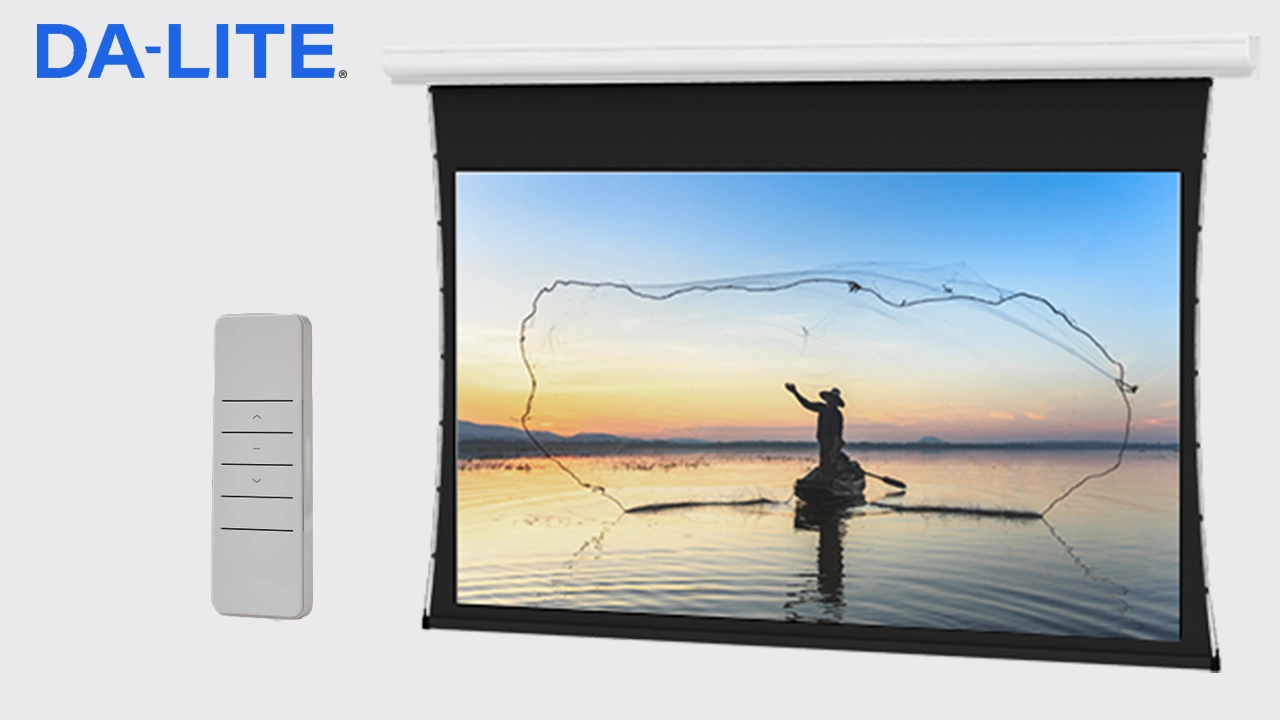
Designer Contour Electrol screen is a tab-tension, motorized, wireless screen powered by a battery, eliminating the hassle of running power wires.
It offers all the benefits of an electric screen but with the flexibility of wire-free installation. The battery can last over 200 cycles on a single charge.
The Tensioned Designer Contour is available in 16:9 and 16:10 aspect ratios. Da-Lite offers screen materials compatible with standard, short-throw, and ultra-short-throw projectors.
Read our full review here.

The Screen Innovations Solo 3 screen is ideal for people wanting to get the most from their new projector system. You will want to determine which projector and projector screen will work best in the room and with the choice of home theater projector, seating arrangements, and any ambient light issues.
The Solo Pro 3 can be flush or wall-mounted, and it is available in 9 different screen materials, allowing you to optimize the picture quality of your specific projector in your room.
In addition, the Solo 3 screen is also available with an optional built-in Lithium-Ion battery. While this increases the cost of the unit, it simplifies installation while dramatically reducing labor costs since you don’t have to hire an electrician to run power to the motorized screen.

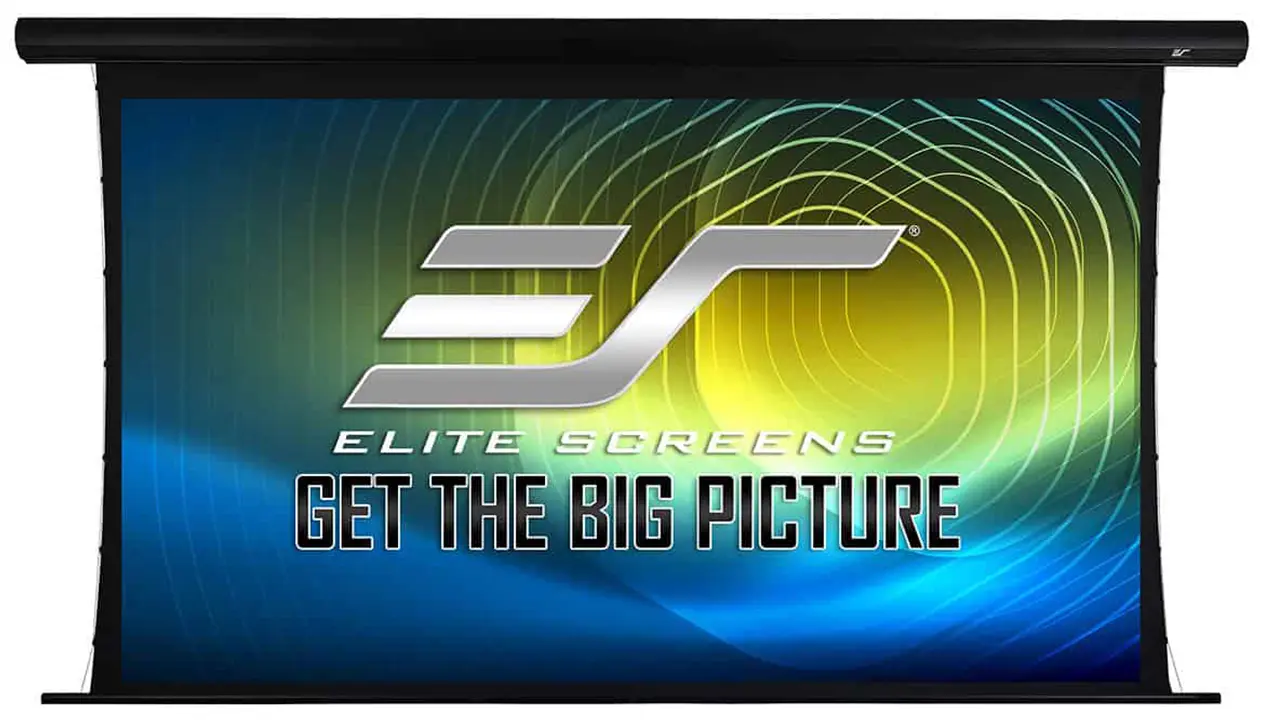
The Starling Tab-Tension 2 Series is an electric motorized retractable projector screen available in multiple screen materials, including CineGrey 5D®, an ambient-light-rejecting material designed for standard-throw projectors.
The material’s gain of 1.5, combined with its ALR properties, makes it a great option for a room with low to moderate ambient light. This screen is available in the following diagonal sizes: 92″, 106″, 120″, 135″, and 150″ in 16:9 format.
The Starling Tab-Tension 2 CineGrey 5D is not compatible with ultra-short-throw projectors. For customers with UST projectors, Elite offers a couple of versions of the Starling Tab-Tension that include UST-compatible screen materials.

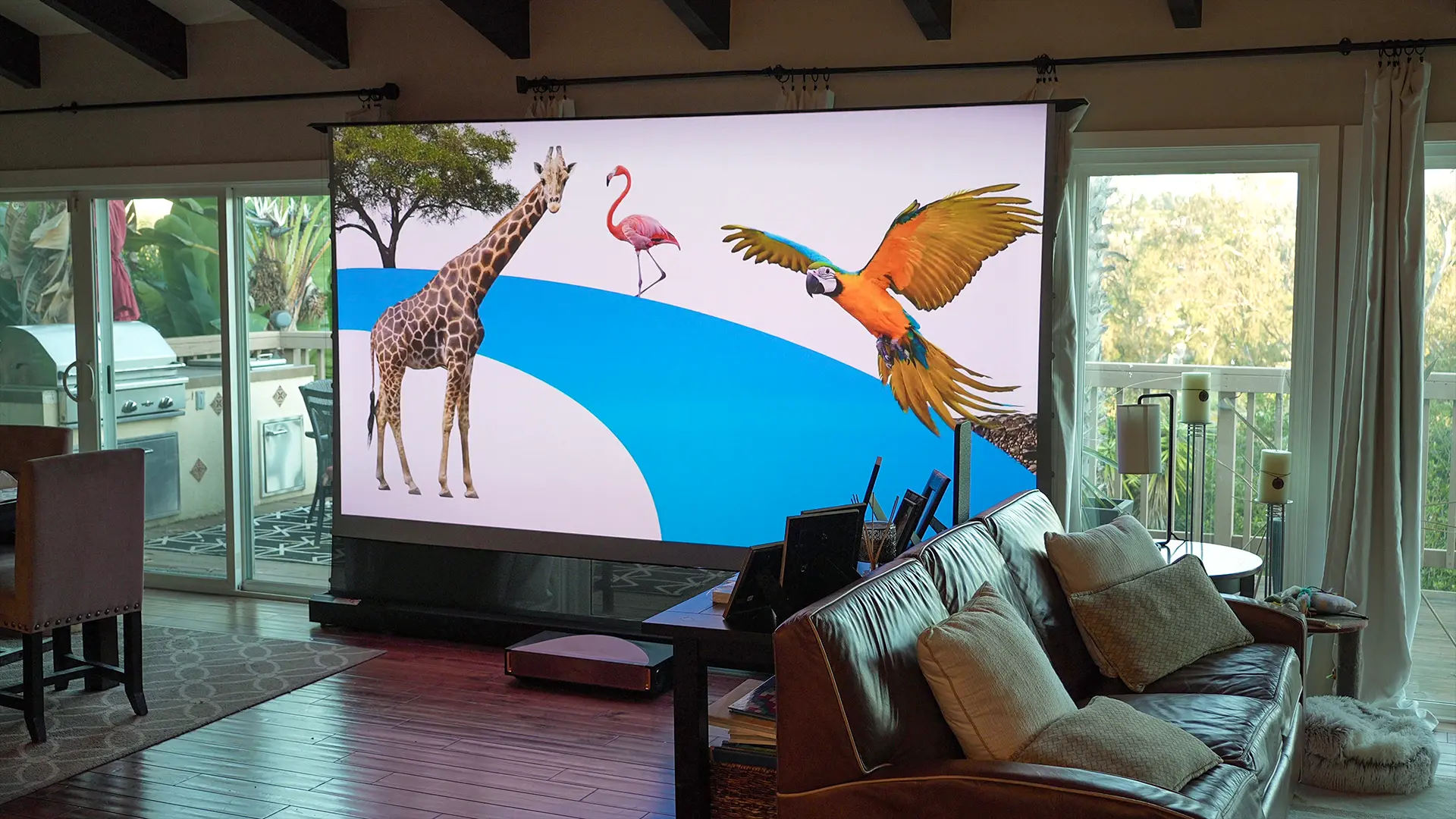
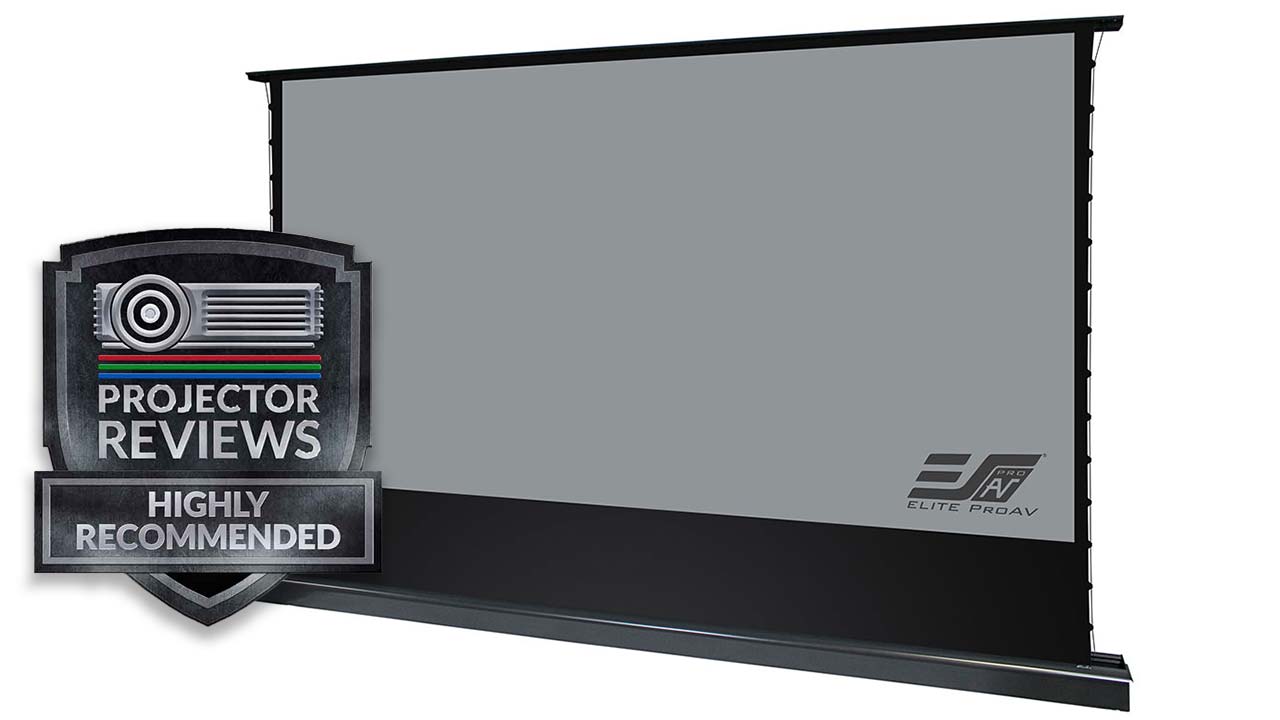
The Elite ProAV Presenter Pro Riser CineGrey 4D is a motorized, floor-rising projection screen. The high-quality CineGrey 4D material is designed for standard long throw projectors and has a gain of 1.1, and it can effectively eliminate up to 63% of ambient light.
While the screen was designed for use in medium-size meeting spaces, its high-quality image and unique form factor should also make it an appealing option in many residential applications.
You don’t have to be in a board room to appreciate a screen that disappears completely when it’s off and doesn’t require you to mount the unit to a wall or ceiling.
The Elite ProAV Presenter Pro Riser CineGrey 4D screen is available in 126-inch, 133-inch, and 150-inch sizes. The screen is exceptionally sturdy and well-built, and Elite ProAV includes a five-year warranty.
Read our full review here.

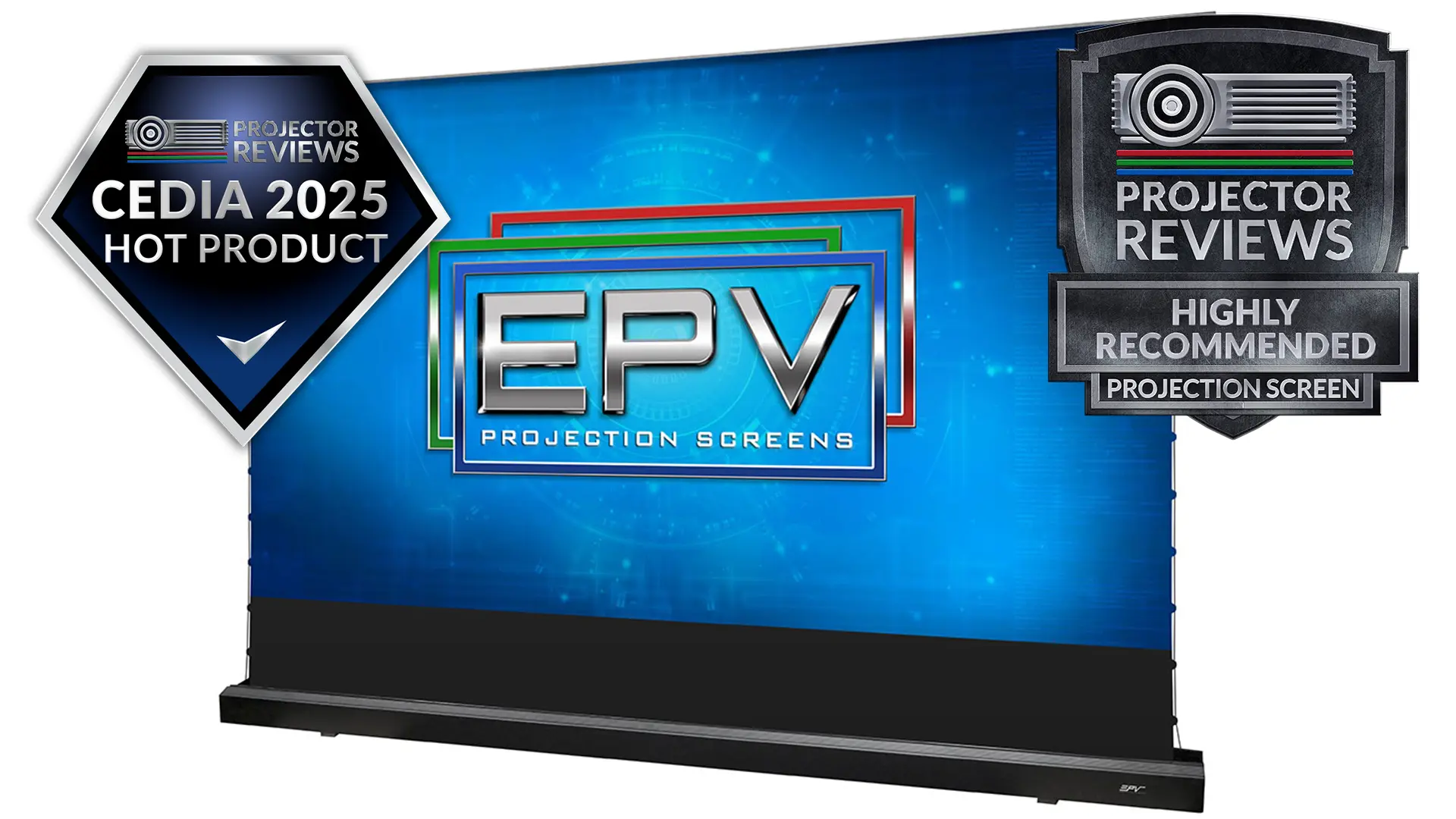
The EPV Screens DarkStar UST 3 Elevate combines a ceiling-light-rejecting screen material with a motorized, floor-rising enclosure to create an immersive image that disappears when not in use.
The DarkStar UST 3 Elevate is a tab-tensioned, electric, floor-rising projection screen available in several sizes, including 126, 138, and 150 inches diagonal.
The DarkStar family of screen materials is designed to work with an ultra-short-throw projector. The screen's micro-ridge surface absorbs 85% of the overhead ambient light.
EPV includes multiple control options including an infrared remote, a radio-frequency remote and a wall-mounted control box.
The EPV Screens DarkStar UST 3 Elevate is a compelling solution for home entertainment enthusiasts who want a large, immersive image without permanently dedicating their living space to projection.
Read our full review here.

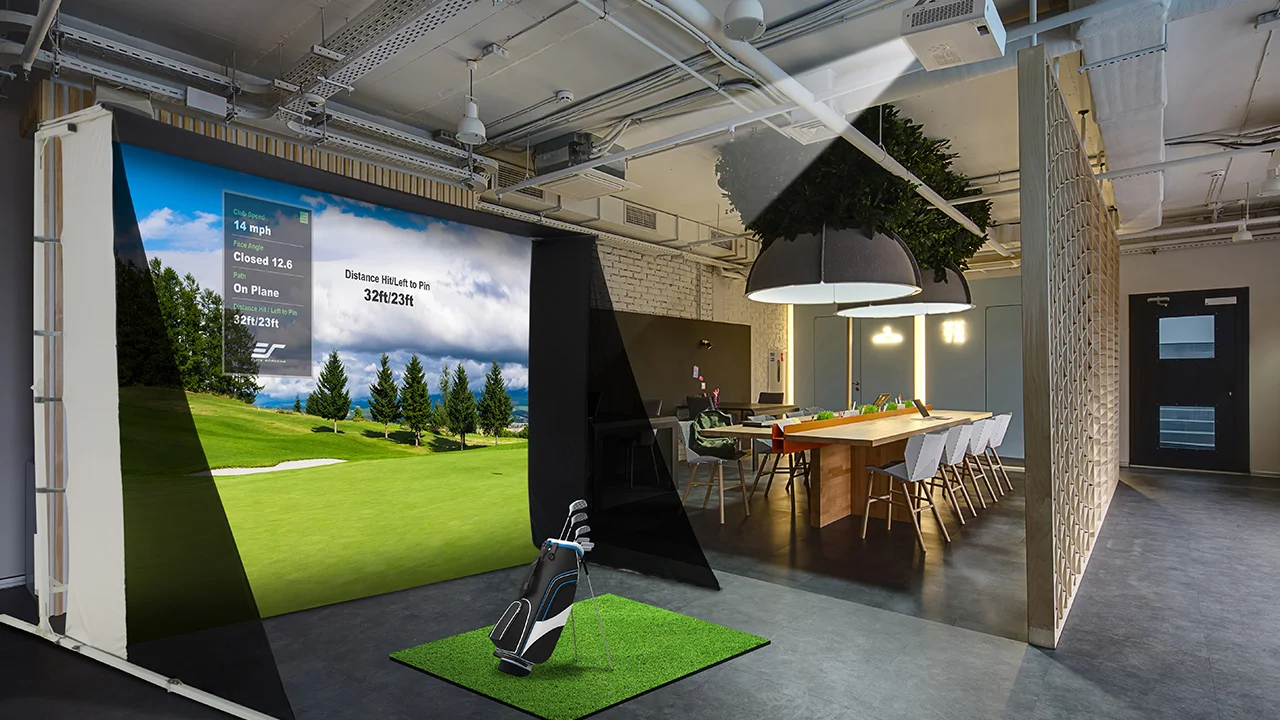
Golf simulation projectors and impact screens make outstanding gifts for golfers who want to practice their swing, refine their skills, or enjoy a realistic virtual round without heading to the course. A well-designed golf simulator setup can turn a garage, bonus room, or basement into a multi-purpose golfing space that provides instant feedback and an immersive experience year-round.
For projector enthusiasts, golfers, and home-entertainment fans alike, the combination of a bright, responsive projector and a durable impact screen delivers a thrilling blend of technology and sport. It feels engaging, interactive, and remarkably close to the real thing—making it an unforgettable holiday gift for anyone passionate about golf.

Impact screens must also be chosen carefully. They need to be durable enough to withstand repeated ball strikes while still delivering a flat, uniform surface for projection. Premium impact screens minimize bounce-back, maintain color accuracy, and provide strong contrast so the image remains vibrant. Many golfers also choose screens designed for multi-use environments, allowing the room to double as a home theater once the clubs are put away. For maximum versatility, some setups pair impact screens with enclosure systems that help manage stray shots and control ambient lighting.
A golf simulator built around a quality projector and impact screen brings the driving range and golf course directly into the home. It offers entertainment, training, and convenience in a single package, transforming spare space into one of the most enjoyable rooms in the house. Whether used for serious practice or fun family competition, it’s a holiday gift that delivers year-round enjoyment and a remarkably immersive indoor golf experience.
If you are interested in purchasing the projector mentioned in this article, we always appreciate it if you use one of the links in the article because Projector Reviews earns a small commission on the sale at no cost to you.

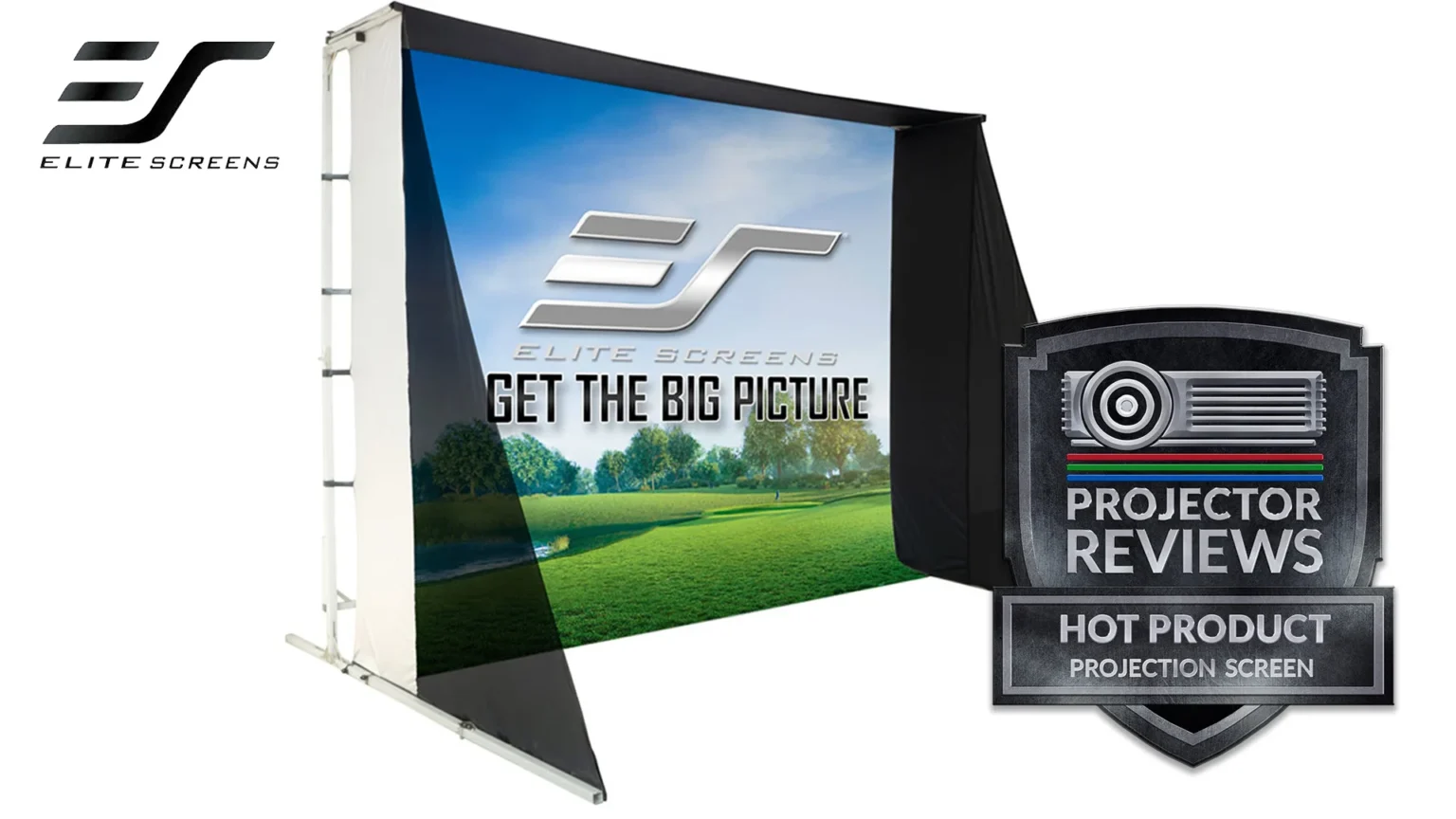
The Elite Screens GolfSim Portable system offers a complete screen solution, including a robust impact screen and a sturdy frame. This series is designed to provide a professional-grade simulation experience in both professional and home applications.
Elite Screens’ proprietary ImpactWhite™ 350 woven polyester, specifically engineered to handle high-velocity impacts, withstanding strikes up to 150 mph. The fabric’s ISF certification ensures excellent color reproduction, allowing the setup to double as a home theater or gaming screen
Elite Screen provided us with a GolfSim Portable system, and we were impressed by its simple setup and build quality. The GolfSim Portable strikes the perfect balance between price, performance, and convenience.
Read our full review here.

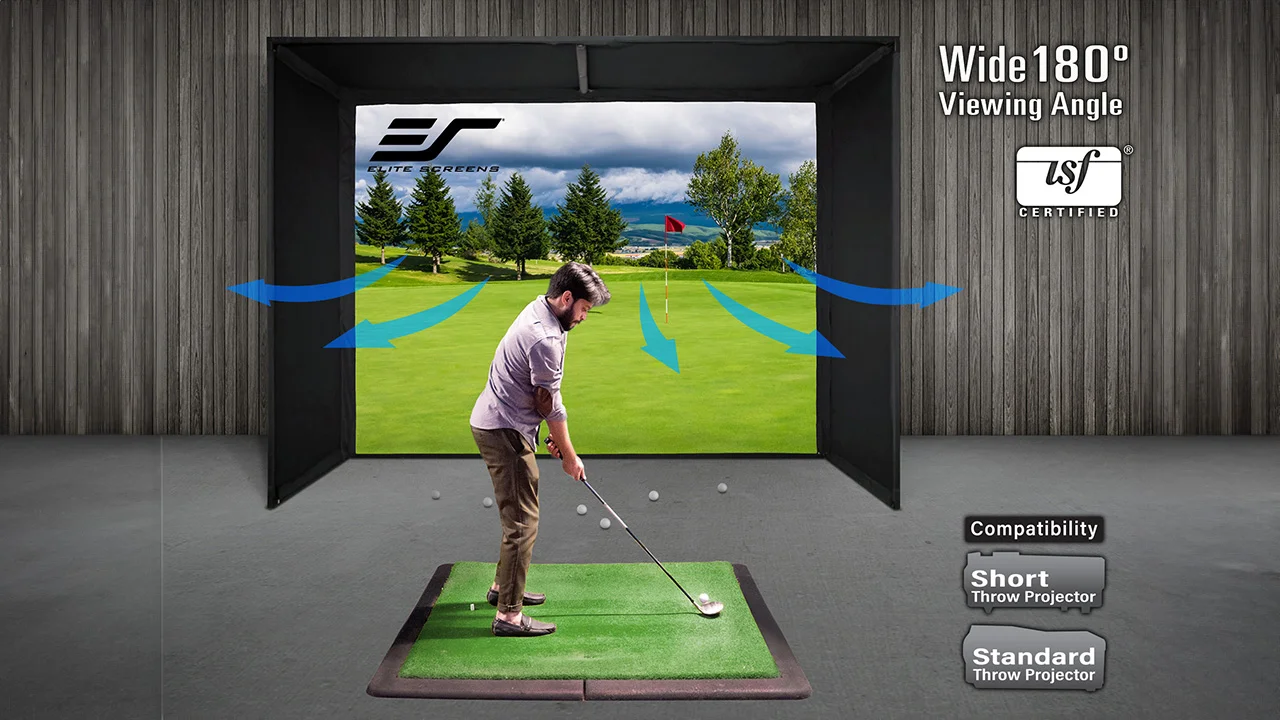
The GolfSim® Bay is a premium, all-in-one golf simulator enclosure designed for commercial facilities, training studios and permanent home installations.
The commercial-grade fabric can withstand golf ball impact at speeds up to 200 mph. The ImpactWhite® 1145 front projection material provides superior contrast in a controlled light room environment. The fabric’s ISF certification ensures excellent color reproduction, allowing the setup to double as a home theater or gaming screen
This enclosure kit provides everything in the box, eliminating the hassle of purchasing additional parts. The GolfSim® Bay includes a high-impact projection screen, reinforced metal frame tubing, precision corner fittings for stability, and enclosure cover panels.
Durable ball bungees ensure an easy installation and excellent screen tension for a smooth surface.