Lightspeed's 3D DepthQ Polarization Modulator and Their 3D Projector System

1/20/2011 - Art Feierman

The Lightspeed system is markedly different from the other 3D projectors and equipment we have reviewed. Lightspeed offers more than a 3D projector, they also offer 3D development system, as we will touch on below. This review primarily focuses on the DepthQ Modulator, with links to a short review of the Lightspeed HDs3D-1 projector.

For these reasons, we did not do a usual review, instead wanting to focus on the whole 3D Polarization Modulator concept and what Lightspeed's DepthQ Modulator brings to the table. This review will mention the 3D projector (that they OEM from InFocus), but will primarily focus on the DepthQ Modulator. Click on this link if you are only interested in their HDs3D-1 projector. (the projector review link will go live on 1/26/11.


Black Diamond II 1.4 gain fixed projection screen
The Black Diamond screen wins a Hot Product Award

The DepthQ Polarization Modulator - an Overview

Lightspeed's DepthQ polarization modulator is a stand alone device that can be placed in front of a variety of projectors that are capable of at least 120hz output. In our review, we used the modulator in conjunction with already 3D projectors - lower end, single chip projectors. Now, normally, such 3D projectors use active shutter glasses, and work with good conventional screens (some are better than others, though).

The other way of doing 3D with projectors, is to polarize the image, using a screen designed to work well with the two different polarized images (generally 3D labeled screens), and then view using inexpensive passive glasses.

The DepthQ allows a projector capable of working with the first type - active shutter glasses, to instead work with polarized screen and passive glasses. You end up spending for the screen, but save a bundle on the glasses, especially if you need a whole lot of them, say, for a classroom. Projectors that are not necessariily 3D may also work with the Polarization Modulator, as the Modulator's controller apparently handle the 3D processing.

Another advantage, is that passive glasses 3D systems (which, confusingly, work with active 3D projectors), are brighter. According to my conversation with the Lightspeed folks, active glasses systems typically lose over 80% of the light. That is, the average amount of light hitting your eyeballs. By comparison, passive solutions usually "only" lose about 2/3 of the light. That makes passive glasses systems potentially almost twice as bright, if you are starting with two projectors with similar brightness, one active, one passive 3D.
In other words, one rationale for a DepthQ Modulator is cost, another is brightness. In fairness though, the DepthQ Modulator is expensive. It's cost is roughly in the same ballpark, today, as buying a couple to three dozen active shutter glasses, and you will need a 3D screen, but, for larger audiences (25+) the Lightspeed DepthQ Modulator is likely to offer you an overall less expensive solution than going with passive single chip DLP projectors, and a whole lot of active shutter glasses. Other avantages, include the potential extra expense that passive projectors/active glasses require in larger rooms, to get the syncing signal to all the glasses in the room. The typical system so far, tends to run out of signal strength at about 30-35 feet, based on my experiences with active shutter glasses, at CEDIA. Now some classrooms will be deeper than that, as well as training rooms, multi-purpose rooms, small auditoriums, hotel ballrooms, basically just about any type of room suitable for presentations, that's bigger than a typical sized conference room.
^ Back to Top

Lightspeed DepthQ Modulator - Highlights

  • Provides brighter solution than active glasses/passive projector solutions
  • Supports a whole host of frame rates for 3D, going up well higher than traditional projector 120hz, IMAX 3D support, etc. The faster the frame rates, the smoother the 3D should be. IMAX for example, I believe runs at 144, compared to most 3D projectors and LCDTV's doing their thing at 120hz. The DepthQ supports up to 400hz!
  • Uses low cost passive glasses
  • Supports circular or linear polarization schemes (Modulators come with one or the other, not both)
  • Requires a 3D screen (most screen companies now offer 3D screens, more on the way)
  • Available in two sizes, the less expensive suitable for portable projectors, most home theater projectors, the larger one primarily for large venue projectors, for auditorium and hotel ballroom type work, or even to work in a command and control center under full lighting
  • Provided the cleanest 3D experience of the 5 3D projector systems to come pass through our testing room, so far. (Next best was also a system using passive glasses, the LG CF3D projector.)
  • Separate note: Lightspeed also offers a passive projector 3D solution using a single chip DLP, but we primarily used that projector with the Modulator, and passive glasses
  • So far, passive glasses are much lighter, and therefore generally more comfortable, especially if wearing for a hours at a time
  • Passive glasses are available (3rd party) with the same lens in both eyes, for people who's eyes are not able to view 3D properly (so some can watch 2D while others, 3D...


^ Back to Top

Lightspeed DepthQ Modulator Specifications

MSRP:
DepthQ Modulator - Small: 2.75 x 2.51" aperture): $6000
DepthQ Modulator - Large: 7.12 x 5.94' aperture): $9000+ (depending on usage)
Controller: Included with both versions
Polarization: Linear or circular (specify when ordering)
Distance and angle relative to Projector Lens: Variable
Maximum cycling of polarization: 400hz
Type of Glasses Used: Passive (linear or circular polarization)

For those interested in the Lightspeed HDs3D-1projector: MSRP is $2995. Click for more info

^ Back to Top

DepthQ Modulator: Special Features

Supports multiple 3D frame rates

First and foremost, the DepthQ Modulator allows virtually any projector capable of double the standard frame rate (say 48fps for 24fps movies, although officially they start at 120fps), or 120fps from 60fps content). By supporting speeds of up to 400hz, the modulator can work with faster frame rates than any existing projectors we're aware of as of this writing.

Two Polarization Modulators To Choose From:

The DepthQ Modulator comes in two sizes, the smaller one is suitable for most portable and home theater projectors, while the larger one is likely to be used in larger, commercial venues, with much more powerful projectors, such as the bigger Christie, Digital Projection, projectiondesign, and other medium and large venue projector models.

The smaller unit has an opening a bit larger than 2.75" x 2.75" while the larger one, used with projectors sporting much larger lenses, supports an opening of over 7.1 inches. That will fit in front of all but the most huge lenses on the largest known projectors. In other words, between the two sizes, they fit just about all projectors.

No Long Distance Run-Around:

With the Depth Q Modulator and passive glasses, there's no inherent maximum distance from the screen. With active glasses, the syncing signal is either embedded into the picture - in which case range is very limited. In my experimenting, most active shutter glasses lose the sync when back much more than 30 feet. That can be a problem in a larger classroom, large training rooms, and certainly larger venues. Essentially those glasses can also work with an IR booster, but, that complicates the installation, and if the room is wide, several might be needed. The DepthQ, by comparison, makes things simple.

3D Compatibility

Right now, almost every brand of display using active shutter glasses, has it's own glasses scheme. Buy glasses for a Sony LCDTV, and they won't work with a Samsung LCDTV, Panasonic plasma, or your favorite 3D projector's choice of glasses. In other words, if you want to have a Super-bowl party, with an active glasses system, plan on buying a lot of glasses, since the ones your friends already own won't work on your screen (unless, of course, they are the same brand).

Fear not, companies like XPanD (major manufacturer of 3D glasses, now makes "universal" ones that support most brands, but those aren't (yet, at any rate), what you'll get when you first buy your 3D display.

Persistence of 3D Image

Active glasses lose sync, when you look away from the screen. Turn to your buddy to comment on how good that last football play looked in 3D, and bingo, the glasses are out of sync when you look back and it can take a second or 3 to regain the sync - and 3D image. Again, companies like XPanD have announced glasses that can hold sync for a number of seconds - upward of 10, a great improvement as well, but, again, another issue that you don't deal with, when using the DepthQ Modulator, and passive glasses.

3D Polarization Options

When using passive glasses two polarization schemes are widely used - Linear, or Circular. Lightspeed offers DepthQ Modulators for either type, but you need to know which you want, as you have to specify circular or linear, one Modulator cannot do both.

^ Back to Top

Depth Q Modulator Operation:

Setting up the DepthQ Modulator, and getting it to work proved to be a straightforward project. (Much easier than finding good 3D content, that's for sure.)

A small control unit syncs with either the computer's graphics card or the projector. The Control unit adjusts the signal to match the requirements of the Modulator (and plugs into the Modulator:

The Depth Q Modulator itself sits in front of the projector's lens. The distance itself is not critical nor is the alignment, or tilt. Just get all the light to pass through the Modulator's glass, and you are in business. The Modulator can be secured to a platform or mount of sorts to keep it in front of the projector.

The Modulator itself works at near "blinding" speeds, in terms of switching from one polarized state to another. Sporting a maximum time of 0.5 milliseconds, that's much faster than, say, the normal panel reponse of an LCD projector, so no worries there.

The smaller Modulator is rated for working with projectors of up to 4000 lumens, the larger one, up to 8500 lumens. If working with high brightness projectors, (higher than 8500), we recommend consulting Lightspeed for compatibility.

In working with the DepthQ modulator, I ran various movies, and other content provided by Lightspeed, and other sources. Lightspeed provided a small server loaded with 3D players, and content. It worked. In addition I was successful in using the Modulator with two non-Lightspeed projectors. (Both offered 120hz speed and claimed 3D with active glasses.

^ Back to Top

Lightspeed HDs3D-1 3D Projector

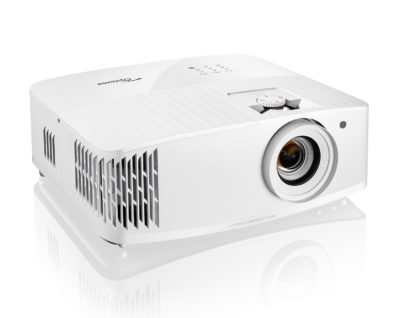
For the review, Lightspeed not only sent the Modulator, but one of their projectors. Their projectors are a joint venture with partner InFocus. We had anticipated their HDs3D-1 projector, but it wasn't ready in time, so they sent the equivalent (for 3D purposes) using a slightly older InFocus projector as the engine. The HDs3D-1 is also an InFocus OEM'd projector. Since we really didn't look at a finishedHDs3D-1 projector as a 2D projector, but just considered it's 3D abilities, that proved just fine for our (and hopefully your) purposes.

Unlike the Modulator, the HDs3D-1 Projector is designed to work with active shutter glasses. That said, it did also work with the Modulator and passive glasses, as would almost any single chip DLP projector with at least 120hz abilities.

Click for our "review" with more details and information on our experience with the Lightspeed / InFocus HDs3D-1 projector.

^ Back to Top

NEXT: Summary of DepthQ Modulator from Lightspeed